Part 1
When Nathan came through the front door Friday night, he carried himself like a man returning from war instead of a two-day conference. His suitcase bumped against the hallway table, and he wore that tight, almost triumphant smile he saved for moments when he thought he’d done something impressive.
“Hey, honey,” he said, as if we’d just spoken an hour ago and not spent the week trading short texts between my pharmacy inspections and his meetings.
I wiped my hands on a dish towel and waited for the usual: a complaint about airport food, a rant about clients, a request for quiet. Nathan wasn’t a gift person. In eleven years of marriage, he’d trained me to expect practicality, not surprises. He tracked every dollar like it was trying to escape.
Instead, he reached into his coat and produced a large white box tied with a satin ribbon.
“I have a surprise for you.”
It took a second for my brain to catch up. “For me?” I asked, like there was a chance he’d meant the cat.
He held it out. The box was heavier than it looked, and the ribbon was real satin, not the cheap plastic kind. My eyebrows climbed.
“What is this?”
“Open it.” He shrugged and wandered toward the kitchen, already reaching for the water pitcher like this was nothing more than picking up milk.
I slid the ribbon loose and lifted the lid carefully.
Inside, wrapped in tissue paper, was a dress so emerald it seemed to glow. The neckline dipped in a clean, elegant line. The cut was structured in a way that made it look like it belonged at an award show, not in the closet of a woman who spent most of her days in a white lab coat.
A brand tag peeked out. The kind you see in glossy magazines while waiting at the dentist.
Then I saw the price tag and my jaw actually dropped.
“Nathan,” I said, and my voice came out wrong, thin and stunned. “This is… where did you get this?”
He took a sip of water and leaned against the counter. “Boutique downtown,” he said. “I walked past it, went in. Thought you’d like it.”
It was the most casual lie I’d ever heard in my life, except I didn’t know it was a lie yet. I just knew the story didn’t fit him.
“You never—” I started, then stopped because the answer was obvious. He never bought expensive things for me. Not because we couldn’t afford anything. But because he hated spending money on anything he couldn’t justify as an investment.
“I noticed you haven’t bought anything for yourself in a long time,” he said. “You run those pharmacies like you’re trying to single-handedly keep the whole city medicated.”
That was true. After my mom died, the business landed on my shoulders. Three neighborhood pharmacies, steady income, steady problems. Inspections, staffing headaches, supplier issues, insurance nonsense. I was proud of what I’d built, but it didn’t leave much time for shopping.
I was still staring at the dress, the fabric smooth as water beneath my fingertips.
“Thank you,” I said finally, because gratitude was the only safe emotion to show in the moment. I leaned up and kissed his cheek. “It’s beautiful.”
Nathan’s smile widened, satisfied. “Good,” he said, and went to shower.
I stood there holding the box like it might change shape if I blinked too hard. A part of me warmed, even while another part stayed cautious. Gifts can be love. Gifts can also be performances.
That night passed quietly. Nathan talked about meetings and negotiation dinners and boring hotel conference rooms. I nodded, filed away the bits I needed, and kept thinking about Monday’s upcoming inspection at our northside location. I told myself I’d try on the dress over the weekend when I wasn’t juggling ten things at once.
Saturday morning, Nathan left “just for a few hours” to finish a report. He kissed my forehead and promised he’d be home early.
By two in the afternoon, the apartment was peaceful. I was in sweatpants with paperwork spread across the dining table, feeling almost human.
Then there was a knock.
When I opened the door, Clare stood there with a hopeful grin, cheeks pink from the chilly air. Nathan’s little sister had always been easy to like. She was thirty-five, a kindergarten teacher with a soft voice and a habit of apologizing for taking up space.
“Hi, Ella,” she said. “I was nearby and thought I’d say hi.”
“Come in,” I told her. “Tea?”
She kicked off her shoes and stepped into the warmth of the apartment. “Is Nathan home?”
“At work,” I said.
Clare rolled her eyes. “Of course.”
We made tea, sat in the kitchen, and talked about small things. Her unfinished apartment renovations. My newest pharmacy hire. The kids she taught, who apparently had recently discovered the joy of glitter and weaponized it.
After a while, we drifted into the living room. That’s when Clare’s eyes landed on the white box sitting on my dresser, still unopened since Friday.
Her face changed instantly.
“Oh my gosh,” she whispered, stepping closer like she might spook it. “What’s that?”
I smiled. “Nathan brought it back from his trip. It’s a dress.”
Clare lifted the lid and peeled back the tissue paper. The emerald fabric caught the light and she inhaled sharply, like she’d just seen a diamond.
“This is designer,” she said, voice rising with awe. “Ella, this is the kind of dress people wear when they’re on TV.”
“I know,” I said, still half-stunned myself.
Clare ran her fingers along the fabric with reverence. Then she looked up at me, eyes bright.
“Could I try it on?” she asked quickly. “Please. I can only dream of having something like this.”
Her excitement was so sincere it made me laugh. “Sure,” I said. “Just be careful.”
Clare practically floated into my bedroom. I heard the soft rustle of tissue paper, the zipper sound, her breathless little giggle.
A few minutes later she came back out, adjusting the strap.
The dress fit her perfectly.
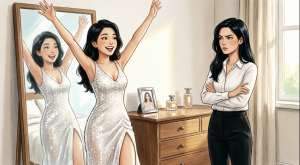
She was slightly slimmer than me, but close enough that it hugged her like it had been tailored. The emerald made her blonde hair look brighter, her skin warmer. She stepped toward the hallway mirror and twirled once.
“How is it?” she asked.
“It’s gorgeous,” I admitted. “It looks like it was made for you.”
Clare grinned and leaned closer to the mirror, examining the neckline, smoothing the fabric against her waist.
And then everything changed.
Her face twisted like she’d been slapped. She grabbed at her throat and coughed—sharp, dry coughs that didn’t sound like a cold.
“Clare?” I stood up fast. “What’s wrong?”
She staggered backward from the mirror as if the reflection itself had attacked her. Her eyes filled with tears. The skin on her neck flushed red, blotchy, spreading like spilled paint.
“I can’t—” she gasped, coughing again. “It burns. It burns so much.”
Her hands clawed at the dress. Panic took over her face. “Take it off,” she choked. “Take it off me. Take it off!”
Then she screamed it, loud enough that I was sure the neighbors would hear.
“Take it off! Take it off me!”
The zipper was in the back, and in her panic she couldn’t reach it, couldn’t think. She was pulling at the fabric like it was strangling her.
I was moving before my brain fully caught up. I rushed behind her, found the zipper tab, and yanked it down hard. The dress slipped from her shoulders and pooled on the floor. Clare kicked it away like it was on fire, gasping, coughing, her breathing thin and frightened.
“Hang on,” I said, already grabbing my phone. “I’m calling an ambulance.”
The dispatcher told me to open a window, to keep her upright, to give an antihistamine if I had one.
I did. I always did.
My own allergy meant I kept medication like other people kept snacks. I dug into my cabinet, hands shaking, and pressed a tablet into Clare’s palm with a glass of water. She swallowed, still coughing, her eyes wide with terror.
When the paramedics arrived, the older woman took one look at Clare’s neck and said, “Contact reaction,” like she’d seen it a hundred times. She sniffed the dress briefly, frowned, and muttered, “Chemical residue.”
Clare shook her head weakly. “I’ve never had allergies,” she whispered.
The paramedic gave her a careful lecture, left her with instructions, and warned us to go straight to the hospital if breathing worsened.
After they left, Clare sat on my couch pale and shaky.
“Ella,” she said, voice hoarse, “don’t wear that dress. Something’s wrong with it.”
I nodded, staring at the emerald fabric on the floor. Up close, I caught it too: a faint chemical smell I hadn’t noticed when it was boxed.
And then a thought hit me so hard my stomach dropped.
I had a severe allergy. Documented. Dangerous. The kind that had put me in the ICU five years ago after a reaction to a synthetic dye.
Nathan knew that.
He’d been there. He’d watched me struggle to breathe.
And he brought me a dress that made his own sister scream for her life.
Part 2
After Clare left, I stood alone in the living room with the dress draped over my arm like a beautiful trap.
The apartment felt different. Not smaller, not colder. Just… less mine. Like the walls had been listening to something ugly.
I carried the dress into the bedroom, held it near the light, and inhaled carefully. The chemical smell was faint but unmistakable, the kind of sharp edge you catch when something has been treated, sprayed, sealed. I remembered the ICU room five years ago—the fluorescent lights, the way my throat had felt like it was closing around nothing, the nurse’s calm voice telling me to breathe while my body refused.
The allergist had called it an anaphylactic reaction to azo dyes, a group of synthetic dyes used in bright fabrics. He’d printed it in bold letters on my chart: high risk of recurrence, avoid exposure, carry medication at all times.
Nathan had sat beside my hospital bed then, pale and shaken, gripping my hand like he couldn’t believe he might lose me.
So why would he bring me an emerald dress without checking a single thing?
I told myself to stop spiraling. Clare could’ve developed a new sensitivity. The dress could’ve been processed poorly. Nathan could’ve been careless, not malicious.
But my mind kept tripping over the same detail: Nathan didn’t do expensive gifts. Nathan didn’t do spontaneous generosity. Nathan did calculations.
I went back to the box and dug beneath the tissue paper until I found the receipt tucked along the bottom seam.
I unfolded it.
Purchase date: Thursday.
My vision narrowed.
Nathan returned Friday night. He had supposedly been in another city all week.
Thursday meant the dress wasn’t bought on his trip. It was bought here, in our city, while he claimed he was out of town.
I lowered myself onto the edge of the bed, receipt in my hand, the blood in my ears loud.
He lied.
Not a little lie like “traffic was bad.” A structural lie. A timeline lie.
I tried to call him. The line went straight to voicemail.
I texted: Call me. Urgent.
No response.
I sat there staring at my own hands. The apartment was in my name. The pharmacies were registered under my company. The business accounts were primarily mine. Nathan contributed, yes, but legally and financially, my world was built under my signature.
And I had never made a will.
Why would I? I was thirty-seven, healthy aside from allergies, busy, responsible. Wills were for older people. For people with time to think about death.
But my allergy didn’t care how old I was.
A “random” exposure could kill me in minutes.
If I died, Nathan would inherit everything as my spouse.
I stood up so fast my chair scraped. My stomach churned with a new kind of fear, the kind that isn’t panic, but clarity.
I put on rubber gloves the way I did at work when handling unknown chemicals. I slid the dress into a thick plastic bag, twisted it tight, and tied it off. Then I shoved it onto the top shelf of my closet, far from my other clothes.
I was trembling, but I forced myself to move like a pharmacist in an emergency: step by step, controlled, procedural. When emotions threaten to drown you, procedures keep you breathing.
My phone rang around six.
Nathan.
I answered immediately. “Hello.”
His voice sounded irritated, rushed. “What is it?”
“Clare came over,” I said, keeping my tone even. “She tried on the dress.”
A pause. “Okay?”
“She had an allergic reaction. A bad one. She couldn’t breathe. We had to call an ambulance.”
Silence stretched, heavy.
“What?” Nathan said finally, too flat.
“The paramedics said it was contact-related,” I continued. “They said there’s chemical residue in the fabric.”
Nathan exhaled sharply. “Well, it happens,” he said. “Clare’s sensitive.”
“Nathan,” I said, and my voice shook despite my effort. “I have the same kind of allergy. Worse. You remember the ICU. You remember what the doctor said.”
Another pause. “Of course,” he said, but his words sounded chosen, not felt. “Ella, it’s just an accident. I didn’t check the composition. I didn’t think.”
“The dress was bought here,” I said, and watched my own hand grip the receipt so tightly it creased. “On Thursday. You weren’t here on Thursday.”
The silence on the line turned thick, almost physical.
Then, after too long, Nathan said, “I asked someone to buy it for me.”
“Who?” I asked immediately.
“I’m at work,” he snapped. “I don’t have time for this.”
“Who bought it?” I pressed.
“What difference does it make?” His voice rose. “It was a gift. An attempt to do something nice. Now you’re interrogating me.”
“It makes a difference because it nearly killed your sister,” I said. “And it could have killed me.”
He sighed, heavy and performative. “We’ll talk tonight,” he said, and hung up.
I stared at my phone screen, my reflection dim in the black glass. My heart was beating too fast, and my mouth tasted metallic.
That night, I didn’t stay alone.
I called my cousin Marla and asked her to come over. I didn’t tell her everything, just enough: weird situation, I’m uneasy, please. She arrived with takeout and that blunt older-sister energy that made the apartment feel safer by force.
While she ate noodles at my kitchen counter, I opened a drawer and pulled out my old medical records, flipping to the allergy documentation. It was there in cold ink: anaphylactic risk. Avoid azo dyes. Carry auto-injector.
Nathan knew.
Marla watched me and frowned. “Ella,” she said slowly, “what’s going on?”
I swallowed. “I don’t know,” I admitted. “But I’m scared.”
Marla’s eyes sharpened. “Then we treat it like it’s real until we know it’s not,” she said. “Who do you trust?”
One name came instantly.
David Harper.
He’d handled my mom’s estate and helped me restructure the pharmacies after she died. He was the kind of lawyer who didn’t panic and didn’t dramatize, which was exactly what I needed.
I stepped into the hallway for privacy and called him.
He answered on the second ring. “Mrs. Mitchell?”
“David,” I said, voice tight. “I need to see you. Urgently.”
There was a pause, then his tone shifted to focused calm. “Tell me what happened.”
I gave him the facts: the dress, Clare’s reaction, the chemical smell, the receipt date, Nathan’s lie, my own allergy history. I didn’t say the word murder. I didn’t have to. The implication was sitting between us like a third person.
When I finished, David exhaled slowly. “Do not touch the dress again,” he said. “Preserve it exactly as it is.”
“It’s sealed,” I said. “Gloves. Bagged.”
“Good,” he said. “And tonight, don’t be alone if you can avoid it.”
I looked toward my kitchen where Marla was washing dishes like she’d claimed the space.
“I won’t be,” I said.
“Meet me Monday morning,” David said. “We’ll make a plan.”
After I hung up, I went to bed and listened to the building noises: pipes, elevator groans, distant footsteps. When Nathan came home around eleven, he moved quietly, like he didn’t want to wake me.
I pretended to sleep.
He slipped into bed and turned his back to me.
“How’s Clare?” he asked, voice too casual.
“Fine,” I said. “Medication helped.”
“That’s good,” he muttered, and went silent.
I lay there staring at the ceiling, listening to his breathing become slow and even, like a man with nothing to fear.
The receipt date burned in my mind.
The chemical smell lingered in my memory.
And Clare’s scream echoed behind my eyelids.
Take it off. Take it off me.
I didn’t sleep.
I counted heartbeats and waited for Monday, because whatever this was, it was no longer something I could ignore.
Part 3
David Harper’s office smelled like old wood and strong coffee, the kind of place where secrets came to die on paper.
He didn’t waste time on pleasantries. He motioned me into a chair, opened a notebook, and said, “Start from the beginning. Slowly.”
I told him everything again, but this time with the details my brain had been hoarding: Nathan’s triumphant smile when he handed me the box, his casual shrug about the boutique, the way his voice had turned sharp the moment I asked who bought it. Clare’s red, blotchy neck. The paramedic sniffing the fabric and frowning. The receipt date like a crack in a story.
David listened without interrupting, only occasionally writing a short note. When I finished, he leaned back and looked at me over his glasses.
“You’re worried your husband intentionally brought you something that could trigger anaphylaxis,” he said, calm as if we were discussing a zoning dispute.
“I’m worried the facts look like that,” I corrected. My hands were clasped so tightly my knuckles ached.
David nodded. “Good phrasing,” he said. “Facts. We build on facts.”
He turned his notebook toward me and began outlining a plan like he was mapping a fire escape.
“First: protect you,” he said. “Second: preserve and document evidence. Third: eliminate motive, if motive exists.”
My stomach tightened. “Motive,” I repeated.
David didn’t flinch. “Your business and property are in your name,” he said. “If you die without a will, your spouse inherits a significant portion by default. That’s motive.”
The word sat heavy, but it also clarified something that had been buzzing in my mind without shape.
David continued. “We need a chemical analysis of that dress. We need a medical report linking Clare’s reaction to it. We need your medical documentation. And we need to identify the buyer.”
“How?” I asked.
“Receipt. Store records. Loyalty system. Surveillance video,” David said. “And possibly a subpoena later, if it comes to that.”
I stared at his notepad as if it might tell me whether my marriage was a misunderstanding or a crime.
“And the property?” I asked, because the question felt ugly but necessary.
David tapped his pen once. “You need a will,” he said. “Today, if possible.”
My throat went dry. “Today?”
“Yes,” he said. “If you’re wrong, the will changes nothing except giving you peace of mind. If you’re right, it removes the incentive.”
I thought of Nathan’s calm breathing beside me last night and felt my skin crawl.
“Who do you trust?” David asked.
“My business partner,” I said. “Gregory Barnes. He owns forty percent of the pharmacies with me
“Good,” David said. “We draft a temporary power of attorney assigning management authority to him, not your husband, in case something happens. We also draft a will that distributes assets deliberately. You can leave the apartment to a cousin, the business shares to your partner, and assign a charitable portion if you want. But the point is clear: Nathan does not automatically receive everything.”
A cold sweat broke out along my spine.
David’s voice softened slightly. “Mrs. Mitchell,” he said, “I’m going to be blunt. If someone intended to harm you using your allergy, they relied on you doing something ordinary—trying on a dress. Ordinary habits become weapons when someone knows your vulnerabilities.”
My throat tightened. “Clare saved me,” I whispered.
David nodded once. “Unintentionally, yes.”
When I left his office, I felt both steadier and sicker. A plan is comforting. The reason you need one is not.
Clare met me outside a clinic later that afternoon. She looked better—less pale, less shaken—but her eyes still carried the memory of panic.
“I went to an allergist,” she told me. “She documented everything. That it happened right after I put on the dress.”
“Thank you,” I said.
Clare took my hand, fingers trembling. “Ella,” she whispered, “you’re scaring me. Are you saying Nathan…”
“I don’t know,” I said, choosing the words carefully. “I’m saying the situation isn’t normal. And Nathan knows about my allergy.”
Clare’s face drained. “Oh my god,” she murmured. “He knows. He was there when you—”
“Yes,” I said quietly.
Clare covered her mouth, eyes wet. “I don’t want to believe it,” she whispered.
“I don’t either,” I said. “But belief doesn’t change facts.”
We went into the clinic together. Dr. Rebecca Morrison was calm and precise, asking Clare questions, taking notes, documenting symptoms. When I told her about my own allergy—azo dyes, risk of anaphylaxis—she went still for half a second.
“Emerald fabrics often use synthetic dyes,” she said. “Azo dyes are common. A chemical analysis would be appropriate. Especially given your history.”
“Can analysis tell if something was added later?” I asked, voice low.
Dr. Morrison considered. “If treatment is abnormal in concentration or distribution,” she said, “it can suggest secondary application. But for intent, you’d need forensic interpretation.”
I left with Clare’s medical documentation in my bag and my own records copied from my pharmacy office. Paper stacked against paper, evidence piling like bricks.
Then David drove me to a notary.
Signing a will at thirty-seven felt surreal, like writing a story I didn’t want to admit could end early. My hand shook slightly as I signed. I named my partner Gregory Barnes as successor for my business interests, my cousin Marla as beneficiary for the apartment. Nathan’s name appeared nowhere.
I also signed a power of attorney assigning temporary authority to Gregory over business accounts if I was incapacitated.
When I stepped back into daylight afterward, I felt something shift inside me.
If someone was planning to profit from my death, I had just cut the profit line.
That night, Nathan came home and stood in the bedroom doorway for a long moment before he spoke. I pretended to read in bed, heart pounding.
“You’ve been weird,” he said finally.
“I’ve been busy,” I replied.
He watched me too long, then said, “You’re not wearing that dress?”
I forced my face to stay neutral. “Not yet.”
Nathan nodded slowly, as if checking something off mentally. Then he climbed into bed and turned away without touching me.
I lay awake listening again, but this time I wasn’t just afraid.
I was ready.
Because tomorrow, David would start tracing the purchase. The store would have records. Cameras. A name.
And whoever had put that dress into my life—whether by mistake or design—was about to be dragged into the light.
Part 4
Nathan left early Tuesday, barely finishing his coffee. His movements were quick, clipped, like he didn’t want to be in the apartment long enough to let tension settle on him. He kissed my cheek without meeting my eyes.
“Long day,” he said.
“Sure,” I answered.
The door shut. The lock clicked.
The sound used to mean normal life. Now it meant I had a window.
David called at nine.
“The store responded,” he said. “Fast. They use a loyalty system. The purchase was registered.”
My pulse kicked hard. “Registered under who?”
“Vanessa Pierce,” David said. “Thirty-three. Address in Riverside District. Works as a stylist consultant for a company that supplies apparel to retail chains.”
Vanessa. The name Nathan had refused to give me last night until I forced it out of him.
“So he didn’t invent her,” I said, voice tight.
“No,” David replied. “But we need to confirm her connection to him. And we need to move forward.”
I stared at the wall of my kitchen, feeling the world narrow into a single sharp point.
“What forward looks like is a police report,” David said.
My mouth went dry. “Today?”
“Today,” he said. “Because the longer we wait, the easier it is for people to claim misunderstanding, to lose footage, to ‘forget’ details.”
I closed my eyes. Clare’s scream flashed in my mind.
“All right,” I said. “Tell me where.”
At two, I walked into the police station with David beside me and a tote bag that felt like it held a bomb. The dress was sealed inside a plastic bag. My medical records were clipped neatly. Clare’s clinic report sat on top like a warning.
Detective Marcus Reed met us in a gray office with a metal desk and a tired overhead light. He was around forty, calm, the kind of man who looked like he’d seen every version of human behavior and no longer wasted time being shocked.
He listened as I spoke. He didn’t interrupt. He didn’t roll his eyes. He asked clarifying questions in a voice that stayed level.
“Your sister-in-law tried on the dress and experienced symptoms within one minute,” he repeated, writing. “Coughing, redness, difficulty breathing.”
“Yes,” I said. “The paramedics called it a contact reaction.”
“And you have a documented severe allergy to azo dyes,” Reed said.
“Yes.”
“And your husband knew,” Reed added, watching my face.
“Yes,” I said, and my voice cracked on the last word.
Reed leaned back slightly. “You understand these are serious accusations,” he said. “You’re essentially suggesting your husband may have attempted to cause harm.”
“I’m asking for an investigation,” I said carefully. “Because the facts are… wrong.”
Reed nodded once, as if he respected that phrasing too.
“Okay,” he said. “We’ll send the dress to the crime lab for chemical examination. We’ll interview your sister-in-law and obtain her medical documentation. We’ll request store surveillance and confirm purchase details. And we’ll speak to your husband.”
My stomach flipped. “You’re going to question him?”
“Yes,” Reed said. “That’s the process.”
David spoke up. “We’d like the lab order to specifically test for azo dyes and any unusual chemical treatment, including preservatives or formaldehyde compounds.”
Reed scanned the list David handed him and nodded. “Competent,” he said. “We’ll use it.”
By the time I walked out of the station, my hands were still shaking, but my breathing felt steadier. I wasn’t alone in my suspicions anymore. I had moved it into a system designed to handle facts.
That night, Nathan was waiting in the living room when I came home. He sat on the couch staring at his phone, but his eyes snapped up the moment I stepped inside.
“Where were you?” he asked.
“My things,” I said, keeping my tone neutral.
He stood, stepping closer. His face carried a mix of irritation and something else—wariness, maybe, the way a person looks when they realize the floor under them might not be solid.
“You’ve been acting strange,” he said. “Avoiding me. Not talking. What is this?”
I stared at him. Eleven years of marriage sat between us like an entire other life. Vacations. Arguments. Quiet mornings. The time he brought me soup when I had the flu. The time he held my hand in the ICU. The time he complained about my work hours like they were a betrayal.
“I was at the police station,” I said.
The color left his face so fast it was almost comical.
“What?” he whispered.
“I filed a report,” I said evenly. “About the dress.”
Nathan blinked, then his voice shot up. “You filed a police report against me?”
“I filed for an investigation,” I corrected. “If you’re right and it was an accident, you’ll be fine.”
Nathan stared at me like I’d just stabbed him.
“You’ve lost your mind,” he snapped. “Because Clare coughed for five minutes, you decided I’m trying to kill you?”
“You lied about where the dress came from,” I said. “You involved Vanessa. You know about my allergy.”
“This is paranoia,” he insisted, pacing. His hands ran through his hair. “Ella, you’re spiraling. Throw away the dress and forget it.”
“I won’t,” I said quietly.
Nathan stopped pacing and looked at me with a coldness I hadn’t seen this clearly before. “You’ll regret this,” he said.
My skin prickled. “Is that a threat?”
“It’s a fact,” he said, and then he grabbed a small overnight bag from the bedroom and headed for the door. “I’m leaving.”
He didn’t say where. He didn’t say when he’d be back.
The door shut behind him, and the apartment fell silent in a way that made my bones ache.
I called David immediately.
“He knows,” I said. “He left.”
“Expected,” David replied. “It’s not necessarily bad. It reduces immediate risk. But we need to protect your assets now. He may try to move money.”
“I signed the will,” I said.
“Good,” he said. “Next: we file for a temporary freeze on joint property until the investigation clarifies facts.”
By Friday, the court granted a temporary order restricting transactions on the apartment and key accounts. Nathan couldn’t sell, mortgage, or move major funds without triggering legal alarms.
When I informed him, he went quiet. Then he said only, “You really did it.”
“I really did,” I answered.
In the days that followed, Clare came over often, still shaken, crying sometimes in my kitchen like she couldn’t fit reality into her chest.
“I don’t understand,” she whispered one night. “He was my brother.”
“People change,” I said.
Clare wiped her eyes. “Money changes people,” she corrected, and her voice sounded older than it had a week ago.
By then, the dress was in a lab.
Vanessa had a name, an address, a paper trail.
And Nathan, for the first time, had lost his ability to control the story by simply denying it.
All that was left was the science.
Because if the lab came back clean, I would be the wife who accused her husband of something unforgivable.
But if it didn’t…
Then I was the wife who survived an attempted murder she never saw coming.
Part 5
The waiting was its own kind of torture.
For two and a half weeks, every day felt like standing on a fault line. I worked my regular schedule—inventory orders, insurance audits, staff meetings—but my body stayed tuned to danger. I jumped at elevator noises. I checked the locks twice. I kept my allergy injector in my pocket even at home.
Nathan didn’t come back. He called intermittently, sometimes demanding I “stop the spectacle,” sometimes trying to soften his voice like he could rewind time by changing his tone. He promised he’d explain everything. He told me I was overreacting. He said he missed me.
I didn’t believe a word.
David kept moving in the background. He requested surveillance footage from the boutique. He subpoenaed loyalty card registration. He pulled basic public information about Vanessa Pierce’s employment and professional contacts.
Detective Reed checked in twice, short and procedural. “Lab is processing.” “Store footage received.” “We’ll update you.”
Clare stayed close, partly because she was afraid for me and partly because she was afraid of what her brother might be.
One night she said, “Ella, what if he didn’t mean it?”
I stared into my tea. “Then the lab will say that,” I answered.
On the seventeenth day, Reed called.
“Mrs. Mitchell,” he said, voice serious, “the lab report is back. Can you come in with your attorney?”
My heart stopped and restarted wrong.
“What did they find?” I asked, gripping my phone so hard my fingers hurt.
“Better in person,” Reed said. “One hour?”
I called David. We met at the station and walked into Reed’s office together, the air between us heavy.
Reed didn’t waste time. He opened a thick folder and read the conclusion in a careful, practiced tone.
“Chemical analysis of the fabric identified traces of azo-group dye, specifically disperse dye compounds, in concentration exceeding regulatory limits by approximately three times.”
My blood turned to ice.
Reed continued. “Additionally, traces of formaldehyde-based antiseptic treatment were detected on the fabric surface. Distribution of the substance is uneven, suggesting secondary application after manufacture.”
David leaned forward. “Secondary application,” he repeated. “Meaning someone treated it.”
Reed nodded. “That’s the preliminary interpretation.”
The room went silent except for the faint buzz of the overhead light.
“So this wasn’t a factory defect,” David said.
Reed’s expression tightened. “The lab notes indicate concentration and distribution are not typical of standard production,” he said. “This appears consistent with deliberate enhancement of irritant properties.”
I closed my eyes. A gorgeous dress. A murder tool.
Reed turned a page. “Given your documented severe allergy and the fact your spouse was aware, we’re considering charges up to attempted grievous bodily harm. If we establish intent to cause death, it may elevate.”
Attempted murder sat in the air like smoke.
“What happens now?” I asked, and my voice sounded distant, like someone else spoke through my mouth.
“We interview your husband and Vanessa Pierce,” Reed said. “We already have footage confirming Pierce purchased the dress. We also have phone records indicating frequent contact between her and Mr. Mitchell.”
“Frequent,” David echoed, dry.
Reed nodded. “Daily communication over the last several months.”
I didn’t feel shock so much as grim confirmation. The refusal to give me Vanessa’s contact. The defensiveness. The name spoken like a shield.
Reed looked at me. “Are you safe at home?” he asked.
“I’m not alone,” I said, thinking of Marla and Clare and the way David had practically ordered me not to isolate.
“Good,” Reed said. “Because we’re moving fast.”
Nathan came to interrogation the next day.
I wasn’t in the room, but Reed later described it to David in enough detail that I could picture it.
Nathan arrived thinner, jittery, dressed down like he thought casual clothing made him look harmless. He answered basic questions with short replies, eyes down, voice controlled until Reed read the lab findings aloud.
Nathan’s face went pale.
He insisted he never treated the dress. He insisted Vanessa bought it in a sealed box and handed it to him exactly like that. He admitted he returned from his “business trip” early and stayed at a hotel Thursday night—no receipt, paid cash. He insisted his relationship with Vanessa was “professional.”
Reed pushed. “Phone records show daily contact.”
Nathan adjusted. “We’re friends.”
Reed pushed harder. “Do you understand we are investigating the possibility that you used your wife’s allergy as a weapon?”
Nathan’s composure cracked. He jumped up, then sat back down, hands trembling. He admitted he had debts. He admitted money problems. He denied intent, then caught himself mid-sentence, like his mouth had moved faster than his brain.
Finally, he asked for a lawyer and ended the interview.
The next day, Vanessa Pierce walked into the same room.
Reed described her as poised, stylish, the kind of woman who looked like she knew how to choose a jacket that made people take her seriously. But her eyes were nervous, darting too quickly.
When Reed asked if she was dating Nathan, she answered plainly, “Yes.”
No shame. No hesitation.
“How long?” Reed asked.
“A year,” she said.
Reed asked about the dress purchase. Vanessa admitted she bought it at Nathan’s request. She claimed Nathan showed her a photo and demanded that exact dress. She claimed she did nothing else. She claimed she didn’t know about my allergy.
Reed pressed the lab results.
Vanessa insisted the store must have sold a defective item.
David listened to Reed’s summary and said, “Either she’s telling the truth or she’s an incredible liar.”
Reed’s response was blunt. “We don’t rely on vibes,” he said. “We rely on proof.”
A week later, proof arrived from an unexpected place.
Reed called again. “Mrs. Mitchell, we have new information. Come in.”
When David and I entered the office, an older man sat beside Reed with a folder of microscope photographs. Dr. Ethan Coleman, an independent chemical expert.
He slid the photos toward us. Under magnification, the fabric showed something I’d never have imagined: concentrated dye spots applied mainly on the inner lining in areas that would press against skin.
“This wasn’t random,” Coleman said. “It was targeted.”
Reed added quietly, “Coleman traced a rare dye batch. An agent reports a woman purchased it a month ago. He identified her.”
My stomach dropped before Reed even said the name.
“Vanessa Pierce,” he confirmed.
The room went very still.
David’s voice was low. “So she didn’t just buy the dress.”
Reed nodded. “She bought the chemicals.”
And suddenly the emerald dress wasn’t just suspicious.
It was a planned weapon.
Part 6
Vanessa confessed the second time because the lie had nowhere left to stand.
Reed didn’t yell. He didn’t threaten theatrically. He laid the evidence out in front of her like pieces of a puzzle she’d already completed.
The agent’s statement. The dye purchase record. The microscope photos. Phone records showing over thirty calls between her and Nathan in the two weeks before the dress purchase.
Vanessa’s face collapsed inch by inch as Reed spoke.
Finally, her shoulders shook, and she whispered, “Okay.”
Reed clicked the recorder on.
Vanessa told the whole story in a voice that sounded like she didn’t recognize herself.
Nathan had asked her to help him “solve” his financial problems. He’d confessed debts, collectors, panic. Vanessa had offered the plan like it was clever, not evil. She had access to suppliers, knew how treatments worked. Nathan had told her about my allergy—azo dyes, anaphylaxis, the whole terrifying medical reality—and they built the plan around it.
“They thought it would look like an accident,” Reed said later, his voice tight with disgust. “She would wear the dress. Reaction would be immediate. Death could be blamed on allergy complications.”
I sat in David’s office listening as he relayed it, my hands numb.
They hadn’t considered Clare.
They hadn’t considered that someone else might try the dress first.
Clare’s impulsive excitement had saved my life.
Vanessa admitted she bought the dye through an agent, treated the inner lining at home using a sprayer and gloves, then repackaged the dress neatly like nothing had changed. She handed it to Nathan Thursday evening.
Nathan gave it to me Friday night with a ribbon and a smile.
He wanted me to put it on immediately.
He wanted me to die beautifully.
When Reed confronted Nathan with Vanessa’s confession, Nathan’s denial lasted less than ten minutes. Then, according to Reed, he stared at the table and said, “I didn’t think about her like a person.
He admitted debts. He admitted greed. He admitted he’d planned to inherit the apartment and the pharmacy business.
He admitted he’d planned my death.
When David told me, I didn’t scream. I didn’t throw anything. I felt hollow, like someone had scooped the center out of me and left the shell standing.
I went home and opened my closet where Nathan’s shirts still hung, crisp and familiar. I touched the fabric and felt nothing except nausea.
Clare came over that night. She sat at my kitchen table with her hands wrapped around a mug, eyes red and swollen.
“He really—” she started, then couldn’t finish.
“Yes,” I said softly. “He really did.”
Clare’s tears spilled. “He was my brother,” she whispered. “How do I live with that?”
I reached for her hand. “You live with it by telling the truth,” I said. “By not covering it.”
Clare nodded, sobbing quietly, and I realized something strange: in the wreckage of my marriage, the strongest bond left was with the one person whose accidental choice saved me.
Over the next weeks, my life became paperwork and safety measures.
David filed for divorce immediately, citing extreme cruelty and criminal conduct. He filed civil claims for damages, legal fees, and emotional distress. He coordinated with prosecutors to ensure my documentation and medical history were formally entered.
Detective Reed asked me for a full statement. I gave it. Calmly. Thoroughly. Like a pharmacist labeling a dangerous drug with bright warnings.
The court extended the asset freeze. Nathan couldn’t touch what he’d tried to kill me for.
The prosecutor’s office charged Nathan with attempted murder from mercenary motives and conspiracy. Vanessa faced complicity charges.
Clare provided her medical report, testified about the attack, and handed over messages from Nathan where he tried to minimize what happened to her. Those messages mattered. They showed his state of mind the moment his plan almost detonated prematurely.
I started sleeping at Marla’s house for a while, because my apartment no longer felt like mine. Every hallway corner held a memory of Nathan’s footsteps. Every cupboard held something he’d touched. I couldn’t unsee the ribbon in his hands.
David urged me to see a therapist. I resisted at first—time felt like a resource I couldn’t spare. Then I realized I’d been measuring my life in survival for weeks. Therapy wasn’t indulgence. It was triage.
On my second session, the therapist asked, “What scares you most right now?”
I answered honestly. “That I won’t trust my own judgment again.”
Because the cruelest part wasn’t just that Nathan tried to kill me.
It was that he almost succeeded by wrapping the weapon in romance.
He’d taken something beautiful—a gift, a dress, a symbol of being seen—and turned it into a delivery system for my death.
Weeks before trial, David showed me copies of the evidence packet. Photos of dye distribution. Vanessa’s confession transcript. Nathan’s financial records. Debt documents. Messages between them where they discussed timing, inheritance, how quickly a death could be certified as “accidental.”
I read it once, then slid it back across the table.
“I don’t want to memorize it,” I said.
David nodded. “You don’t have to,” he said. “You only have to show up.”
So I did.
I kept running my pharmacies. I focused on inventory and staff training and the ordinary rhythms of work, because ordinary life was my rebellion. Nathan had planned an ending. I kept writing mornings instead.
The trial date arrived like a clock striking.
Clare came with me to court on the first day. She held my hand in the hallway, her grip firm.
“I’m sorry,” she whispered.
“You saved me,” I corrected gently.
She swallowed hard. “Then I’m going to finish it,” she said. “I’m going to tell the truth.”
And for the first time since that scream in my living room, I felt something solid under my feet.
Not certainty.
But support.
Part 7
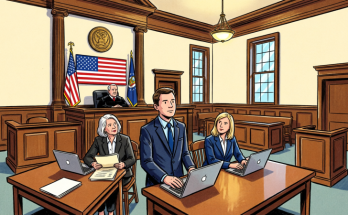
Courtrooms don’t feel like justice at first. They feel like theater built out of wood and rules and people pretending their lives aren’t shaking.
Nathan sat at the defense table in a suit that didn’t fit him the way it used to. He looked smaller, drained, his eyes avoiding mine. Vanessa sat behind her attorney, posture rigid, mascara flawless, face pale. She didn’t glance my way either.
The prosecutor laid out the story simply: premeditated plan, financial motive, knowledge of a severe allergy, deliberate chemical treatment of a garment, intent to cause death disguised as an accident.
David sat beside me, calm, prepared. Clare sat on my other side, hands clasped so tightly her knuckles were white.
When the prosecutor called Clare, my throat tightened.
Clare walked to the witness stand and swore in. Her voice trembled at first as she described trying on the dress, the instant burning, the cough that felt like suffocation, the panic, the scream.
Then she looked toward Nathan, and something in her steadied.
“He knew,” she said clearly. “He knew about Eleanor’s allergy. He watched her nearly die years ago. And when I called him after the ambulance, he acted like it was nothing.”
The defense tried to twist it into an accident, into ignorance. Clare didn’t budge.
“I’ve never had allergies,” she said. “And that dress did that to me within a minute.”
The forensic expert took the stand next. Dr. Ethan Coleman showed microscope images on a screen for the jury. Green fabric under magnification, chemical spots concentrated where skin contact would be highest.
“This is not a factory anomaly,” he said. “This pattern is consistent with deliberate application.”
Then came the agent who sold the dye, identifying Vanessa in court without hesitation. He described the cash payment, her stated purpose, the timeline.
Vanessa’s lawyer tried to rattle him. He stayed firm.
Finally, the prosecutor introduced Vanessa’s confession.
Hearing the words out loud in court made my stomach twist even though I already knew them.
She described spraying the lining. Packing it neatly. Handing it to Nathan. Knowing it was meant to trigger my allergy.
“I thought it would be quick,” her recorded voice said. “I thought it would be an accident.”
An accident with a plan.
Nathan’s lawyer argued Nathan was desperate, manipulated, not the mastermind. Then the prosecutor produced Nathan’s own statement, where he admitted the motive: inheritance, debts, relief.
Nathan’s voice in that transcript sounded almost bored by my humanity. Like I’d been a barrier between him and a clean slate.
When it was time for my testimony, I walked to the stand on legs that felt oddly detached.
The prosecutor asked me about my medical history, my documented allergy, the ICU incident. I answered calmly. Then he asked about the dress, the receipt, Nathan’s lie about the trip, my decision to preserve evidence.
I told the truth without embellishment.
The defense attorney asked, “Mrs. Mitchell, isn’t it possible you were simply paranoid? That you misinterpreted an unfortunate series of events?”
I looked him in the eye. “If I had been paranoid,” I said evenly, “I would have been dead.”
The courtroom went still.
When I stepped down, Clare squeezed my hand hard enough to hurt, like she needed the pain to be real.
After closing arguments, the jury deliberated less than a day.
The verdict landed with a heavy finality that made my ears ring: guilty.
Nathan was sentenced to ten years. Vanessa received seven for conspiracy and complicity.
Neither looked at the other as the judge spoke. Neither looked at me.
It didn’t feel like triumph. It felt like a door slamming on something that had been poisoning my life.
Outside the courthouse, cameras waited. I didn’t stop to speak. I walked to my car with Clare and David on either side, my breath steady.
In the months that followed, the divorce finalized quickly. The judge awarded me full control of the apartment and business holdings given the criminal context. Nathan’s claim to my assets disappeared along with his freedom.
I sold the apartment anyway.
It wasn’t about fear. It was about reclaiming space. The walls had held too many lies. I wanted different sunlight, different hallways, different air.
Clare helped me pack. She folded sweaters in silence, then suddenly said, “I’m proud of you.”
I paused, box in hand. “For what?” I asked.
“For not disappearing,” she said, voice thick. “For not letting him rewrite reality.”
I swallowed. “I didn’t do it alone,” I said.
Clare nodded. “No,” she agreed. “But you did the hardest part. You believed yourself.”
Six months later, I opened a fourth pharmacy.
I didn’t do it because I needed more money. I did it because building something living felt like the opposite of what Nathan tried to do. He planned a death. I built a place that kept people alive—medications, vaccinations, advice, small conversations over a counter.
Sometimes at night I still dreamed of emerald fabric and woke with my heart racing. Sometimes I smelled bleach and remembered the ICU, remembered air refusing to enter.
But then I’d sit up, touch my own throat, breathe, and remind myself: I am here.
I survived the dress.
I survived the lie.
And I didn’t owe my survival to luck.
I owed it to the moment I decided fear was data, not a command.
Part 8
The first time I laughed again, it surprised me.
It happened in the new pharmacy on a Wednesday afternoon, when one of my techs accidentally printed a label that read, “Take one tablet by mouth and call your ex-husband never.” She’d been trying to type “call your physician,” and autocorrect had apparently been on my side.
I stared at the label, blinked, then laughed so hard I had to grip the counter.
My tech looked horrified. “I’m so sorry—”
“No,” I said, still laughing through tears. “It’s perfect. It’s exactly what I needed today.”
Healing wasn’t dramatic. It was moments like that—brief, unexpected proof that my body could still feel joy without immediately scanning for danger.
Clare stayed in my life. Our relationship shifted into something deeper than in-law politeness. She went to therapy too, because the betrayal was hers as well, and she refused to bury it under denial.
One evening she told me, “I keep thinking about how close it was.”
“How close what was?” I asked.
She looked at me, eyes haunted. “If I hadn’t asked to try it on.”
I reached across the table and took her hand. “If you hadn’t,” I said softly, “something else would have happened. They would have tried again. People who plan like that don’t quit after one miss.”
Clare swallowed hard. “That’s terrifying.”
“Yes,” I said. “But it’s also why you shouldn’t carry guilt. You didn’t cause it. You exposed it.”
David stayed in touch too, partly as my attorney during civil claims, partly as a steady adult presence who didn’t let me minimize danger the way I’d been trained to do.
One afternoon, after a hearing for restitution, he said, “You did everything right.”
I shook my head. “I didn’t even try on a dress,” I said. “That’s not bravery.”
David’s mouth tightened. “Bravery isn’t wearing the dress,” he said. “Bravery is admitting the people closest to you might be capable of harm and still acting on the evidence.”
The civil case ended with a settlement order that covered my legal fees and some damages. It didn’t matter much financially—my business was fine—but it mattered psychologically. It was another official record that what happened was real, not a misunderstanding I’d invented.
The press moved on quickly. That’s what news cycles do. They devour a horror story, chew it into headlines, then spit it out for the next one. For a while, strangers recognized me at the grocery store, whispered about “the dress case,” looked at my hands like they expected bruises.
Eventually, the world forgot.
I didn’t.
But I stopped living inside the moment.
I started taking self-defense classes, not because I expected Nathan to reappear but because learning to move with confidence in my own body felt like reclaiming something he’d tried to take.
I drafted a safety protocol for myself the way I did for my pharmacies: emergency contacts, travel check-ins, simple habits that made my life harder to sabotage.
And I wrote a new will every year, updated and clear, because I refused to ever again let “default rules” decide my life.
One night, about a year after sentencing, Clare asked quietly, “Do you hate him?”
I thought about Nathan in our bed, breathing calmly after I told him his sister almost suffocated. I thought about the ribbon, the receipt, the way he’d said I’d regret protecting myself.
“I don’t waste energy on hate anymore,” I said. “I hate what he did. But hating him doesn’t build me a life.”
Clare nodded, exhaling. “I want to feel that,” she admitted.
“You will,” I said. “It just takes time.”
On the anniversary of the day Clare tried on the dress, we didn’t hide from it. Clare came over. We made dinner. We watched a ridiculous reality show and mocked it like teenagers. The night ended with both of us on the couch, half-asleep, safe.
Before she left, Clare glanced toward my closet and said, “Do you still have it?”
I knew what she meant.
“The dress?” I asked.
She nodded.
I hesitated. “No,” I said finally. “The police kept it through trial, and after everything finalized, I signed the release to destroy it.”
Clare swallowed. “Good,” she whispered.
“It doesn’t get to exist in my world anymore,” I said.
As she walked out, I stood at my window and watched her car pull away, and I realized something else that had changed: my home no longer felt like a place that could turn against me. It felt like mine.
I went to bed and slept through the night.
No dreams of emerald fabric.
No phantom chemical smell.
Just breath. Quiet. Ordinary.
And that ordinariness felt like the biggest victory of all.
Part 9
Two years later, a customer asked me why there was a small framed sign near the allergy medication aisle in my newest pharmacy.
It wasn’t flashy. Just a simple message printed in clean font:
If you have severe allergies, always treat new fabrics, cosmetics, and products with caution. Ask questions. Trust your body.
She pointed at it, curious. “That’s unusual for a pharmacy,” she said.
I smiled. “It shouldn’t be,” I answered. “Allergy safety doesn’t stop at food.”
She nodded slowly, thoughtful, and walked away.
That little sign was my quiet rebellion. Not against Nathan, not against Vanessa, not even against my old life. Against the idea that danger only comes from strangers in dark alleys.
Sometimes danger shows up in a white box with a satin ribbon.
My pharmacies grew steadily. Not at a frantic pace, but at a healthy one. I hired carefully. I trained managers the way my mom had trained me: steady systems, no shortcuts, treat people like they matter. I sponsored a local education program for allergy awareness in schools, because kids should know what anaphylaxis looks like before someone’s throat starts closing in a cafeteria.
Clare moved into a new apartment and finished her renovations. She stopped apologizing for taking up space. She started dating a kind, gentle man who laughed easily and never tried to control her.
One afternoon she called me and said, “I said no today.”
“To what?” I asked.
“To my brother’s old friend,” she said. “He tried to guilt me into writing a letter for Nathan’s parole review in the future. I said no. No explanation. Just no.”
My chest warmed. “I’m proud of you,” I told her.
Clare exhaled like she’d been holding her breath for years. “I learned it from you,” she said.
Nathan filed an appeal from prison once. It went nowhere. His confession and Vanessa’s confession and the forensic evidence didn’t leave him much room to rewrite reality.
Vanessa wrote me a letter too, a year into her sentence. David asked if I wanted it. I said yes, but only because I wanted to know if she was still lying.
The letter was short and messy, handwriting cramped. It didn’t ask for forgiveness. It didn’t try to charm me.
It said, I convinced myself you were a concept, not a person. I was wrong.
I read it once, folded it, and put it away. Not as a trophy. As a reminder of how people can turn cruelty into an idea if they want something badly enough.
One spring evening, I hosted a small dinner in my new home—Marla, Clare, Gregory Barnes, and a few employees who’d become friends over years of crisis and growth. Someone spilled wine on my rug. There was a moment of collective stillness, an old reflex in my body waiting for shouting.
Then Marla laughed and said, “Well, the rug wanted a personality.”
Everyone laughed, and my nervous system recalibrated again: accidents don’t have to be punishments.
Later, after everyone left, I washed dishes in the quiet kitchen and realized how far I’d come.
The old Eleanor would have lived in fear of making a scene, fear of being difficult, fear of accusing someone who promised love.
The new Eleanor understood something simpler and harder: love that requires your silence isn’t love.
I went to the window and looked out at the streetlights. Cars moved steadily, people living lives I’d never know. Somewhere across town, a woman was trying on a dress without thinking it could be dangerous. Somewhere else, someone was ignoring a gut feeling because they didn’t want conflict.
I wished I could reach them all with one message.
Trust the evidence. Trust your body. Protect yourself early.
Not because paranoia is wise, but because denial is expensive.
I turned off the lights and went upstairs, breathing easily, throat open, chest calm.
I didn’t win because Nathan got ten years. I didn’t win because Vanessa got seven. I didn’t win because the court gave me my property and my business intact.
I won because I stayed alive long enough to build a life that doesn’t revolve around fear.
I won because I believed my own instincts when the facts started to line up.
And I won because when the emerald dress tried to turn my home into a crime scene, I chose the one thing Nathan didn’t plan for.
I chose to survive.
THE END!
Disclaimer: Our stories are inspired by real-life events but are carefully rewritten for entertainment. Any resemblance to actual people or situations is purely coincidental.