My husband had spent years warning me never to set foot on that farm.
Not in anger. Not in one of those sharp, household arguments that leave a bruise in the air long after the words are gone. Joshua had never been that kind of man. He was steady, careful with his voice, careful with mine, careful even with silence. But whenever the farm came up, something in him changed. His face would close the way old houses do before a storm. His shoulders would go stiff. His eyes, usually so kind they made strangers trust him within minutes, would go cold and distant, as if he were looking past me and straight into something I could not see.
“Never go there, Catherine,” he had told me more than once over the course of our twenty-four-year marriage. “Promise me.”
And because it was one of the few things he had ever asked of me with real force behind it, I had promised.
That was the thing about loving someone for a long time. You stop needing explanations for every wound they carry. You learn which doors are locked for a reason. You let certain rooms in their past stay dark because marriage, if it lasts, is not built only on confession. Sometimes it is built on respect. Sometimes on restraint. Sometimes on looking at the person beside you and deciding that whatever they cannot yet say is not proof they do not love you.
So I never asked too hard about his childhood in Alberta. I never pushed when he would mention horses, or winter, or a river behind a farmhouse, and then go quiet. I never insisted when his jaw tightened at the mention of his brothers. I told myself everyone came from somewhere complicated. I told myself we had built a good life in Minnesota, and maybe that mattered more than the place he had escaped.
Then Joshua died on an ordinary Tuesday in late September.
There are tragedies that arrive with warnings, long hospital hallways, slow thinning, terrible nights when the body teaches the family to brace itself. And then there are tragedies that split the day in two without permission. One half of your life belongs to the person you were before the phone rang. The other belongs to the stranger who hangs up and cannot seem to breathe.
He had been gone before the ambulance reached him.
A heart attack, they said. Massive. Sudden. Unpreventable, perhaps. A cruel phrase if I have ever heard one. It gave the event a kind of clinical dignity while leaving me with the mess of it: his coffee cup still in the sink, his reading glasses folded neatly on the nightstand, the jacket he had worn the night before still hanging by the mudroom door with a receipt in the pocket for birdseed and motor oil. Marriage does not end in grand gestures. It ends in objects. In habits. In the obscene normalcy of things still waiting to be used by hands that are gone.
I became a widow at fifty-two.
There is no graceful sentence for that. The word felt too old and too theatrical all at once, as if it belonged to women in black crepe or old novels with stone houses and candlelit staircases. It did not feel like me, standing in the fluorescent aisles of Lunds & Byerlys wondering whether one woman really needed to buy a whole loaf of bread. It did not feel like me, a high school English teacher with grading still piled on the kitchen table and a daughter who had not yet decided whether grief would make her softer or sharper.
Jenna chose sharp.
She was twenty-seven, living in Minneapolis, smart as a whip and angry in the clean, polished way of young women who are used to having explanations. Grief offended her. It offended her that death could be random. It offended her that her father, the calmest man she had ever known, could leave a vacuum no logic could fill. She moved through the funeral like a woman standing in a courtroom she had not agreed to enter, accepting condolences with her mouth but not with her eyes. By the time the casseroles started coming, her sorrow had already begun hardening into something more dangerous: indignation.
Why hadn’t he seen a doctor sooner? Why had no one known anything was wrong? Why had he looked tired all summer and brushed it off as work? Why had the world gone on outside our house as if this were not a violation of some basic contract?
I did not have answers for her. I barely had any for myself.
Two weeks after the funeral, I sat in the office of Joshua’s attorney, a careful, silver-haired man named Richard Winters who smelled faintly of cedar and old paper. The building was in downtown St. Paul, one of those red-brick structures with narrow windows and a lobby that had not changed its carpeting since the Reagan years. Outside, leaves skittered along the sidewalk in the first real snap of autumn. Inside, the world had been reduced to signatures and legal language and the humiliating bureaucracy of death.
Mr. Winters had already guided me through the will, the accounts, the house, the life insurance, the practical shape of loss. I had signed my name so many times that morning it no longer looked like my own. At some point, I realized I had been gripping my pen as if it might keep me anchored to something.
“There is one more item,” he said at last.
His tone changed. Only slightly, but enough for me to notice. He opened the bottom drawer of his desk and brought out a small wooden box, the kind jewelers used for watches or cuff links. He set it between us with unusual care.
Inside was an antique brass key attached to a maple leaf keychain darkened with age. Beneath it lay a sealed envelope with my name written in Joshua’s precise handwriting.
The sight of his hand on paper hit me harder than I expected. It was not even a long note. Just my name. Catherine. Still, my throat tightened as if that one word contained the whole weight of our life.
“What is this?” I asked.
Mr. Winters folded his hands. “Your husband purchased property in Alberta, Canada, approximately three years ago. Per his written instructions, you were only to be informed of its existence in the event of his death.”
I looked at him for a moment, certain I had misheard.
“A property?”
“Yes.”
“In Canada?”
He nodded once. “The deed has been transferred to your name. All taxes and maintenance expenses are prepaid for the next five years.”
Joshua and I had lived carefully. Comfortably, yes, but carefully. He had been an engineer, methodical to the core, and I had spent decades teaching literature to sixteen-year-olds who believed Shakespeare existed to ruin their afternoons. We had saved. We had planned. We had paid off our mortgage and helped Jenna through college. But we were not the kind of people who secretly bought foreign property on a whim.
“What property?”
“It is called Maple Creek Farm.”
The name landed in the room like an object dropped from a great height.
I stared at the key in my palm. Heavy. Cold. Real.
“The farm,” I said, though I had not meant to speak aloud.
Mr. Winters adjusted his glasses. “You knew of it?”
“I knew it existed. Or existed once. It was his childhood home.” My voice came out distant, detached, as if someone else were answering. “He told me almost nothing about it except that I was never to go there.”
Mr. Winters hesitated, and I could tell there was more.
“What?” I asked.
He leaned back slightly. “Mrs. Mitchell, there is another complicating factor. The property has increased significantly in value over the last eighteen months due to oil discoveries in the surrounding region. Your husband declined several purchase offers.”
My first thought was not about money. It was simpler and stranger than that.
Joshua had gone back.
Somehow, sometime, while we were making dinner and paying electric bills and attending district curriculum meetings and pretending middle age was as stable as it looked from the outside, my husband had gone back to the one place he had forbidden even me to see.
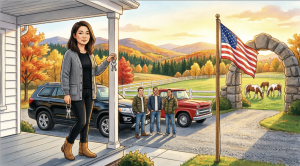
He had bought it. Restored it, apparently. Kept it secret. Hidden it so completely that even now, dead and folded into paperwork, he was still capable of changing the shape of my world with one more revelation.
“How?” I asked quietly. “How did he afford it?”
“I cannot speak in detail about his private finances beyond what is contained in the estate documents,” Mr. Winters said, which was the lawyer’s way of saying he absolutely could, but would not. “I can tell you he arranged matters lawfully and meticulously. There is no issue there.”
“Why keep it from me?”
His expression softened. “I suspect the letter may answer that better than I can.”
My fingers shook as I broke the seal.
My dearest Catherine,
If you are reading this, then I left too soon, and for that I am more sorry than these words will ever be able to say. There is more I should have told you. More I wanted to tell you. But some truths felt too heavy while I was still asking you to live beside them.
The farm is yours now.
I know I spent years making you promise never to go there. I am releasing you from that promise. More than that, I am asking you to go once before you decide what to do with it. Please do not sell it until you have seen it with your own eyes.
On the desk in the main house there is a laptop. The password is the date we met, followed by your maiden name.
I have spent the last three years turning that place from the broken ground of my childhood into something worthy of you. Whether you keep it or not is entirely your choice. But before you choose, let me show you what I was trying to build.
I love you, Cat. More than you know, more than I said well enough, more than I got the chance to prove in all the ways I should have.
Joshua
By the time I finished reading, my eyes were too blurred to make out the last line properly. I pressed the paper to my chest, ridiculous gesture though it was. Grief has no dignity. Love does not, either, when it is interrupted.
“I need to see it,” I said.
Mr. Winters did not look surprised. “There is one more thing you should know before you go.”
I lowered the letter.
“Your husband’s brothers have filed objections to the transfer. They are contesting his capacity at the time of purchase and claiming the property is ancestral land that should have remained within the Mitchell family.”
The rage that moved through me then was so clean it almost steadied me.
“That’s absurd.”
“I agree. But given the property’s current value, they appear motivated.”
Of course they were. Men who had not cared enough to attend the funeral in person were suddenly animated by family heritage the moment oil entered the story. I should have felt shocked, maybe. Instead I felt a dark, almost weary recognition. I had never met Joshua’s brothers, not once in twenty-four years, but I knew enough. Their absence had always been one of those facts we lived around without unpacking. There are estrangements that announce themselves with one dramatic story, and then there are the quiet, ossified ones that become so permanent they begin to seem geological.
“I’m going,” I said.
Mr. Winters glanced at the clock. “To Canada?”
“Yes.”
“Today?”
“Yes.”
He studied me for a beat, then gave the smallest nod. “In that case, I’ll have copies of every relevant document prepared for you before you leave.”
Forty-eight hours later, after one hurried flight from Minneapolis to Calgary, one sleepless night in an airport hotel off Barlow Trail, and a long drive north through miles of open Alberta country, I found myself staring at wrought-iron gates marked MAPLE CREEK FARM in weathered black metal.
It was late afternoon, one of those vast prairie hours when the sky seems less like atmosphere and more like architecture. The land rolled outward in gold and faded green, scattered with poplar and maple turning amber at the edges. The road behind me had been nearly empty for the last hour, just trucks, grain silos, the occasional church spire, and long stretches of fence where the world seemed to narrow to wind and distance.
I had expected something harsher. Something abandoned. A place worthy of warning.
Instead, beyond the gates, I saw a winding gravel drive, stands of trees blazing with autumn color, and in the distance a farmhouse so elegant and self-possessed it looked less like a relic than a promise. White-painted wood. Deep porch. Broad windows reflecting the western light. Several outbuildings stood farther back, all restored, all in use. Fenced pastures stretched beyond them. It was not a forgotten farm. It was an estate.
I sat there with the engine idling, my hands locked around the steering wheel.
Who had my husband been in this place? A boy? A son? A victim of something he could not name? A man rebuilding what had once hurt him? I thought I knew the contours of Joshua’s life. Suddenly they looked like a map drawn from memory, with whole regions left blank.
The key turned smoothly in the gate lock.
As I drove up the lane, gravel crunching beneath the rental car’s tires, I noticed things that felt unmistakably him. The neatness of the fencing. The freshly painted trim. The way the fields had been kept not merely functional but beautiful. Joshua had never done anything halfway. Even his weekend home projects, the small domestic kind, came with research, annotated sketches, measurements, and a box of labeled hardware. If he had restored this place, he would have done it as an act of devotion, not vanity.
The farmhouse front door was painted a deep blue, the exact color I had once pointed out on a trip to coastal Maine and said I loved. Not casually, either. I had stopped and stared at it long enough for him to laugh.
That memory struck me so hard I had to close my eyes.
“Something worthy of you,” he had written.
I stepped onto the porch, fitted the key into the lock, and opened the door.
The first thing I felt was not fear, or suspicion, or even awe. It was recognition.
Not of the room itself. I had never seen it before. But of the hand behind it. Of the intelligence arranging beauty with the sort of precision only love can sustain for years in secret.
The entry opened into a soaring great room with exposed beams and a stone fireplace large enough to anchor winter itself. Warm wood tones. Clean lines. Light spilling across wide-plank floors. Every detail seemed measured, chosen, refined. But it wasn’t the architecture that made my breath catch.
It was the horses.
They were everywhere.
Not living ones, not at first. Paintings, sculptures, photographs, sketches, bronze figures, pencil studies, old equestrian prints in black frames. Running horses. Resting horses. Wild horses on open land, thoroughbreds in profile, heavy winter-coated ranch horses under snow. One wall held an oil painting of a black stallion turning into weather. Another displayed a series of sepia photographs of working horses in old Alberta winters. On the mantel sat two carved wooden mares, smooth with age.
My lifelong love. My oldest private language. The passion I had never quite outgrown and never fully indulged. Joshua had supported it, yes, with kindness and humor and birthday gifts that always seemed to circle the edges of it. He had never mocked it, never dismissed it as childish, but he had not shared it either. Horses were my world, not his.
And yet here I stood inside a house he had built in secret, surrounded by a museum of everything I loved most.
By the window sat a silver laptop with a single red rose laid carefully across the closed lid.
I had taken only a few steps toward it when I heard the crunch of tires on gravel outside.
I froze.
Through the front window I saw a black SUV pulling up behind my rental car. Three men got out. Even at a distance, I could see the resemblance. Tall, dark-haired, broad-shouldered in the same severe way Joshua had been broad-shouldered, though age and temperament had sharpened them differently. One moved with the confidence of a man long accustomed to entering rooms as if he owned them. Another carried himself like an attorney or banker or someone else whose war was usually fought on paper. The third hung back half a pace, watchful.
The brothers.
Of course.
I crossed the room, locked the front door, and stood very still while they approached. My pulse had gone fast and cold. I was alone, in a foreign country, inside a house that now legally belonged to me but emotionally still felt like stepping into someone else’s dream.
The oldest man raised a hand and knocked. Not hard at first. More like a man announcing himself where he expected eventual compliance.
“Mrs. Mitchell,” he called. “We know you’re in there.”
His voice carried through the wood with that softened Canadian cadence Joshua’s own voice sometimes slipped into when he was exhausted or caught off guard. Hearing it from another man felt like hearing a private melody turned into something public and unpleasant.
I did not answer.
He knocked again, more sharply this time. “Catherine. My name is Robert Mitchell. I’m Joshua’s older brother. These are our brothers, Allan and David. We need to talk.”
Need. Not hope. Not would appreciate. Already the language of entitlement.
My eyes shifted to the desk.
Whatever answers Joshua had left for me were there. Not on the porch with three men who had appeared less than five minutes after I first unlocked the house. The timing alone told me enough. Someone had been watching. Or waiting.
The knocking grew harder.
“Mrs. Mitchell, this won’t help anyone,” Robert called. “This property is under dispute, and you need to understand the situation.”
Still I remained silent.
I crossed the room, opened the laptop, and entered the password: 05151998Holland.
The screen came to life immediately. A folder sat on the desktop labeled FOR CATHERINE.
I clicked it.
Hundreds of video files appeared, each one dated. My mouth went dry. The first began two weeks after his death. The dates continued forward, one by one, for a full year.
I opened the earliest file.
Joshua filled the screen.
Not the Joshua from the hospital corridor where I had last seen him. Not the pale, still version from the funeral home with its cruel attempt at dignity. This Joshua looked healthy, tanned, alive, seated in what I now realized was this very house months before I ever knew it existed. His smile came easy, crooked at one corner, the one that had undone me from the beginning.
“Hello, Cat,” he said.
My hand flew to my mouth.
“If you’re watching this, then I’m gone, and you made it to the farm despite all those years I spent making you promise not to.” He gave the faintest laugh. “To be fair, I was counting on that.”
Outside, the knocking resumed. Harder now. A fist, not a hand.
Joshua continued as if he could hear none of it.
“I’ve made a video for every day of your first year without me. One year of me keeping you company while you grieve. One year of explanations I should have given you while I was still there to answer your face in real time.”
Tears blurred my sight. Even now, he knew exactly how I grieved: with anger at evasion, with a demand for coherence, with a private hatred for half-finished things.
He grew quieter then. More serious.
“I need to start with the truth I should have told you three years ago. I was diagnosed with hypertrophic cardiomyopathy.”
The words did not register at first. Or maybe they registered too well and my mind rejected them on arrival.
“It’s inherited,” he said. “My father had it. The doctors gave me somewhere between two and five years if things progressed the way they expected. I chose not to tell you. Or Jenna.”
The room tilted.
Outside, voices rose. One of the brothers said something sharp. Another answered. The porch boards creaked under restless weight. But all of it seemed far away now, muffled behind the roaring in my ears.
Joshua looked down for a moment, then back into the camera. “You have every right to be angry when you hear that. I know you. You’ll think I robbed you of the chance to prepare. And I did. But I need you to understand why.”
He leaned back in his chair, hands clasped the way they always were when he had to say something difficult but wanted to say it cleanly.
“I did not want my last years with you to turn into a waiting room for death. I did not want you watching my body for signs. I did not want Jenna measuring our holidays against a countdown. I wanted our life to stay our life for as long as it could.”
I had to grip the desk to steady myself.
Love and fury hit at once, equal and opposite. He had hidden his illness. He had let me go on planning a future he knew he might never reach. He had deprived me of the right to stand beside him knowingly. And yet I could hear the logic in him, the devastating tenderness of a man who believed he was protecting what he loved by carrying the worst of it alone.
Outside, the knocking stopped.
Through the window I saw the brothers conferring near the SUV. Allan, I guessed, was on his phone. Robert held a sheaf of papers under one arm. David kept looking toward the house in a way that suggested less confidence and more calculation.
Joshua went on.
“When I got the diagnosis, I knew I wanted to leave you something more than money. More than paperwork. More than absence. You always talked about land, Cat. Horses. Space. The kind of life where beauty had room to breathe. So I came back to the last place anyone would expect me to go.”
He smiled without warmth.
“The farm.”
The word itself seemed to cost him.
“I bought it from my father before he died. Legally. Quietly. He was nearly broke by then. Years of bad investments, drinking, stubbornness, and whatever else he called strategy. He sold it for a fraction of what it was worth because he thought it was ruined and because he believed he could keep that fact from my brothers.”
I stared at the screen. Every sentence rearranged another wall in my memory. Business trips. Late returns. The periods of distraction I had called stress. The new reserve in him those last three years, as if part of him were always somewhere else.
“It was in terrible condition when I got it,” he said. “Not just structurally. Spiritually. The place carried every bad thing I remembered from childhood. But I thought maybe that was why it was the right place to begin again. If I could turn that land into something beautiful, maybe I could leave you something untouched by the ugliness I came from.”
The front window flashed with movement. Robert was back on the porch. He held up a document toward the glass, tapping it with two fingers in a gesture designed to imply authority. Court order, maybe. Or something intended to look like one.
Joshua’s expression shifted. Hardened.
“My brothers will come for it,” he said. “They never wanted that property until oil was discovered nearby. Then suddenly family history became sacred.”
A humorless laugh escaped me. Even dead, he was still right on time.
“In the bottom drawer of this desk,” he continued, “there’s a blue folder. Every deed, transfer, bank record, survey, and notarized statement you’ll need. I made sure the title path was clean. The farm is yours. Entirely yours.”
Another vehicle appeared on the drive then, blue lights flickering across the afternoon. An RCMP cruiser.
My stomach dropped.
The brothers had escalated.
Joshua’s voice softened again, and in that contrast lay the thing he had always done to me best: he could move from warfare to tenderness in a single breath.
“In the stables,” he said, “you’ll find six horses. Every breed you ever admired aloud when you thought I wasn’t listening. The staff know what to do. Whether you keep them or not is your choice. Everything here is your choice now. That matters.”
I stared at him through tears.
The video ended on his face frozen mid-smile.
Then came a knock at the door different from the others. Official. Controlled.
“Mrs. Mitchell,” a male voice called. “RCMP. We need you to open the door, please.”
For a moment I could not move.
Then survival, or fury, or widowhood, or some new alloy of all three moved through me and steadied my hands. I opened the bottom drawer. There it was: a blue folder thick with documents, exactly where he had said. Deeds. Certified copies. Banking records. Transfer papers. Notes in Joshua’s clean engineering hand.
My phone rang.
Jenna.
I stared at the screen and almost let it go to voicemail. Instead I answered.
“Mom,” she said immediately, no greeting. Her voice was taut with agitation. “Why didn’t you tell me about Dad’s farm?”
I closed my eyes.
“How do you know about it?”
“One of his brothers just called me. Actually, all of them have been calling. They say there’s property, oil, a will dispute, and that you’re in Canada refusing to cooperate. What the hell is going on?”
I looked out the window. Robert was speaking with the officer now, posture calm in the false way of men who weaponize reason. Allan had stepped back, phone still in hand. David kept scanning the house.
So this was their plan. Not just pressure me. Divide me. Reach Jenna first. Cast themselves as family. Cast me as emotional, isolated, uninformed.
“Jenna,” I said carefully, “do not sign anything. Do not agree to anything. I’ll explain everything, but not right this second.”
Her voice sharpened. “If there’s money involved—”
“This is not about money.”
It came out so firmly that even I was startled by it.
There was silence on the line. Then, quieter: “Then what is it about?”
I looked at Joshua’s frozen face on the laptop screen. At the rose. At the blue folder in my hand. At the men outside who shared his blood and not, apparently, his soul.
“It’s about what your father intended,” I said. “And right now, I need you to trust me.”
A long exhale crackled through the phone. “Fine. But call me back.”
“I will.”
When I ended the call, the knocking came again.
I walked to the front door, blue folder in hand, shoulders squared with a steadiness I did not feel. Then I opened it.
A young RCMP officer stood there, polite but alert, one hand resting near his belt. Beside him were the three Mitchell brothers, all dressed for the kind of conflict men conduct with paperwork and timing. Robert, silver at the temples and expensively composed. Allan, smoother, lawyerly, eyes quick. David, younger than the others by several years, handsome in a tired, slightly unfinished way.
“Mrs. Mitchell?” the officer said.
“Yes.”
“I’m Constable Wilson. These gentlemen have presented a court order requesting preliminary inspection of the property in connection with an estate dispute.”
Robert gave me a measured nod that managed to suggest civility and contempt at once. “This needn’t be unpleasant, Catherine.”
The use of my first name from a stranger nearly made me smile.
“Of course,” I said to the constable, and held out the blue folder. “Before anyone steps onto my property, I’d appreciate it if you reviewed these.”
The word my landed between us like a pin driven into wood.
Robert made a small dismissive gesture. “Family property disputes are often more complex than they appear. My sister-in-law is understandably emotional.”
I turned to him at last.
“Actually,” I said, “I’m neither emotional nor confused. I’m a widow standing on land that legally belongs to me while three men who never bothered to know me are trying to talk their way around that fact.”
The constable took the folder.
Something changed, very slightly, in his face as he began reading. He was young, but not foolish. His eyes moved quickly over seals, signatures, dates, notarizations. His expression lost its neutrality and acquired professional caution.
The brothers saw it too.
Robert’s posture shifted first. Allan’s jaw tightened. David looked away toward the pasture as if scenery might yet rescue him.
The wind rose across the porch, carrying the smell of dry grass and cold wood and distant earth. Somewhere behind the house, I thought I heard the low nicker of a horse.
For the first time since Joshua died, I felt something that was not exactly peace but came from the same family.
Purpose.
Constable Wilson closed the folder and looked at Robert.
“These documents appear to be in order.”
“They need full review,” Allan said quickly. “There are broader issues of inheritance and historical claim—”
“Perhaps,” the constable said. “But I see no grounds here for immediate forced entry or inspection. This is a civil matter. You’ll need to pursue it through the proper channels.”
Robert’s face flushed with an anger he was too disciplined to fully show.
“This is outrageous,” he said.
“That woman has no right—” Allan began.
“That woman,” I said calmly, “was married to Joshua Mitchell for twenty-four years. And that woman will decide who enters her home.”
The word home surprised me as it left my mouth. But once spoken, it fit.
The brothers retreated not dramatically, not with shouted threats or cinematic fury, but with the sort of clipped, humiliated stiffness that belongs to men who believe they were supposed to win the first round on presentation alone. The constable gave me an apologetic nod before following them down the steps.
I closed the door and leaned against it.
The house went quiet around me. Big, breathing quiet. A silence full of wood grain and memory and whatever love can build when it knows time is short.
On the desk, the laptop waited.
Tomorrow’s video was already there.
And I knew, with the kind of certainty that comes only after the ground breaks open beneath your feet, that my husband had left me far more than a secret farm.
He had left me a map through a war he knew I would have to fight.
I slept badly that first night at Maple Creek Farm, if sleep is even the right word for the thin, drifting state in which grief and exhaustion take turns waking you. The farmhouse was warm, too warm if anything, with radiant heat beneath the floors and a fire laid ready in the stone hearth as if someone had expected my arrival with more tenderness than I felt prepared to receive. Yet every unfamiliar creak of settling wood pulled me awake. Every shift in wind against the windows became, for half a second, a car on the drive or a fist on the door or the ghost of Joshua moving through rooms he had made for me without ever saying so.
By dawn I gave up and rose.
The kitchen was immaculate, deeply American in the best sense of the word, broad farmhouse sink, butcher-block counters, an old-style enamel stove paired with modern steel appliances, as if the room had been built by someone who respected history but did not trust old plumbing. Through the east windows, the first light touched pasture and fence line with a pale honey glow. A stand of trees beyond the barn looked almost incandescent in the morning cold.
I made coffee and carried it through the house slowly, letting myself see it in daylight.
Every room spoke in some dialect of us. The library held first editions of several novels I had mentioned only once in twenty years. The guest bedroom downstairs was done in soft greens and creams exactly the way I had once described wanting a lake cottage to feel. In the mudroom by the back entrance, a neat row of boots stood beneath hooks labeled with brass plaques, and one of them, absurdly enough, was my size. In the pantry, there were the tea brands I bought at home. In the linen closet, the lavender detergent I used because Joshua used to say it made the whole house smell like a summer apology.
I had been loved by a man capable of astonishing, almost secretive attention. That should not have been news after twenty-four years. Yet here, in the architecture of his final labor, I was forced to confront the fact that there are forms of devotion even a marriage may not fully reveal until after death.
The stables took my breath cleanly away.
They stood just beyond the main house, red cedar with white trim and cupolas, immaculate against the morning sky. The smell hit me the moment I stepped inside, hay, clean shavings, leather, horse heat, metal, dust, and some deep animal sweetness that always felt to me like truth itself. I had not realized how badly I needed that smell until it wrapped around me and undid something in my chest.
Six heads turned toward me from six spotless stalls.
For a long second, I could only stand there.
An Andalusian with a silver-white mane lifted his neck and watched me with princely suspicion. A dark Friesian stallion stood like a carved storm cloud in the next stall, one hind foot cocked, eyes bright and intelligent beneath his forelock. Two quarter horses, one chestnut, one bay, moved with the easy steadiness of ranch stock. A sleek thoroughbred mare regarded me with refined impatience. And in the corner, an Appaloosa with the softest expression of the lot let out a low, warm sound as if greeting someone expected.
“Good morning, ma’am.”
I turned sharply.
A man in his sixties stepped out from the tack room wiping his hands on a folded rag. He wore denim, work boots, and the kind of weathered face that suggested half his life had been spent outdoors and the other half refusing to complain about it.
“I’m sorry,” he said. “Didn’t mean to startle you. Name’s Ellis. Your husband hired me on as stable manager.”
Of course he had. Joshua would never have left living creatures to chance.
“I’m Catherine Mitchell.”
He smiled gently. “Yes, ma’am. I figured.”
His voice carried the wide vowels of rural Alberta, softened by age and restraint. He did not offer condolences right away, and for that I liked him immediately. Some griefs do not need fresh handling every five minutes.
“You knew my husband well?” I asked.
“Well enough to know he was the sort of man who checked every gate twice and never asked anybody to do a job he wouldn’t do himself.” Ellis glanced toward the stalls. “He talked about you often.”
That undid me more than it should have. Widows become greedy for ordinary details. Not declarations. Not grand final messages. Simple continuities. He asked about the weather. He hated store-bought pie crust. He fixed a loose hinge himself because he thought the contractor was overcharging. He talked about you.
Ellis must have seen something shift in my face because his own expression softened.
“The black one there,” he said, nodding toward the Friesian, “that’s Midnight. Your husband spent near six months tracking him down through a breeder outside Edmonton. Said you once loved a painting of a horse looked just like him.”
I laughed once, quietly, in disbelief.
A painting at the Minneapolis Institute twenty years earlier. A black horse against a storm-dark background. I had stood in front of it long enough for Joshua to tease me for falling in love with anything that looked like it might kick down heaven’s front gate.
And he had remembered.
“Did he ever…” I stopped, then tried again. “Did he ever tell you he was sick?”
Ellis lowered his eyes. “Not directly. But the last six months, he worked like a man who knew time had changed its terms.”
I looked at Midnight again. The horse lifted his head higher and stepped toward the stall door, enormous and shining and alive. Grief is strange that way. It can hit hardest not in funerals or documents or last words, but in the evidence of how long someone planned to love you after they were gone.
“His brothers were here yesterday,” I said.
Ellis’s jaw tightened.
“That so.”
“You’re not surprised.”
“No, ma’am.” He folded the rag once, neatly. “They’ve been circling since word got out about oil on neighboring land. Funny thing, none of them cared much for the family farm when it was just dirt and bad roofs. Now they speak about legacy like they invented the word.”
“What can you tell me about them?”
He leaned against the stall divider, considering. “Robert’s the oldest. Toronto money type. Likes to sound reasonable while he’s rearranging the furniture under your feet. Allan’s a lawyer. Sharp enough to peel paint. David’s the youngest, though he’s still older than your husband was. He mostly follows Robert’s lead, but don’t mistake quiet for harmless.”
“And Joshua?”
“What about him?”
“With them.”
Ellis looked at me for a long moment, measuring what to say.
“From what I gathered,” he said carefully, “your husband never really stopped being the one they thought they could corner. Childhood patterns run deep, especially in families that prefer force to affection.”
That was answer enough.
When I returned to the house, I carried with me a new sense of the place, not just as Joshua’s secret project but as a deliberate inheritance. Not money. Not even land, exactly. A field of choices he had prepared for me before stepping off the map.
I took my breakfast at the long kitchen table with the laptop open in front of me.
The second video began with Joshua seated in what I now recognized as the library, shelves behind him, morning light at his shoulder.
“Good morning, Cat,” he said. “If I know you, you’ve already been through the house, looked in every cabinet, met the horses before breakfast, and probably made coffee stronger than your doctor would prefer.”
I let out a helpless sound that was almost a laugh.
“I want to show you something today,” he said, then picked up the camera and carried it down a hallway I had not yet fully explored. At the end was a closed door. “There’s a key for this in the top drawer of the silver bedside table in the master bedroom. The old one with the horse engraving. I’d like you to open it before you hear the rest of what I have to say.”
I paused the video.
The key was exactly where he said it would be.
The hallway in real life felt longer than it had on screen. Quiet. Sunlit. The door itself was plain white, almost unremarkable. I inserted the key and turned it.
When I opened it, I had to brace one hand against the frame.
An art studio.
Not a hobby room. Not some half-furnished gesture toward a forgotten interest. A real studio. High ceilings. Perfect north light through floor-to-ceiling windows. Easels. Archival drawers. Cabinets of brushes, paint, canvases, papers, mediums, tools. A long worktable. A sink. Books stacked neatly on shelves about technique, color, composition, American impressionists, equine anatomy, landscape studies, modern figurative work. Everything arranged with the reverence of someone who knew this was not decoration but recovery.
I had not painted seriously in twenty years.
Not because I had stopped loving it. Because life had narrowed and widened in practical places. Because I needed a steady job. Because Jenna came. Because mortgages came. Because school districts do not much care whether their teachers once had talent with oil and light. Because after a while, anything untended begins to feel less like a passion and more like evidence against you.
I went back to the laptop with tears already rising.
Joshua smiled at me from the screen, and somehow the expression held apology and triumph at once.
“You gave up more than you ever said out loud,” he told me. “Your painting was first.”
I sat down hard in the chair nearest the desk.
“You never complained,” he continued. “Which is exactly why I knew how much it mattered. Some people shout when they lose what they love. You did something harder. You folded it away neatly and kept living. I always told myself that if the day came when I could give it back, I would.”
He glanced off-screen for a moment, toward the studio around him. Toward the room I was now standing inside.
“There’s one more thing. Check the cabinet beneath the window seat.”
I crossed the room almost without feeling my feet.
The cabinet door opened on a large archival box.
Inside were my paintings.
Not all of them, but enough to make the room blur. College work. Figure studies. Landscape attempts. Horse sketches. My final senior project. Pieces I had thought were lost in one move or another, or damaged, or left behind in storage units when life became too crowded for sentimental inventory. Joshua had saved them. Preserved them. Carried them through years I had spent assuming that part of myself had simply been misplaced beyond retrieval.
On top lay a note in his hand.
She’s still in there, Cat.
I sank to the floor with the note in one hand and an old canvas in the other.
There are moments when grief changes shape. This was one of them. Until then it had mostly been subtraction. The absence of his voice, his body, his routines, his place at the table, his side of the bed. But here, in the studio, grief became revelation. He had not only loved me. He had been paying attention to the rooms inside me that I myself had abandoned.
I did not hear the cars at first.
Only when a shadow crossed the studio wall did I look up toward the long drive.
The black SUV was back.
And behind it, a silver sedan I recognized immediately.
Jenna.
My daughter stepped out first, wind catching her dark hair and pressing her coat against her long frame. For one impossible second, with the prairie light behind her and Joshua’s posture in the set of her shoulders, she looked so much like him it hurt.
Then I saw Robert approach her.
She smiled. Shook his hand. Allan did the same. David leaned in and said something that made her nod.
A coldness spread through me with terrifying speed.
They had gotten to her.
I stood at the studio window, one hand still gripping the cabinet door, and watched my daughter exchange greetings with three men Joshua had spent most of his life avoiding.
It was not a dramatic betrayal. Not yet. There was no obvious hostility in the scene below, no raised voices, no gestures sharp enough to call a warning by themselves. But that was what made it more unsettling. Jenna looked comfortable. Curious. Receptive. She was listening with the earnest focus she used to reserve for professors she admired and boyfriends she had not yet learned to mistrust. Robert stood a little too close in that way older men do when they want to project authority as warmth. Allan’s posture was open, practiced, reassuring. David, quieter than the others, hung back with just enough detachment to seem reasonable rather than ambitious.
I knew manipulation when I saw it. Not because I had lived with it, but because I had spent thirty years teaching teenagers how to hear tone under language. Sometimes the most dangerous performance is the gentle one.
My phone buzzed in my pocket.
A text from Jenna.
Arrived. We need to talk. Please don’t make this difficult.
No hello. No question about whether I was all right. Just the quick, controlled wording of someone who had already accepted another version of the story before hearing mine.
I read it twice and slid the phone back into my coat pocket without answering.
By the time I came down the hall, locked the studio, and crossed the great room, the front door had opened. Ellis stood just inside, weathered face unreadable, while Jenna entered ahead of the brothers as if her daughter’s privilege covered them all. It was not until Robert stepped over the threshold that the shift in the room became complete. Whatever this house had been a moment earlier, sanctuary, secret, message, legacy, it was now also contested ground.
“Mom,” Jenna said.
She came toward me and hugged me briefly, almost dutifully, then stepped back to take in the room with an expression halfway between awe and accusation. “This place is unbelievable.”
“It is,” I said.
“Why didn’t Dad ever tell us?”
Before I could answer, Robert moved in with perfect timing, his voice smooth as polished wood.
“Catherine, I believe we may have gotten off on the wrong foot yesterday.”
That single sentence told me everything I needed to know. Not We were wrong. Not I’m sorry. Just the managerial language of a man resetting optics.
He had Joshua’s height, and some of his bone structure, though life had sharpened him where my husband had softened. At close range, the resemblance was almost painful. The same dark eyes. The same broad brow. But where Joshua’s face had always opened before it judged, Robert’s seemed built from calculation outward.
“We were surprised by your sudden appearance,” he went on, “just as you were surprised by ours.”
Jenna nodded as if this were balanced, as if everyone here had been caught equally off guard by circumstance rather than by a dead man’s final strategy colliding with greed.
“Jenna,” I said, keeping my eyes on my daughter, “I thought we agreed you wouldn’t involve yourself with these men until we had a chance to talk.”
She flushed, but only slightly. “They called this morning with a proposal. I thought I should at least hear them out. They’re family.”
Family.
The word hit harder than it should have. Perhaps because grief makes you territorial. Perhaps because I had spent twenty-seven years helping build her understanding of what family meant, and in the span of twenty-four hours three men with excellent coats and no moral center had begun rewriting the definition.
“Family you didn’t know existed until yesterday,” I said.
“That wasn’t my fault,” she snapped.
“No,” I agreed quietly. “It wasn’t.”
Allan stepped forward then, portfolio in hand, smile trimmed to professional sympathy. “Perhaps we should all sit. Emotions are understandably high.”
“I’m perfectly comfortable standing,” I said.
A flicker, brief but real, crossed his face. Men like Allan preferred conversation arranged physically to their advantage. Seated people looked managed. A woman standing in her own house with her daughter beside her and no intention of softening was less convenient.
Robert took over again.
“The farm has been in the Mitchell family for generations. Joshua repurchased it from our father, yes, but this was always meant to remain family property.”
“Interesting,” I said. “Because yesterday none of you seemed particularly interested in the family aspect until after oil entered the conversation.”
Jenna exhaled, exasperated. “Mom.”
Robert raised a hand as if magnanimity were his to dispense. “No, that’s a fair concern. We should be honest. The mineral rights do complicate matters. But they also create opportunity. Our position is simple. Rather than dragging this through court, we can settle now in a way that benefits everyone.”
Allan opened the portfolio and withdrew a set of documents already tabbed for presentation. Of course he had. Men like him never came to a room without paper designed to make surrender look elegant.
“We’re prepared to offer a generous division,” he said. “One-third to you, Catherine. One-third to Jenna. One-third among the brothers. Everyone exits with security. No prolonged litigation, no ugly publicity, no stress.”
My daughter looked at me expectantly, as if this were common sense and my refusal would be stubbornness rather than self-preservation.
It was such a neat, reasonable theft I almost admired its construction.
“And the western acreage?” I asked.
Allan blinked. “What about it?”
“The rocky land to the west. Included in this division?”
He smiled thinly. “That section has limited practical value.”
So there it was. Not just greed. Selective greed. Greed with a map.
Jenna, still unaware she was standing inside a chessboard, said, “Mom, we don’t need all this. We’re not ranchers. We could sell and walk away from this with more money than either of us would know what to do with.”
Money. There it was at last. Not because she was shallow. My daughter had never been shallow. But because grief had made her crave solid answers, and money at least looked solid. Money translated chaos into numbers. Numbers felt fair even when they weren’t.
“Your father left this property to me,” I said.
Robert smiled in that pitying, elder-statesman way that made my skin crawl. “Out of sentiment, perhaps. Out of confusion. The end of life alters judgment.”
My pulse kicked once, hard.
“My husband was of sound mind.”
“Then why the secrecy?” David asked.
It was the first time he had spoken. His voice was softer than the others’, almost careful, which made the question more dangerous, not less. It let him pose as the thoughtful one. The brother who merely wanted clarity. The brother who could say the hardest thing with no visible aggression at all.
Why the secrecy.
Because he was dying. Because he was trying to build beauty before the dark closed in. Because he trusted you so little he designed legal redundancies from beyond the grave.
But I could not say any of that yet. Not to them. Not in front of Jenna while her emotions were still pointed in the wrong direction.
Instead I said, “Complicated family history is not evidence of confusion.”
Jenna crossed her arms. “That’s not really an answer.”
Something in me softened then, unexpectedly. Not toward the brothers. Toward her. She looked tired. Too polished. Too fast. Like a child wearing certainty because grief had left her underdressed.
“Maybe not,” I said. “But it’s the only answer you’re getting while they’re standing in my living room.”
Robert’s mask slipped then, if only by half an inch.
“This property is worth tens of millions now. Perhaps more, depending on the survey results. You are a schoolteacher from Minnesota, Catherine. We’re offering to save you from a legal and financial situation that will become unmanageable very quickly.”
There are moments when someone tells you exactly how they see you, and the insult in it is almost secondary to the gift of clarity. A schoolteacher. As if the phrase itself disqualified me from strategy. As if a life spent reading motive and contradiction and buried meaning in text had somehow made me naive rather than dangerous.
I smiled.
“My husband,” I said, “did not spend the last years of his life building this place only to leave it to men who suddenly discovered family values after an oil strike.”
Robert’s expression hardened.
Jenna turned to me with visible frustration. “Why are you being like this?”
Like this. Defensive. Difficult. Emotional. Female. Protective. Inconvenient.
Before I could answer, Ellis appeared in the doorway from the back hall.
“Everything all right, Mrs. Mitchell?”
Robert pivoted toward him with the impatience of a man unaccustomed to staff having names. “This is a family matter.”
“Ellis is employed by me,” I said. “Which makes this his concern too.”
Allan interjected smoothly, “Pending resolution of ownership, employment arrangements may also be subject to review.”
Ellis did not move an inch. “Mr. Mitchell hired me direct and made me promise to look after the place.”
Robert dismissed him with a glance. “We’ll revisit all staffing decisions later.”
I looked from one brother to the next, then at my daughter.
“You all need to leave.”
Silence.
Jenna stared at me. “You’re serious?”
“Yes.”
“Even me?”
I held her gaze. “You are always welcome here. They are not.”
That landed where I meant it to, not as rejection, but as a line.
Jenna’s face changed. Not much. Just enough for me to see the war inside her. Loyalty, anger, humiliation, hunger for explanation, the ache of her father still fresh enough to make any thread to him feel valuable.
“I think I’ll go with them,” she said finally. “For now.”
She kissed my cheek quickly. The gesture was so automatic, so little-girl familiar, that it hurt worse than the words.
“Think about the offer,” she said.
Then she turned and left with them.
I watched from the window as the SUV pulled away with my daughter in the silver sedan behind it, and for the first time since arriving in Alberta, I felt genuinely afraid.
Not of losing the farm.
Of losing Jenna to the story they would tell her next.
Ellis waited until the vehicles disappeared beyond the gate before speaking.
“There’s something you should know,” he said.
I turned. “About the brothers?”
“About the property. And about your husband.”
He hesitated in a way that made clear he did not hesitate often.
“Mr. Mitchell asked me not to mention it unless things became necessary.”
A strange laugh caught in my throat. “I’m beginning to suspect my husband prepared for necessity more thoroughly than most people prepare for retirement.”
Ellis gave the faintest shadow of a smile. “That sounds about right.”
He led me not to the house or office or stables, but beyond them, toward an old weathered barn I had noticed only in passing. Unlike the rest of the property, it had been left mostly unrestored. Gray boards. Sagging roofline. Rusted hardware. The kind of structure a person’s eye skipped once it had seen the polished version of everything else.
Inside, hay bales and old tools sat in carefully believable disorder. Ellis moved to the far corner and pulled aside several stacked bales. Beneath them lay a trapdoor flush with the floor.
I stared at it.
“He had this built last winter,” Ellis said. “Workers thought it was a root cellar.”
He lifted the door.
A staircase descended into darkness.
“After you, Mrs. Mitchell.”
The tunnel below was not rough or improvised. It was concrete, climate-controlled, lit by recessed fixtures that clicked on in sequence as we walked. Fifty yards perhaps, maybe more, leading to a reinforced room beneath the earth outfitted with filing cabinets, computer terminals, maps pinned to every wall, and enough documentation to suggest not panic, but campaign.
“What is this?” I asked.
Ellis’s expression held something like respect. “Mr. Mitchell called it insurance. I called it a war room.”
He gestured to the nearest wall.
A full survey of the property covered it, not just the visible fields and structures, but topographic overlays, mineral-rights boundaries, neighboring tracts, pipelines, access roads, water tables. Red markings indicated oil-bearing formations. Not only to the east, where anyone would expect them based on recent finds nearby, but concentrated deep beneath the western acres Robert had so casually described as worthless.
My eyes moved slowly across the map.
“He knew,” I said.
“At first, no. He bought this place for you. That was true from day one.” Ellis opened a cabinet and withdrew a bound set of reports. “But after the Petersons struck oil east of here, he brought in private geologists under non-disclosure agreements. Three different teams, actually. Didn’t trust the first one on principle.”
I almost smiled through the shock. That was Joshua. Never suspicious in the theatrical sense. Simply unwilling to rest anything important on one source.
“The largest reserve is under the western foothills,” Ellis said. “Deeper than expected. Harder to extract. Easy to miss if you were only looking for a continuation of the eastern formations.”
“And the brothers don’t know?”
“They suspect oil. They don’t know how much. Or where the mother lode sits.”
I turned slowly.
“Why gather all this down here?”
Ellis exhaled through his nose. “Because your husband knew men like his brothers don’t stop at one legal filing. And because oil wasn’t the only thing he was preparing for.”
He opened another cabinet.
Inside were folders labeled with the brothers’ names.
Not childish dossiers. Not rumor. Documents. Bank records. Emails. Sworn statements. Copies of civil filings from Ontario and British Columbia. Old partnership agreements. Tax irregularities. Correspondence with regulatory bodies. Evidence of questionable conduct layered over decades with the patience of a man who had never intended to use it lightly, but had no intention of dying without leverage.
“Good God,” I said.
“He thought they’d come after you,” Ellis said simply. “He wanted you to have options.”
I sat down at the metal desk in the center of the room because my knees had started to go loose.
Your husband knew what he was doing.
Your husband anticipated this exact situation.
Your husband built you a farm, an art studio, six horses, a year of video messages, airtight legal protection, and an underground command center full of geological surveys and evidence against his brothers.
It was too much and exactly him at the same time. Joshua had always believed that if something mattered, you prepared for the worst possible version of it with quiet thoroughness. Spare batteries. Duplicate keys. Emergency funds. Backups for backups. He was the kind of man who read insurance policies line by line and packed road flares even in good weather. I had teased him for it for years.
Now I sat in the physical proof of what that instinct looked like when sharpened by love and mortality.
“He didn’t tell me he was sick,” I said, though I wasn’t sure why that was the line that came out.
Ellis looked at the floor. “No, ma’am.”
“He let me go on thinking we had time.”
“Yes.”
I swallowed. “And still he did all this.”
“Yes.”
There are griefs that collapse you, and griefs that recruit you. Somewhere in that underground room, surrounded by the architecture of Joshua’s foresight, mine began turning into the second kind.
“What do I do now?” I asked.
Ellis did not answer immediately. He seemed too respectful for false wisdom.
“That depends,” he said at last, “on whether you want peace, justice, or control. Sometimes you can only pick two.”
I thought of Jenna in the silver sedan, listening to men who knew how to weaponize bloodline. I thought of Robert’s soft contempt. Allan’s legal precision. David’s dangerous quiet. I thought of the horses in the stable and the studio upstairs and Joshua’s face on the laptop telling me, even in death, that everything here was now my choice.
“I want my daughter back,” I said.
Ellis nodded once.
“Then start with her.”
I watched a week of videos in one night.
By the time dawn came again to Maple Creek Farm, I had a legal strategy, a geological education I never asked for, and a worse understanding of how precisely my husband had anticipated his brothers’ psychology.
“They’ll divide and conquer if they can,” Joshua said in the fourth day’s recording. He was seated in the library again, sleeves rolled up, a legal pad on the desk beside him. “Robert will play reasonable. Allan will play inevitable. David will watch and feed them what they miss. If they have any route to Jenna, they’ll take it. She wants connection when she’s grieving. That’s not a weakness. It’s just where the opening is.”
In another video, he walked the western rise while wind tore at his jacket and the foothills stood blue in the distance.
“This land looks worthless if you don’t know what you’re seeing,” he said, panning the camera across scrub, rock, and difficult grades. “That’s why it matters.”
He was right, of course. The western section was beautiful in a stern, American-West kind of way, if a person had the eye for it. Rugged. Difficult. Unadvertised. The sort of terrain developers called impractical and horse people called honest.
By late morning I had arranged to meet Jenna in a café in the nearest town, neutral ground, far enough from the farm to cut the emotional theatrics and close enough to keep her from being fully absorbed into her uncles’ orbit before I could reach her.
The town itself was the kind of place that could have existed in Montana, Wyoming, or rural Colorado if you blurred the flags and road signs. Grain elevators. A feed store. A diner with a hand-painted sign in the window promising all-day breakfast. Pickup trucks parked diagonally on Main Street. A church, a hardware store, a Tim Hortons attached to a gas station. Places like that tend to look simple until you realize they contain enough memory to outlast whole cities.
Jenna arrived fifteen minutes late in a camel coat and city boots not made for slush or gravel. She looked beautiful, tired, and defended.
“I can’t stay long,” she said instead of hello. “Uncle Robert is taking me to meet the family attorney this afternoon.”
Uncle Robert.
I stirred my coffee slowly. “That was fast.”
She sat across from me and folded her arms. “Why are you making them sound sinister? They’ve been kind to me.”
Kind. The oldest disguise in the book.
“Do you remember your art history professor at Madison?” I asked.
Her brow furrowed. “What?”
“The one who talked about perspective. About how the object itself doesn’t change, just the angle from which you stand.”
Her expression tightened. “Mom, don’t do the teacher thing.”
“I’m asking you to consider that you’ve only heard one angle.”
“Dad is dead,” she said bluntly, pain flashing through the control in her face. “And apparently he was hiding half his life from us. So forgive me if I don’t instinctively trust the silent-mystery version of events anymore.”
There it was. The real wound under all of it. Not the money. Not the farm. The secrecy.
I reached into my bag and took out the tablet I had prepared.
“Then hear from him.”
Her gaze dropped to it, then snapped back to me. “What is that?”
“Your father left video messages.”
The color drained from her face. “What?”
“He knew he was dying, Jenna.”
The words hung between us.
For a moment the whole café seemed to recede, the hiss of the espresso machine, the murmur of ranchers in the corner booth, the clink of cutlery from the kitchen. My daughter looked suddenly younger than twenty-seven, not in her features but in her helplessness before a truth she had not consented to receive in public over coffee and chipped white mugs.
“That’s not possible,” she said.
“It is.”
I told her, carefully, about the diagnosis. About the laptop. About the daily videos. About the fact that the secrecy had not been born of confusion, but intention.
Tears rose in her eyes before she could stop them. “He would have told me.”
“He should have,” I said softly. “But he didn’t.”
I turned the tablet toward her and started the file I had chosen, the one Joshua had labeled FOR JENNA IF NEEDED.
His face appeared on the screen. Healthy. Strong. Heartbreaking.
“Hello, my brilliant girl,” he said.
Jenna’s hand flew to her mouth.
“If you’re seeing this, then I’m gone, and either your mother has decided the timing is right or you’ve managed to bulldoze your way into information someone was trying to pace for you.”
A watery, involuntary sound escaped her. It might have been a laugh. It might have been a wound opening.
“I should have told you I was sick. I know that. You’ll probably be angry first, and then curious, and then angry again. That seems fair.”
His eyes gentled.
“I wanted your last years with me to feel like life, not a countdown. That was selfish in some ways, and maybe loving in others. You can decide which later.”
He paused. Then his expression changed.
“There’s another reason your mother may be showing you this. My brothers.”
Jenna straightened without realizing it.
“What they are telling you now,” Joshua said, “it’s important you understand that our estrangement was not some dramatic misunderstanding or petty grudge. When I was nineteen, they used my name in fraudulent documents tied to part of our father’s estate. When I threatened to expose it, they made clear I could either stay quiet or be pulled under with them. I left. Changed Jonathan Mitchell to Joshua Mitchell. Came to Minnesota. Started over.”
My daughter went completely still.
The camera caught Joshua leaning closer, voice lower now.
“Whatever version of family they’re offering you now, remember this: they use proximity as leverage. They always have. If there is money on the table, they will call it heritage. If there is pain in the room, they will call it loyalty. If there is grief, they will use that too.”
Jenna’s tears spilled silently.
“They may target you because they think you’ll want connection to me through them. That’s natural. I understand the temptation. But blood is not always an inheritance. Sometimes it’s just a route people use to reach what they want.”
The video ended.
Jenna did not speak for a long time.
Then, very quietly, “They lied to me.”
I reached across the table and took her hand, not because she needed comforting exactly, but because she needed a place to put the shock.
“They told you a version that served them.”
She shook her head once, furious at herself. “They had photos of him. Stories. Things I’d never heard.”
“I know.”
“I wanted…” She stopped, swallowed, and looked away through the café window toward the grain elevator across the road. “I wanted more of him.”
There it was. The thing the brothers understood and exploited. Not greed. Grief. The desire for additional father, as if memory itself might still be expanded by the right relatives in the right mood.
“I know,” I said again.
She wiped her face and sat straighter. When she looked back at me, the sharpness in her had changed direction. It no longer pointed toward me.
“So what now?”
I smiled for the first time in days.
“Now,” I said, “we stop reacting and start thinking.”
That night, with Jenna beside me in the farmhouse library and Ellis keeping the coffee coming like a man who understood siege conditions, I laid out everything. The western oil reserve. The war room. The brothers’ selective proposal. The legal leverage Joshua had compiled. The geological surveys. The fact that Robert had tried to sell her a fair division while conveniently omitting the most valuable land on the property.
By the time I was done, she looked half devastated, half impressed.
“Dad really did all this?” she asked.
I looked around the room Joshua had built in secret while smiling through dinner at home, while grading term papers with me, while pretending ordinary time still belonged to us.
“Yes,” I said. “He really did.”
Jenna gave a small, incredulous laugh and wiped at one eye. “He always said people underestimated you.”
I looked at her.
“He did?”
“All the time.” She smiled despite herself. “Said underneath the whole calm-English-teacher thing was a strategic mind that could outthink most executives if properly annoyed.”
For the first time since his death, I laughed without guilt.
The attorney Joshua had lined up in Alberta arrived the next day: a woman named Maren Bell, mid-forties, sharp-boned, impeccably direct, and blessedly uninterested in theatrics. She read through the blue folder, the war room files, and the settlement proposal the brothers had drafted.
When she looked up, something like admiration touched her expression.
“Your husband,” she said, “did not leave loose ends.”
“No,” I said. “He never did.”
“Then I suggest we honor that.”
We set the meeting for three days later.
Ten a.m. sharp.
Maple Creek Farm.
Robert arrived exactly when expected, black SUV gliding up the gravel drive with the confidence of a man still convinced the room could be tilted in his favor if he controlled the introductions. Allan came with him, portfolio in hand. David followed. This time they also brought a silver-haired man in an expensive suit whose corporate posture radiated resource extraction from forty feet away.
“Who’s that?” Jenna asked from the window beside me.
“Someone they think will impress or intimidate us,” I said.
I had dressed carefully. Not extravagantly, but with intent. Navy suit. Hair pulled back. Pearl earrings my mother left me. The sort of armor women wear when they know men are about to mistake polish for concession. Jenna stood beside me in a dark blue dress and Joshua’s watch on her wrist. Ellis had arranged the dining room exactly as I requested, documents at each place, water glasses, coffee service, projection screen hidden in the ceiling, and two additional doors left conveniently unremarkable.
When the brothers entered, they carried themselves like men stepping into a negotiation they had largely predetermined.
“Catherine,” Robert said with a smile that strained at the corners. “Thank you for agreeing to meet.”
“Of course,” I said. “I thought it was time we discussed the true value of Maple Creek Farm.”
He missed the emphasis. Allan didn’t. I saw it in his eyes.
They took their seats. Robert at the center. Allan to his right. David to his left. The oil executive, introduced as Harrison Wells of Northern Extraction, placed himself where he could see the room and control his papers at once.
I remained standing at the head of the table.
“Before we begin,” I said, “I want to thank you for your proposal. It was educational.”
Robert smiled more broadly, already hearing submission in my tone because he wanted to.
“We’re pleased to hear that.”
I picked up the remote.
The projection screen descended from the ceiling with a soft mechanical hum.
That got their attention.
The first image that filled the far wall was a clean property map of Maple Creek Farm, all 2,200 acres of it.
Allan shifted.
Robert’s smile thinned.
“The division you proposed,” I said mildly, “focused primarily on the eastern 800 acres.”
“That is where current development potential appears strongest,” Harrison Wells said.
“Appears,” I repeated. “Yes.”
I clicked the remote again.
The complete geological overlay illuminated the map in reds and golds and contour lines.
This time even Harrison leaned forward.
“As you can see,” I continued, “the primary reserve lies beneath the western section, the same section your proposal treated as negligible.”
Silence.
Then Allan said, too quickly, “These private surveys are not necessarily reliable.”
The connecting door opened.
“Actually,” said a new voice, “they’re quite solid.”
Every head turned.
Thomas Reeves, CEO of Western Plains Energy, entered the room with Maren Bell beside him and two geologists in company jackets behind them. If Harrison Wells represented old extraction muscle, Reeves looked like the version that had gone to Stanford, hired environmental consultants, and understood the modern value of appearing civilized while pursuing the same underground substance. Younger than Harrison by a decade, immaculate, controlled, not uncharismatic.
Robert half rose from his chair. “What is this?”
“This,” I said, finally taking my seat, “is what happens when everyone in the room gets access to the full set of facts.”
Harrison turned on Robert with visible anger.
“You told me you had negotiating authority.”
Robert’s composure faltered. “We are family stakeholders—”
“No,” Maren Bell interrupted, sliding official documents across the table. “Mrs. Mitchell is sole legal owner of Maple Creek Farm, including mineral rights. Your clients have no authority to negotiate on her behalf.”
Harrison’s face changed from annoyance to calculation to disgust in about three seconds.
Robert tried a different angle. “This property has been in the Mitchell family for generations. Joshua had a moral obligation—”
“Moral obligation,” Jenna said quietly, “like the one you had when you forged his name on estate documents?”
It was the perfect moment, not because it was rehearsed, though in a sense it was, but because it came from her. Not the widow. The daughter. The niece they had tried to recruit.
Allan froze.
David went pale.
Harrison turned slowly toward them. “Excuse me?”
I nodded to Maren, who distributed sealed envelopes.
“Copies only,” she said. “The originals remain secured.”
Inside were selected pieces from Joshua’s files. Not everything. Not enough to create spectacle. Just enough to establish pattern. Fraud. Misrepresentation. Prior misconduct. Enough to contaminate credibility. Enough to make any corporate actor in the room suddenly reassess who had brought him into this conversation and why.
Allan opened his envelope and read with the expression of a man watching a ceiling crack above him.
“These are private family matters,” he said.
“On the contrary,” I said, “they are directly relevant to whether anyone at this table should treat you as honest brokers.”
Robert’s face darkened. “What do you want?”
I did not answer immediately.
I looked at him. At all of them. At the brothers who had spent years becoming the kind of men Joshua had prepared against. At my daughter, sitting straighter than she had all week. At the rival oil executives. At Maren, calm and impossible to rattle. At the map of the western reserve glowing on the wall like a buried accusation.
Then I said, “I want you to leave this property. Permanently. I want you to cease all efforts to contest my ownership, contact my daughter regarding financial claims, or negotiate in my name. In exchange, these materials remain confined to the people in this room.”
Harrison stood first.
“I believe Northern Extraction’s involvement in this matter is concluded.”
He gathered his papers with sharp, offended efficiency and left without another glance at the brothers.
Thomas Reeves, by contrast, remained seated, fingers steepled, interest sharpened rather than diminished.
“The extraction challenges on the western section are significant,” Robert snapped, desperate now to muddy the field. “Access, depth, terrain—”
“Western Plains has updated recovery methods better suited to that geology,” Reeves said calmly. “Frankly, it’s one of the most intriguing undeveloped reserve structures I’ve seen in years.”
Which meant, translated from executive into English: this land is worth even more than Robert fears.
The room went very still.
By the time the meeting ended two hours later, the brothers had signed a settlement prepared in advance by Maren, legally binding them to abandon their claim under penalty severe enough to make even Allan stop posturing. They left not ruined, not arrested, not destroyed. Joshua had never been vindictive for sport. But they left defeated.
As the SUV disappeared down the drive, Ellis came to stand beside me on the porch.
“Your husband,” he said quietly, “would have been proud of that.”
I watched dust settle over the lane, sunlight catching in it like ash.
“No,” I said, and smiled through the ache in my throat. “He would have said I missed at least two strategic opportunities and should sit down before I mistook adrenaline for wisdom.”
Ellis laughed.
Beside me, Jenna slipped her hand into mine.
And in that moment, standing on the porch of a house I had not known existed a week earlier, looking out over land my husband had reclaimed from his past and given to my future, I understood that victory does not always feel triumphant.
Sometimes it feels like surviving the first wave of a storm while still hearing thunder farther off.
3/3
The weeks that followed passed in the strange tempo that always comes after a crisis has declared itself over while your body still hasn’t believed the news.
Lawyers moved paper from one side of the border to the other. Survey teams arrived in trucks with corporate decals and hard hats and polite smiles. Maren Bell and Western Plains drafted terms so detailed they would have made most landowners give up and sell outright, but I had not come this far to hand the west section to a company that treated land like a temporary inconvenience between drilling phases. If Maple Creek was going to produce oil, then it would do so on conditions I could live with. Slow extraction. Strict reclamation. Water protection. Independent environmental review. Restoration trust funds. Ellis watched those negotiations with open amusement.
“You sure you didn’t miss your calling and choose the wrong profession?” he asked me once after I had sent back a marked-up agreement covered in notes.
“I teach Sophocles to seventeen-year-olds who think tragedy is a Wi-Fi outage,” I said. “This is easier.”
Jenna stayed through all of it.
At first she moved through the farmhouse with the tentative guilt of someone who had briefly stood on the wrong side of something important and was still learning how to come back without making the wound about herself. But day by day the place got under her skin the way it had gotten under mine. She watched the daily videos with me every morning. She helped Maren sort legal packets at the dining room table. She let Ellis show her how to tack up one of the quarter horses. She wandered the house touching objects Joshua had chosen with the reverence of a daughter discovering the scale of a father’s hidden tenderness.
“Did you have any idea?” she asked me one night on the porch as snow clouds gathered in the western sky and winter announced itself in the wind. “Any suspicion at all that he was planning all this?”
I thought about that honestly.
“There were things,” I said. “The will update three years ago. The way he started photographing ordinary days. His sudden refusal to postpone anything personal. But I thought he was hitting that age where people start trying to prove to themselves they still have time.”
Jenna looked out over the pasture where Midnight moved like a dark comma against the fading grass.
“He did know he was running out of it,” she said.
“Yes.”
We sat with that for a while.
The truth was, in retrospect, Joshua had been changing in small ways that now looked obvious. He had started booking trips instead of merely discussing them. He had stopped talking about retirement as a category and started talking about particular mornings, a porch somewhere, coffee somewhere, horses perhaps, though he never said that part directly. He took more photographs of us in the kitchen. Of Jenna asleep in the passenger seat on a drive home from Duluth. Of me reading in bed with the lamp on and my glasses sliding down my nose. I had thought it was middle-aged sentiment. It had been inventory.
The first snow fell two days later.
By then Maple Creek had crossed some quiet emotional threshold and become, if not fully mine in feeling, then no longer merely secret. Snow transformed the property in a way that felt almost ceremonial. Fence lines sharpened. Roofs took on solemn geometry. The western hills looked older, sterner, more private. Smoke from the chimney drifted blue against the pale Alberta afternoon. The horses came in steaming from the paddocks, their backs dusted white at the edges.
It was beautiful in the kind of way that would have sounded exaggerated to anyone who had never stood alone on cold land and felt grief settle into something less raw, less frantic, more like weather than injury.
One month after I arrived, I entered the art studio with a cup of coffee in one hand and a trembling brush in the other.
I had spent the previous week pretending I was only reorganizing the room, not avoiding the fact that it existed for me. I sorted tubes of paint. I read labels. I stood at the windows and looked out. I opened drawers and closed them. I told myself I was too tired, too distracted, too newly widowed, too old to begin again, too absurd to imagine that the version of myself who once painted with total conviction was waiting patiently inside a fifty-two-year-old schoolteacher in borrowed ranch boots.
Then I saw Midnight standing in the far pasture at dawn with steam lifting off him into the cold and some old instinct reached past all my arguments, and the first lines appeared on canvas before my fear had time to stop them.
When Jenna came to the studio doorway around noon, laptop in hand, there was wet paint on my fingers and light on the easel and the sort of shocked stillness in my body that only arrives when a lost self announces she has not, in fact, died.
“Today’s video is marked differently,” she said softly. “I think he knew.”
I wiped my hands and took the laptop.
The file title read: WHEN CATHERINE STARTS PAINTING AGAIN.
For a moment I couldn’t breathe.
Joshua appeared on the screen in the unfinished studio. No canvases yet. No brushes. Just the room, the light, and him seated on a stool in a place he had made before he could be certain I would ever use it.
“Hello, my love,” he said.
I touched the edge of the laptop without realizing it.
“If you’re watching this, then you found your way back.” He looked around the room and smiled. “I suspected you would, though not quickly. You tend to return to the deepest things in yourself only after you’ve exhausted every practical reason not to.”
A helpless laugh caught in my throat.
“I’ve thought a lot about legacy these last few years,” he went on. “Most people think legacy means money or land or children or professional achievements, the visible things. But there is another kind. The life you make possible in someone you love.”
He gestured toward the windows.
“The farm, the horses, the studio, the legal arrangements, the oil, they are not the inheritance, Cat. They’re tools. The inheritance is freedom. The chance for you to become more fully yourself without being trapped by what our life had to demand before.”
Tears blurred the screen.
He leaned forward then, and the look on his face was the one he used only when saying the most important thing in the room and refusing to soften it.
“You spent years giving away parts of yourself for us. Not unhappily. Not resentfully. But still, you gave them. This is me giving some back.”
The video ended with his usual signoff.
Until tomorrow, my love.
I sat in the studio for a long time afterward while snow light drifted across the floorboards and the smell of paint returned to me like a language I had once spoken fluently in dreams.
There was a storage closet behind the room. In it, exactly where he said it would be in a later recording, stood a large, custom-built canvas meant for the great room below. Blank. Waiting.
Over the next several weeks I sketched obsessively.
Not because I had discipline so much as because once the door reopened, I could not seem to close it again. I painted mornings and threw them out. Painted horses badly, then better. Painted the western ridge in six different moods. Painted memory badly and weather beautifully and human faces with embarrassing caution. Ellis, who had no patience for false modesty, would stop by the studio door each afternoon and say things like, “That horse’s neck’s too short,” or, “The sky in this one looks like it means business,” and then leave before I could ask whether either was criticism.
Jenna laughed more during that period than she had since the funeral.
There is no measuring what it means to watch your daughter come back to herself after nearly handing her grief to the wrong people. She and I did not become sentimental just because the crisis had redirected us. We remained who we were. She was still quick-tempered, still analytical, still impatient with vagueness. I was still prone to overthinking and sudden, useless guilt. But the farm made honesty easier. Perhaps because the place itself had been built from hidden truth finally forced into daylight.
We kept watching Joshua’s videos every morning, though increasingly they became less about secrets and more about companionship. Instructions about where the best sunrise sat in January. Stories about his first horse as a boy. A recording of him trying, and failing, to fix a gate latch while muttering things he would never have said in front of Jenna at twelve. Memories of the first apartment we rented in St. Paul, where the radiator hissed all winter and our downstairs neighbor practiced saxophone badly after ten p.m.
Some mornings we cried. Some mornings we laughed. Some mornings we simply let him sit at the kitchen table with us while frost crept over the windows and coffee steamed between our hands.
By Christmas, Maple Creek no longer felt like a place I had inherited. It felt like a place I was participating in.
Western Plains began preliminary infrastructure work on the far edge of the eastern tract under tight terms and constant oversight. The western reserve remained untouched while engineering studies continued, and I found I liked that. Let the oil stay under the hills a little longer. Let it remain possibility instead of immediate extraction. Money has a way of making people hurry toward their own moral compromises. I was in no rush.
Then, six months after the settlement, my phone rang on a winter morning while I was standing in the kitchen in thick socks and one of Joshua’s old wool sweaters, trying to decide whether the day required bread or merely coffee.
It was Jenna.
She did not usually call unexpectedly now that she was back in Minneapolis. We had fallen into the habit of scheduled evening conversations, modern life making room for family the way it always does, by appointment and necessity both. The second I heard her voice, I knew something was wrong.
“Mom,” she said, “David came to see me.”
I set the mug down.
“When?”
“Just now. He showed up at my building. Said he wanted to apologize.”
My body went very still.
“For what?”
“For all of it. The farm. The pressure. The lies. He said Robert is sick.”
My grip tightened around the edge of the counter.
“Sick how?”
“Heart condition. Serious. He mentioned surgery. He was… strange, Mom. Softer than before. But he kept asking odd questions too. Whether I visit the farm often. Whether anyone else is living there. Whether there’s unusual activity on the property.”
I looked out through the kitchen window toward the white fields beyond the barn and felt something cold move through me that had nothing to do with weather.
Reconnaissance.
“Did you tell him anything?”
“No.”
“Good.”
I exhaled slowly. “I’ll alert Ellis. And Maren.”
“There’s more,” Jenna said. “He tried to make it sound like family should come together in hard times. Like whatever happened before ought to be set aside.”
Of course he did.
Illness has a way of tempting people to retrofit morality onto old behavior. It can make urgency look like redemption when sometimes it is simply desperation in a cleaner coat.
After we hung up, I went straight to Ellis. He listened without interruption, then nodded once.
“I’ll check perimeter systems,” he said. “And increase remote camera coverage at the gate.”
Another of Joshua’s hidden precautions. Security installed quietly throughout the property, tasteful enough not to turn the place into a fortress, effective enough to record every approach. Six months earlier I would have called it excessive. Now it felt like another conversation across time with a man who had understood his brothers far better than I wanted him to.
That afternoon I went back to the war room beneath the barn.
There, in the bottom drawer of Joshua’s desk, I found a folder labeled IF THEY RETURN.
Inside were contingency plans. Injunction drafts. Contact information for regulatory investigators in Toronto and Calgary. Notes on how Robert tended to escalate when he felt cornered. Suggestions on which of the brothers would crack first under financial scrutiny. And at the very back, sealed in an envelope, a letter addressed to Robert Mitchell in Joshua’s hand.
Paperclipped to it was a note.
Last resort.
I slipped the envelope into my pocket.
The next morning, all three brothers arrived at the gate in the black SUV, accompanied by a modest sedan and two men I did not recognize.
Ellis came to find me in the great room.
“They’re asking to speak with you,” he said. “Saying it’s personal.”
“Of course it is,” I murmured.
I called Maren. Then Jenna. Then pinned to my sweater a small digital recorder Joshua had left in the master bedroom safe, disguised as an antique brooch. If the brothers wanted another conversation, I intended to keep it.
When they entered, the difference in Robert was visible at once.
He looked older than when I had last seen him. Not dramatically, not theatrically, but with that unmistakable leaching that serious illness performs on a face. The skin under his eyes had gray shadows. His posture, still upright through pride, had lost some of its ease. Allan stayed close to him in a way that suggested concern more than strategy this time. David looked strained. The two strangers were introduced as Dr. Harmon, a cardiologist, and Mr. Pearson, Robert’s personal attorney.
“Thank you for seeing us,” Robert said.
His voice had changed too. Not weaker exactly. Less armored.
“Sit,” I said.
Ellis served coffee and withdrew.
Robert did not circle the matter long.
“I’ve been diagnosed with hypertrophic cardiomyopathy,” he said. “The same condition Joshua had.”
The room held still around the sentence.
Part of me felt a quick, shameful flare of something like cruel symmetry. Another part felt only exhaustion. Illness does not redeem people, but it does complicate hatred.
“I’m sorry to hear that,” I said carefully.
He inclined his head, accepted the courtesy, and kept going.
“My specialists believe I may need a transplant. There’s a problem with compatibility. Our family has uncommon blood and tissue markers.”
A shape began forming in my mind before he said it.
Dr. Harmon took over in the gentle, professional cadence of a man who had clearly been asked to deliver the medically respectable version of something morally appalling.
“Based on the genetic profile available through your late husband’s records, there is a meaningful possibility your daughter could be a match for certain forms of living donation.”
The words seemed to arrive from a great distance.
“You want Jenna tested,” I said.
“Only preliminary blood work,” Allan said quickly. “At this stage.”
“And if she is compatible?”
Robert answered this time, eyes fixed on me. “Then we would hope she might consider becoming a donor.”
It is difficult to describe the exact quality of anger that rose in me then because anger was too small a word for it. It was not rage in the loud sense. It was something colder. Deeper. The fury of moral trespass. They had tried to defraud us, divide us, manipulate my daughter’s grief, and now they sat in my living room asking for her body as if biology itself were a debt she might owe.
“You lied to her,” I said. “You tried to use her. And now you’re here asking whether she might undergo surgery to save your life.”
Robert closed his eyes briefly, as if conceding the ugliness of how it sounded without conceding the entitlement beneath it.
“We are still family, Catherine.”
I reached into my pocket and took out Joshua’s envelope.
“Funny you should say that.”
Robert’s gaze fixed on it immediately.
“He left this for you. With instructions to use it only if absolutely necessary.” I looked from one brother to the next. “I think we’ve arrived there.”
His hand shook slightly when I gave it to him.
He opened the letter. Read the first lines. Then stopped breathing for a second in that visible way people do when reality catches them behind the knees.
Allan leaned in. “What is it?”
Robert kept reading.
Color drained from his face.
Finally he whispered, “How long have you known?”
“I don’t know what’s in it,” I said. “Only that Joshua believed you might need it one day.”
He handed the letter to Allan without answering me. David stood and read over Allan’s shoulder. Their expressions moved through the same sequence, disbelief, recoil, recognition, fear.
“This can’t be right,” Allan said.
“It is,” Robert replied hoarsely. “It explains too much.”
I let the silence ripen until it was unbearable.
Then I said, “Would someone like to tell me what my husband wrote?”
Robert looked up as if remembering I was there.
“Joshua discovered that our mother didn’t die giving birth to him,” he said.
I stared.
“What?”
“Our father lied. She left him when Joshua was an infant. Couldn’t bear the abuse anymore. He told us she’d died in childbirth because it was more useful to him.”
The room seemed to tilt slightly.
“There’s more,” David said, still holding the letter. “Our father had another family. A long-term relationship in Saskatchewan. Two more children. Our half brother and half sister. In their forties now.”
Dr. Harmon straightened sharply. Mr. Pearson blinked twice behind his glasses.
I understood before they said the rest.
“They share the family markers,” I said.
Robert nodded once, numb with the fact of it. “According to Joshua, yes. He had them traced. Confirmed medical compatibility probabilities through private records.”
The irony was so exact it might have been fiction. The brothers had come to my house seeking my daughter as a donor while a hidden branch of their own bloodline existed, one their father had erased and Joshua had quietly documented.
“Why didn’t he contact them?” I asked.
Robert looked back at the letter.
“He says he considered it. But their lives were built. Families established. He didn’t know whether he had the right to drop our father’s history into their world.” He swallowed. “He maintained updated contact information anyway. In case one of us ever needed what he himself never got.”
I sat back slowly.
There it was again. Joshua. Even in preparing defenses against these men, he had still left them a route toward life. Not forgiveness. Not reconciliation. Just truth, and the choice to use it honorably if they could.
“Then it seems,” I said, “that you have alternatives to asking my daughter for anything.”
Robert gave a bitter half laugh. “Strangers.”
“And whose fault is that?”
He did not answer.
Dr. Harmon cleared his throat. “From a medical standpoint, if these individuals can be located quickly, they should be informed at once.”
“Then inform them,” I said.
Allan looked at me with something new in his expression. Not liking. Not gratitude. Humility, perhaps, though the word sat awkwardly on him.
“And Jenna?” he asked.
“If the time ever comes that she needs to make that decision, she will do so with complete information and no manipulation. But you are not going to corner her into it through guilt or omission.”
Robert folded the letter carefully, almost reverently, and slid it back into the envelope.
“We’ll go,” he said.
As Ellis showed them out, I remained seated by the fire, listening to the door open and close and the vehicles start on the drive. Outside, snow fell in loose, slow strands over the pasture. Inside, the house seemed to inhale.
That evening I opened the day’s video from Joshua.
He appeared in the living room, filmed exactly a year earlier in the same winter light now fading outside my windows.
“If I’ve guessed correctly,” he said, “today may be the day my brothers finally play the medical card.”
I closed my eyes briefly.
Of course he had guessed correctly.
“If they have come asking about donation compatibility,” he continued, “then you’ve given Robert the letter. Good.”
He smiled sadly, almost tiredly.
“I knew about our father’s other family after my diagnosis. I could have contacted them. Some part of me wanted to. Not for revenge. For honesty. But their lives were not mine to detonate. So I did the only thing that felt right. I kept the truth in reserve in case one day it might give someone a choice.”
Then he leaned closer.
“Family isn’t blood, Cat. Blood can be evidence, sometimes, but it is not proof. Family is choice, repeated. Care, repeated. Loyalty without extraction. I chose you. I chose Jenna. Whatever my brothers do with the truth after this, let it be theirs. It no longer belongs to us.”
When the video ended, I sat for a long time in the fading light.
He was right, of course. About all of it.
The brothers had come seeking to use Jenna just as they had once used him. Instead they left carrying the burden of their father’s lies and the knowledge that survival, if it came, might require humility rather than manipulation. Whether they were capable of that remained to be seen, but it was no longer my war to fight for them.
Spring returned slowly to Maple Creek Farm.
Alberta does not surrender winter gently. It peels it back in layers. Mud first. Wind second. Then patches of stubborn green in the fields, runoff in the low ground, birds returning as if they have forgiven the place for how long it took. The horses shed in drifts. Fence repairs multiplied. Ellis became cheerful in direct proportion to how hard I found mud season.
Jenna visited more often. Not out of obligation now, but because she wanted to. She brought work calls with her and city shoes and half-finished thoughts about leaving her firm and doing something that made more sense of the years ahead. I did not push. Reinvention cannot be assigned like homework. But I watched her ride Midnight across the eastern meadow one warm April morning and thought that perhaps Joshua’s inheritance had reached her too, not in the form of control, but permission.
As for me, I painted.
Not every day well. Not every week bravely. But steadily. The large canvas for the great room took shape over months. The farm in layered time, present, past, possibility. The broken property beneath the restored one. The old childhood wound beneath the sanctuary. Riders crossing all three planes at once, not portraits exactly, but echoes. Joshua and me. Jenna behind, not following but emerging. Horses not merely as animals, but as motion between versions of a life.
When Ellis helped me hang the finished piece in the great room, he stood with hands on hips and considered it in silence.
“That’s all of it,” he said finally.
I looked at him. “All of what?”
“The place before. The place now. The people carrying both.”
Jenna cried when she saw it.
I did not. Not then. Some works take the tears out of you while they are being made and leave only recognition behind.
Months later, when I watched another of Joshua’s videos and found him speaking casually about how beautiful the western hills were after rain, I realized I had begun hearing him differently. Less as a man reaching backward from death to hold me in place, more as a man who had prepared me to move forward without asking permission.
That, perhaps, was the truest thing he left me.
Not the oil. Not the legal protection. Not even the farm itself.
A future with enough room in it to become someone I had postponed.
I do not know what became of Robert in the end. Maren heard through discreet channels that he made contact with the half siblings Joshua had identified. Whether they chose to help, or even to know him, is not a story that belongs to me. Sometimes the most moral thing you can do is refuse to make another family’s turning point into your epilogue.
What I do know is this: the forbidden farm became the place where everything hidden was forced into daylight. Joshua’s illness. His childhood. His brothers. My daughter’s vulnerability. My own abandoned life in art. The oil under the land. The terrible and beautiful fact that love can prepare for your future while still failing to tell you everything you deserved to know.
People like clean stories. I understand why. They want grief to reveal a lesson, betrayal to sharpen into justice, secrets to justify themselves by the time the final paragraph closes. But life does not do that. Love does not either. Joshua was wrong to keep his diagnosis from me. He was also loving me the best way he knew how. His brothers were selfish and manipulative, but not inhuman, and illness proved that in the ugliest possible way. Jenna was not foolish to want connection to her father through his blood relatives. She was grieving. I was not noble in any of it. I was angry, defensive, frightened, and occasionally strategic enough to hide all three.
Maybe that is why the farm feels real to me now. Not because it became perfect, but because it stopped pretending.
Some evenings I still sit on the porch after the horses are in, after the western light has gone copper and then blue, after the house settles around me with its old wood and new purpose, and I think about the first day I drove through those gates with Joshua’s key in my palm.
I thought I was coming to decide whether to sell a secret.
I was actually arriving at the place where my life would split open and ask whether I intended to remain the person grief first made me, or become someone larger because of what love had left unfinished.
The videos ended eventually.
That was hard in a way I had expected and still not prepared for. The last one was simple. No revelations. No plans. No legal notes or hidden compartments or contingency instructions. Just Joshua in the great room, sunlight behind him, saying that if I was watching this one, then I had made it through the year. That grief did not disappear, but it changed citizenship. It no longer ruled every room. That he hoped I had laughed. That he hoped I had ridden. That he hoped I had painted something reckless and beautiful. That he hoped Jenna knew, beyond every secret and mistake, that she had been loved in a way large enough to outlast his body.
I keep that final video unopened most days now. Not because I cannot bear it, but because I no longer need it in the same way. There is a difference.
Maple Creek still stands. The horses still run. Western Plains works slowly under terms they once called unreasonable and now call visionary in press releases I refuse to read. Jenna comes and goes. Ellis still critiques my skies. I still teach part-time online because some part of me remains too loyal to classrooms and language to leave them completely behind. I still miss my husband with a force that can blindside me while choosing apples or folding sheets or hearing a song in a grocery store that once played in our kitchen on a Tuesday no one understood was precious.
But I no longer live as if the story ended when he died.
That, too, is a form of loyalty.
And if there is one thing this place taught me, one thing I would hand to anyone standing in the wreckage of a life they thought they understood, it is this: sometimes the people we love leave behind more than grief. Sometimes they leave a demand. Not spoken cruelly. Not even spoken aloud. A demand that we become equal to the life still in front of us.
I used to think the question was whether Joshua should have told me the truth sooner.
Now, after everything, I think the harder question is this:
If someone you loved built a second chance for you in secret, would you have the courage to live inside it, even knowing it was made from things they never found the strength to say?
If you’re still here, thank you. That means more than you know.
Hit subscribe if you want to hear more stories like this one. Drop a comment and tell me, have you ever had to set a boundary with family.
Until next time, take care of yourself.