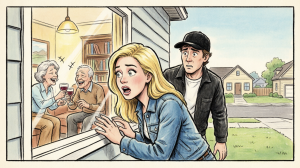
My Parents Texted: “Party’s Canceled, Don’t Come.” I Was Already At The Door. They Were Toasting: “So Much Better Without Her.” I Raised My Hand To Knock… Then A Voice Behind Me Whispered: “Don’t. Wait. You’ll Want To See What Happens Next.”
Part 1
The text came in at 8:14 on a gray December morning while I was standing in my kitchen with melted butter on my fingers and a sheet pan of candied pecans cooling by the window.
From Mom: Christmas party is canceled. Don’t come. Money’s tight and your father isn’t up for company. We’ll do something small after New Year’s.
I read it twice. Then I looked at the six wrapped boxes lined up on my counter, the bottle of pinot I’d tied with velvet ribbon, the ridiculous hand-painted ornament I’d bought because my sister Dana once said my taste ran “aggressively tasteful” and I wanted to make her laugh. There was cinnamon in the air, and brown sugar, and the faint static hiss of the old radio I always kept on for company. Outside, the neighborhood looked rubbed pale by cold. A man across the street was dragging a blow-up Santa upright after the wind had folded it in half overnight.
My mother did not cancel Christmas anything.
She hosted like it was a competitive sport. There were always too many candles, too much food, too many little silver bowls of spiced nuts set out like she expected a magazine photographer. If money was tight, she’d cut back on shrimp or switch to cheaper wine. She would not cancel. And if my father was sick, she would have texted me six dramatic updates before breakfast, each one more detailed than the last.
I stood there long enough for the butter on my knuckles to go tacky, then I typed back: Understood.
That should have been the end of it. Instead, I wrapped the gifts anyway.
Maybe because habit is stronger than pride. Maybe because I’d spent thirty-two years learning that if my family shifted the ground under me, I was supposed to adjust my footing and smile. Maybe because part of me still believed there had to be an explanation that would make the whole thing less ugly.
By four-thirty, it was dark. The sky had that bruised winter look, purple at the edges. I loaded the gifts into the passenger seat of my SUV and told myself I was just dropping them off. No knocking. No scene. I’d leave everything on the porch, maybe text from the car, and drive home before the fudge in the back seat picked up the smell of the pine-scented trash bags rolling around near the hatch.
Theo called while I was at a red light near the highway exit.
“You still going?” he asked.
His voice was calm in the way it always was, but I knew him well enough to hear the thought underneath it. Theo never liked my mother’s vague texts. He said vague people treated confusion like a tool.
“Just dropping things off,” I said. “Five minutes.”
A beat. “Call me if something feels off.”
I laughed once, a small dry sound. “Something already feels off.”
“I know,” he said. “That’s why I’m saying it.”
The house I grew up in sat at the end of a cul-de-sac lined with bare maples and those expensive mailbox posts people buy when they want a street to look established faster than it actually is. When I turned onto my parents’ road, my chest tightened before my mind had fully caught up. Cars were already there. Not a full driveway, but enough. My uncle’s dark Lexus. Dana’s white Audi with the dent in the rear bumper she kept promising to fix. My cousin Brent’s pickup crooked near the curb like he had parked in a hurry.
The house itself glowed.
Every downstairs window was lit. Warm yellow squares on the lawn. The front room chandelier was on, and the tree in the bay window threw off that soft, expensive kind of sparkle that comes from glass ornaments, not plastic ones. Even through the windshield I could hear music when I cut the engine. Nat King Cole, low and smooth, the kind of soundtrack my mother preferred when she wanted a night to feel important.
I sat there for three full seconds, my hands still on the steering wheel.
Then I got out.
The cold hit the back of my throat. I could smell wood smoke from somewhere nearby and rosemary from the wreath hanging on the front door. Under my boots, the stone path held a sheen of damp that made it glint under the porch light. I picked up the gift bags, balancing the wine under one arm, and went up the steps as quietly as I could, though I wasn’t exactly sure why I was trying to be quiet. The front door was cracked open a finger’s width. Enough to let laughter slip through.
Dana’s laugh came first—high, bright, always half a note too loud when she was pleased with herself.
Then my mother’s voice, warm in that public way she did so well. “I’m telling you, this was the only way to manage it.”
Someone clinked a glass.
My uncle said something I couldn’t make out, and then Dana answered, “Honestly? It’s better without Miriam here. She notices everything.”
I stopped moving.
There are moments when your body understands before your pride does. My fingers went numb around the ribbon handles. My mouth tasted metallic, like I’d put a coin on my tongue.
My mother laughed softly. “Well, yes. And we needed one evening without questions.”
“By Monday it won’t matter anyway,” Dana said. “Once the wire clears, the pressure’s off.”
I don’t remember deciding to move closer. I only know I was suddenly near enough to see the edge of the foyer through the gap: candlelight on the mirror, my mother in a green silk blouse, Dana in cream cashmere holding a coupe glass by the stem like she’d been born doing it. My father stood with his back half turned, carving board on the entry table behind him because he never could keep appetizers in the kitchen where they belonged. The smell of glazed ham drifted out, sweet and clove-heavy, so normal it made something inside me lurch.
Questions stacked up so fast in my head they jammed each other. What wire? Why lie? Why tell everyone else to come? Why was my father “not up for company” while he was apparently passing crab puffs to half the county?
I reached for the door.
A hand closed around my elbow from behind, firm enough to stop me without hurting.
I spun so fast the wine bottle nearly slipped. Theo stood in the porch shadows, coat collar turned up against the cold, breath fogging white between us. He must have come up the side path because I hadn’t heard him at all.
“What are you doing here?” I whispered.
“I followed you.”
“Why?”
“Because I had a bad feeling,” he said, and there was none of his usual teasing in it. “And because I found something this afternoon that I needed to show you before you walked into that house.”
Inside, Dana laughed again. My mother said, “Just keep her calm until after the holidays.”
Theo gently took the gift bags from my hands and set them down beside the porch swing. Then he looked at me with that steady, almost painfully controlled expression he wore in real emergencies—the expression I had seen once in an ICU waiting room and once in a deposition where a man lied badly and ruined his own life in under six minutes.
“Not here,” he said quietly. “Come with me.”
I should have yanked the door open anyway. Part of me wanted to. Part of me wanted to step into that bright room with my hair full of cold air and say surprise, I got your text. But the part of me that had built two clinics from a borrowed office and a secondhand exam table knew the difference between fury and leverage. Fury feels better for five seconds. Leverage lasts.
Theo led me back down the walk to his car, parked under the dead branches of the maple across the street. The heater was already running. The windshield ticked softly as it defrosted. He opened a leather folder on the center console and slid one printed page toward me.
At the top was an invoice from a vendor I had never heard of: Meadowfield Biomedical Supply.
At the bottom was my father’s signature.
And in the middle, in a neat little line of numbers that made my stomach drop clear to the floor mat, was the exact amount of Dana’s overdue condo payment from last month.
I looked up at Theo, my pulse roaring in my ears.
He drew in one slow breath and said, “Miriam, I think your parents have been taking money from your clinics.”
Part 2
For a few seconds, I honestly thought he was wrong.
Not because the paper in my hand made sense—it didn’t. Not because my father’s signature looked forged—it didn’t. It looked exactly like his, that square impatient G and the long flat tail on the d like he was underlining his own importance. I thought Theo was wrong because the alternative required me to rearrange half my life in one motion, and the mind will stall for time when the truth is expensive.
“No,” I said automatically. “No, there has to be—”
“A bookkeeping explanation?” Theo finished, not unkindly.
The heater pushed out air that smelled faintly dusty, like the first hot breath from an old radiator. Across the street, through my parents’ front windows, I could see movement and gold light and the ghostly blink of the tree. I pictured my mother passing plates, my father telling one of his stories about the clinic, Dana tilting her face toward a compliment like a flower toward sun. I had spent years teaching myself not to be surprised by the ways they used me. But this was a different category. This had numbers. This had intent.
Theo flipped to the next page. Then the next.
Meadowfield Biomedical. Crestline Facility Services. Hollow Creek Imaging Logistics.
All of them billed in small enough amounts to slip past a casual glance. Six thousand here. Forty-two hundred there. Nine thousand split over two dates. Nothing so outrageous it would trip an obvious alarm. But there were dozens of them. Maybe more. And I knew my own business well enough to feel how wrong the names were. We didn’t lease imaging units from outside vendors. We didn’t outsource sterilization. We didn’t even use half the equipment listed on one of the invoices. The language was just plausible enough to sound boring, and boring is where theft likes to hide.
“When did you find this?” I asked.
“I started noticing irregularities three weeks ago,” he said. “You asked me to look over the year-end compliance packet before it went to the board. The revenue dip didn’t match patient volume. Claims were steady. Payroll was normal. Supply costs were inflated in very specific places.”
“Why didn’t you tell me?”
“I wanted to be sure before I blew up your Christmas.”
I let out a laugh that came out closer to a choke. “That ship feels sailed.”
Theo’s hand rested on the folder, long fingers, wedding band catching the dash light. He worked in healthcare compliance law, which meant he had a professional allergy to sloppy records and a personal dislike of people who used complexity as camouflage. When he said he had found something, he didn’t mean a hunch. He meant structure.
“You let your parents handle day-to-day operations eighteen months ago,” he said. “That’s when the pattern starts.”
I stared at the pages. Eighteen months. That tracked. I had been opening our second location then, spending four days a week in zoning meetings, lender calls, fundraising dinners, staff recruiting, the thousand stupidly exhausting details that sit between an idea and a building with your name on the lease. My father had offered to help with vendor oversight because he said I looked tired. My mother had offered to manage vendor relations and community outreach because, in her words, ‘It’s family, Miri. Let us finally do something for you.’
I had cried when they said it.
That memory sat in my chest now like a shard of glass.
“Could it be Dad covering something?” I asked. “Taxes? A settlement? Some issue he was embarrassed about?”
“It could be several things,” Theo said. He chose his words carefully, which made me more afraid, not less. “But you need to know this too.”
He took out his phone, unlocked it, and turned the screen toward me. A county records page. A P.O. box registration. The listed contact person was S. Vale.
Sandra Vale had been my mother’s maiden name.
The inside of my mouth went dry.
“No,” I said again, softer now.
Theo nodded once, like he had expected that exact tone. “I know.”
I looked back toward the house. My mother passed the window with a platter of something golden and steaming. She was smiling at whoever was in the room with her. She looked happy. Not stressed. Not broke. Not like a woman who had just canceled Christmas because money was tight.
And then, because once the mind opens one door it starts kicking the others in too, I thought of Dana.
Dana was thirty-five and beautiful in the high-maintenance, camera-aware way some women make look effortless and some women wear like armor. She had also been drowning financially for two straight years. First the boutique she swore would “curate elevated basics” ate through a small-business loan, then her divorce turned ugly, then the condo, then the cards, then the lawsuit from a supplier she claimed was fake until the court papers showed up at my office by mistake.
She never ran out of crises. She only ran out of people.
Theo must have seen it hit my face because he said, “I don’t know where the money ended up yet.”
But he said yet.
I closed the folder and opened it again. My hands needed something to do. “Show me everything.”
He did.
We sat there for forty minutes with the engine idling. He walked me through payment logs, vendor approvals, authorization chains. My father had approved nearly all the suspect invoices. My mother had handled communication on half of them. A couple had been processed under my own admin credentials, which made my stomach turn in a whole new direction. Theo explained how saved permissions could be abused, how old passwords linger, how people trust the familiar shape of their own system until it becomes the easiest place to be robbed.
Every now and then laughter burst from the house. Every now and then a car door slammed. My life, apparently, had split into two rooms: the warm one where my family toasted themselves, and the cold one where my husband showed me the scaffolding inside their lie.
“What do we do?” I asked when there were no more pages left to flip.
“For tonight?” he said. “Nothing visible.”
“My whole family is in there.”
“I know.”
“They lied to keep me out.”
“I know.”
“And they’re talking about some wire clearing on Monday.”
He looked at me then, not as my husband, not even as a lawyer, but as the one person in the world who had no use for any version of me except the real one. “You can walk in there and let them spend the night making you look hysterical,” he said. “Or you can give me twenty-four hours and let me help you know exactly what they did.”
The cold had worked its way through my coat. My toes were numb. My cheeks burned. Across the windshield, my childhood house shimmered in the dark as if warmth itself had chosen a side.
“Twenty-four hours,” I said.
Theo nodded. “Good.”
When I reached for the folder again, one loose page slid out and landed face-up across my knee. It was a login record from the clinic management system. Date, time, IP address, user authorization. I almost missed the line that mattered because I was still looking at vendor codes.
Then I saw the username at the top.
miriam.holt_admin
Mine.
And beside it, in a note field added by our IT consultant after a system update six months earlier, were four words that made the hair lift at the back of my neck.
Password reset by request.
I never requested it.
Part 3
The next morning smelled like burnt coffee, printer toner, and panic.
Theo had converted our dining room into a temporary war room before sunrise. My laptop sat open at one end of the table beside his legal pad. My clinic tablet was charging against the wall. He had printed spreadsheets in neat stacks and clipped them with color-coded tabs because he understood, better than anyone, that when my emotions got messy, clean paper helped. Outside, sleet tapped at the windows with that soft, persistent sound that makes the whole world feel like it’s being sanded down.
I barely tasted breakfast. Renata came over at seven carrying a cardboard tray of coffees and a bag of sesame bagels, her dark curls damp from the weather and her expression already sharpened into business. She had been my best friend since nursing school and my operations director since the year I opened Cedar Ridge Women’s Health in a converted dental office with peeling wallpaper and one exam room that smelled faintly like old cloves no matter what we did to it. If I trusted anyone besides Theo with the inside of my work life, it was her.
I opened the door, and she took one look at my face and said, “How bad?”
Theo answered for me. “Potential embezzlement. We’re confirming scope.”
Renata set the coffees down slowly. “By who?”
I didn’t say my parents right away. I watched her understand it from my silence.
“Oh,” she said. Then, quieter, “Oh, honey.”
That was all. No pity voice. No overreaction. Just enough softness to remind me I was not crazy and not alone.
By eight, we had pulled every payment record from the last twenty-two months. Theo cross-referenced vendor approvals against shipping logs and service schedules. Renata checked inventory movement and facility maintenance requests. I handled the part that felt most obscene: combing through my own permissions history to see how often my name had been used as a key.
The answer was often.
Not daily. Not enough to be obvious. Just enough to bridge a gap here, approve an exception there, make a transfer look routine. Whoever had done it understood the rhythm of the business well enough to hide theft inside normal motion. That hurt almost as much as the theft itself. It meant attention. Planning. The kind of patience people only use when they feel entitled.
Around ten, I drove to Cedar Ridge because I needed to see the place with my own eyes. I told Theo I was just checking on a vaccine delivery. He didn’t believe me, but he let me go with instructions to call if my father was there.
The clinic lobby smelled like peppermint hand soap and the citrus cleaner our evening crew used on the counters. The Christmas tree by reception was lopsided because one of the medical assistants had let her toddler decorate the bottom third with felt gingerbread men and paper snowflakes with glitter coming loose at the folds. A patient in a camel coat flipped through a magazine under the muted TV. Someone laughed down the hall. Everything looked normal, which made the wrongness underneath it feel even more grotesque.
My father’s office door was open.
He sat behind the desk I’d bought from an estate sale, reading glasses low on his nose, one hand around a ceramic mug from the hospital auxiliary gift shop. He looked up and smiled, quick and easy.
“There she is,” he said. “Thought you were taking the week light.”
I stood in the doorway and took him in. The tie. The polished shoes. The expensive pen he liked to leave uncapped until it stained everything. My father always looked most like himself in rooms that belonged to me.
“Needed to check the inventory discrepancy on the prenatal supplements,” I said.
He made a face like bureaucracy bored him. “Your mother said you were upset about the party.”
“She said you weren’t feeling well.”
He waved a hand. “Just tired. Better not to make a fuss.”
There it was. A lie delivered without heat, as if the facts themselves were a little embarrassing for not keeping up with him.
I wanted to step forward and ask him if he could smell the cleaner, if he could hear the printer in the back office, if he understood what it meant to steal from a place where women came in scared and left feeling steadier. I wanted to ask whether he’d always planned to take from me or whether the first time had been accidental and greed had just liked the way it felt. Instead, I said, “Did IT reset my admin password in June?”
His eyes flicked once, fast, toward the desktop monitor.
Maybe nobody else would have noticed. I noticed.
“System update,” he said. “We all had access issues for a week.”
“That’s not what I asked.”
He smiled again, thinner this time. “Miriam, I’m in the middle of payroll. Is there something you actually need?”
I looked at his hands. My father had nice hands for a liar—trim nails, careful knuckles, a wedding band he polished more often than he admitted. On the desk beside him sat a stack of vendor files. The one on top had a green tab. Crestline.
My pulse kicked once, hard.
“I’ll circle back,” I said.
On my way out, I stopped in the back office and asked Sheila, our part-time bookkeeper, whether she remembered the June reset. Sheila frowned over her bifocals, one hand still on the adding machine tape.
“That week Mr. Holt asked me for blank vendor templates?” she said. “I remember it because he swore the formatting was wrong and then the IT fellow came in twice.”
“Blank vendor templates?”
“So he could draft cleaner versions for the board packet, he said.”
I smiled like it meant nothing. My skin felt cold from the inside.
Back at home, the pieces clicked faster. Theo dug up the IT ticket. There had been no global reset. Only one admin credential had been changed: mine. Submitted by phone. Approved manually because the caller answered security questions correctly.
Who knew those answers?
Anyone in my family.
By noon, Renata had mapped service dates against suspect invoices. Meadowfield billed us for exam light replacements on a wing that hadn’t been renovated yet. Crestline charged monthly maintenance on an ultrasound unit we sold the year before. Hollow Creek Imaging invoiced us for transport services between facilities that shared a parking lot.
“Whoever created these knows enough to sound legit to non-medical people,” she said, tapping one line with a capped pen. “But not enough to fool staff.”
“Because staff wasn’t meant to see the pattern,” Theo said. “Only the summary.”
He printed bank routing records obtained through our accounting portal. The transfers stepped through three small business accounts before landing in something called Riverside Recovery Trust.
The beneficiary name on the final account was blurred in the initial export.
Theo widened the image.
Dana Mercer.
Not Dana Holt—she’d kept her married name after the divorce because, as she once explained over martinis I paid for, it sounded “like someone with generational money.”
A buzzing started behind my eyes. I had expected to feel rage when proof arrived. What I felt first was something thinner and more humiliating: recognition. Of course it was Dana. Of course there was a rescue operation. Of course my parents had wrapped theft in family and called it love.
Then Renata found the spreadsheet.
It was tucked inside a misnamed archive folder, a clumsy mistake in an otherwise careful setup. holiday_menu_final.xlsx
When she opened it, there were no recipes inside. Just columns. Dates. Debts. Minimums. Shortfalls. A note field beside each line.
Condo association
AmEx settlement
Attorney retainer
Holiday rescue
And on the last row, highlighted in pale red like it had mattered most, six words from my mother in a cell comment attached to the payment schedule:
Need this covered before Christmas dinner.
I stared at the screen until the letters blurred.
Last night, while I stood on the porch holding gifts, they had been celebrating because the rescue was nearly complete.
And I had paid for the champagne.
Part 4
Three hours after we found the spreadsheet, my mother called as if nothing at all had happened.
I was in the laundry room folding towels I had no intention of using just because I needed something square and simple in my hands. The washer hummed. Somewhere in the house, Theo was on speaker with one of his associates, using his clipped work voice. Rain had replaced sleet, and the downspout outside knocked every time the gutter overflowed.
I looked at my mother’s name on the screen until it almost rang out. Then I answered.
“Miri,” she said, smooth as cream. “Your father and I need to discuss a business matter with you. Nothing dramatic. We thought perhaps lunch tomorrow at Bellamy’s?”
Bellamy’s was the kind of restaurant people chose when they wanted discretion upholstered in leather. Dark wood, good bourbon, waiters who could pretend not to hear a nervous breakdown two tables over if it came with a decent tip.
“Tomorrow?” I asked.
“If possible. We really should align before year-end.”
Align.
My mother loved corporate words when she wanted to sound above reproach.
“Sure,” I said. “What business matter?”
“Oh, better in person,” she said. Then, after the tiniest pause, “And perhaps dress nicely. We may stop by the hotel after.”
“The hotel?”
“For the foundation dinner planning. You’ve been so busy, sweetheart. Someone has to keep the holiday wheels turning.”
I said yes, because saying no would have wasted an opportunity.
Bellamy’s smelled like leather booths, onion soup, and expensive cologne trying too hard not to be noticed. I arrived early and chose a corner table where I could see both the entrance and the mirrored wall behind the bar. Theo wanted to sit nearby. I told him absolutely not, then compromised by letting him and Renata take the coffee shop across the street where I could call if things went sideways.
At twelve-oh-six, my parents came in together.
My father’s overcoat looked new. Camel hair, tailored shoulders, one of those quiet status pieces he never bought unless he wanted to be read a certain way. My mother wore winter white and red lipstick and the pearl earrings my grandmother Evelyn had left her, though Mom always claimed they were “too sentimental” for daily use. I noticed these things because I always noticed these things. Dana’s line from the porch came back to me—It’s better without Miriam here. She notices everything—and I almost laughed at how much they hated the one trait that kept their lies from settling comfortably.
My mother kissed my cheek. My father squeezed my shoulder. Both of them smelled like polished cold air and hotel-lobby perfume.
We ordered coffee. No one touched the menus.
My father got right to it. “There’s an opportunity we think you’re in a position to move on before the new year.”
I folded my napkin into quarters. “What kind of opportunity?”
“A private healthcare investment group,” he said. “Early-stage outpatient acquisition strategy. There’s a chance to reposition some funds from Cedar Ridge and Lakeview through a holding company before Q1. It protects the clinics, gives us agility, and frankly, opens a lane for family wealth we’ve been stupid not to take.”
Family wealth.
He said it like we’d been building it together all along, not like I’d spent a decade working twelve-hour days while he dropped in for ribbon cuttings and mothered the donors whenever it suited him.
“Who’s us?” I asked.
My mother smiled. “Darling.”
No answer. Just that one word and the smile. My childhood in miniature.
I let the silence stretch.
My father took a folded paper from inside his jacket and slid it across the table. It wasn’t a contract. It was a handwritten number. Clean, precise, not especially round. The exact kind of figure people use when they want a demand to feel calculated rather than greedy.
I recognized it immediately from the spreadsheet.
Dana’s largest outstanding debt.
I looked at the paper, then at him. “What am I looking at?”
“A short-term family need,” my mother said. “And a way to stabilize things before the year closes.”
“There it is,” I said before I could stop myself.
My father’s jaw shifted. “There what is?”
“The truth peeking through the strategy language.”
My mother’s smile cooled by two degrees. “Miriam, there is no need to be dramatic.”
I thought of the forged password reset. The vendor templates. The comment in the spreadsheet. I kept my voice level because anger is a gift to people who want you discredited.
“Tell me about Meadowfield Biomedical,” I said.
My father blinked once.
“Excuse me?” my mother said.
“Or Crestline Facility Services.” I took a sip of coffee. It had gone bitter already. “Actually, tell me why Cedar Ridge has been paying monthly maintenance on an ultrasound unit we sold in May of last year.”
For a second, all three of us sat inside the same silence, but only I knew what it contained.
My father recovered first. “You’re reading documents without context.”
“Great,” I said. “Give me context.”
“There are contract structures you don’t understand,” he said.
I almost smiled. “I own the clinics.”
“And we have been keeping them running while you play visionary,” my mother cut in, sharp now. “You would do well to remember that before you start throwing accusations around like an adolescent.”
There she was.
Not the gracious hostess. Not the wounded parent. The real Sandra Vale Holt—elegant, efficient, and mean in ways that left no fingerprints.
“So there’s no holding company?” I asked.
“There is,” my father said. “And if you were wise, you would let me finish.”
“For what? So I can sign something before year-end?”
Neither of them answered.
The waiter appeared with soup for a nearby table, and the smell of thyme and stock drifted between us. My mother smoothed her napkin. My father stared at me like he could will me back into the version of myself they preferred—useful, grateful, manageable.
Then my sister arrived.
She swept in fifteen minutes late wearing a cream coat with a fur collar I knew she couldn’t afford and sunglasses she left on until she reached the table, because Dana never met a room she didn’t think deserved an entrance. She looked from my face to our parents’ and instantly understood the air.
“Oh,” she said lightly, sliding into the booth beside my mother. “Are we doing this now?”
That one sentence did more for clarity than any spreadsheet.
“You knew,” I said.
Dana gave a small shrug. “About the restructuring? Obviously.”
“No,” I said. “About the theft.”
Her expression changed—not to guilt, exactly, but to irritation that the script had moved ahead without her approval. “That’s not what this is.”
“Then what is it?”
“Family handling family.”
I stared at her. The little gold cross at her throat. The fresh manicure. The expensive coat. The tiny dry crack near the corner of her mouth where she’d probably been chewing her lip at night from stress. For one flicker of a second, I almost pitied her. Then I remembered the porch.
It’s better without Miriam here.
I pushed my chair back.
“Miriam,” my mother snapped.
I stood. “No. You don’t get to do this from across a lunch table and call it sophistication.”
My father lowered his voice, the way men do when they want anger to masquerade as control. “Sit down.”
“No.”
“You are making a mistake.”
“Maybe,” I said. “But at least it’ll be mine.”
I picked up my coat. My heartbeat felt like a fist in my throat. The whole restaurant looked absurdly polished, every glass catching light, every fork aligned, every conversation around us continuing as if the center of my life weren’t cracking open three feet from the bread basket.
By the time I reached the door, my phone was already vibrating.
Mom.
I let it ring once, twice, then answered from the sidewalk where the cold slapped some steadiness back into me.
Her voice had changed completely. Sweet again. Honey over blade.
“You’ve always been emotional before holidays,” she said. “Let’s not ruin a beautiful season over misunderstandings. Wear silver to the foundation dinner on Friday. Invite us properly, and your father will stand beside you when you make the announcement.”
I stared at traffic crawling through wet December light. “What announcement?”
“The check, darling,” she said. “If we’re doing this, we should at least do it with dignity.”
Then she hung up.
I stood there under the awning with rain needling the street and one thought rising hard and clean through all the others.
They weren’t scared.
They thought I was still the daughter they could move with tone.
And that meant Friday was going to teach them otherwise……