Part 8
The Ohio case ended faster than Melinda expected.
Because performance doesn’t survive documentation.
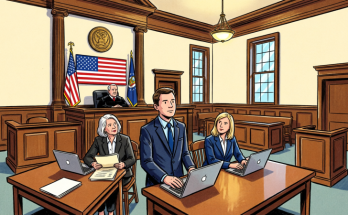
The prosecutor introduced my medical records, the wound pattern analysis, and my deposition. They introduced the federal hallway video as character evidence of her pattern of fabrication. They introduced the knife package, traced through prison mail channels to an associate who admitted Melinda instructed him, believing intimidation would scare me into silence.
The jury didn’t need to know me personally.
They just needed to understand a simple pattern:
Melinda harmed, then cried.
My parents believed the crying.
The system believed the parents.
Until evidence broke the spell.
Melinda was convicted.
When the judge sentenced her, he didn’t use poetic language. He used legal language. Years, not adjectives.
But the effect was the same.
The story she’d controlled for so long became something she couldn’t edit.
After the verdict, I expected to feel lighter.
Instead I felt tired.
Justice isn’t a magic wand. It’s a door that finally opens, and then you still have to walk through and build a life on the other side.
I went back to New York and returned to work.
The first day back, I sat at my desk and stared at the spreadsheet on my screen until my vision blurred. Then I blinked, forced my hands to move, and began again.
Not because work was distraction.
Because work was mine.
For a long time, my family had owned my narrative.
They’d convinced teachers I was dramatic, neighbors I was unstable, police I was violent. They’d written my life like I was an inconvenience.
Now I wrote it back, one day at a time.
I moved apartments again, not because I was running, but because I wanted a place untouched by their footsteps. I chose a building with a quieter hallway, better camera coverage, and a doorman who didn’t panic under pressure.
Henry gave me a small wave the day I moved out.
“I’m glad you’re okay,” he said.
“I am,” I replied, and meant it.
A year later, I hosted a dinner.
Not at my parents’ table.
At mine.
I invited people who had earned a place in my life: my lawyer, my therapist, my best friend, two coworkers who’d quietly covered my workload without gossip, and one neighbor who’d helped Henry call security when the hallway screamed.
We ate pasta and laughed in a way that wasn’t forced.
At one point, my best friend raised her glass. “To Catherine,” she said. “For making your life yours.”
I didn’t cry.
I smiled.
Because the dinner table wasn’t a place of power anymore.
It was just food and chosen family and a life not built on obedience.
Later that night, after everyone left, I stood at my window and watched the city lights glitter like a thousand separate stories.
I thought about sixteen-year-old me running with a backpack, shoulder burning, convinced no one would ever believe her.
I thought about twenty-four-year-old me on the floor of my own foyer, cuffs biting, hearing my father’s lies echo off the hallway walls.
And I thought about now—standing upright, unafraid of my own front door.
My phone buzzed.
A notification from my bank.
Ten dollars received.
My breath caught, body reacting before my brain could catch up.
Then I looked closer.
It wasn’t Melinda.
It was a coworker paying me back for lunch, the memo reading: Thanks for dinner.
I let out a shaky laugh, relief washing through me.
Trauma is like that. It makes harmless things feel like threats until time and truth retrain your nervous system.
I turned off the light, locked the deadbolt, and went to bed.
Not because I was hiding behind locks.
Because I could choose safety without shame.
That was the ending.
Not a reunion. Not forgiveness. Not a dramatic apology from people who never deserved the power to name me.
A conviction. A record corrected. A scapegoat set free.
A woman who ran away at sixteen and came back to herself—older, scarred, and finally untouchable by anyone who needed her to be small in order to feel big.
Part 9
Two months after the convictions, the city stopped feeling like a battlefield and started feeling like a place I lived in again.
Not because I forgot.
Because routine is a kind of re-training. You walk to the subway. You swipe your badge at work. You argue with a barista about oat milk. You file reports. You answer emails. And slowly, your body learns that not every day ends with sirens.
Then the charity’s attorney called.
Her name was Elena Martinez, and she spoke with the kind of professional calm that comes from spending years untangling other people’s greed. “Ms. Vance,” she said, “we’re moving forward with restitution.”
I stared out my office window at a delivery truck squeezing into traffic. “Okay,” I said. “What do you need?”
“You’re listed in several documents as a potential facilitator,” she replied. “Not legally. Publicly. Jared and Susan told anyone who’d listen that you were involved, and some of our donors believe it.”
My stomach tightened. Even after court, even after video, even after handcuffs—lies had inertia.
Elena continued, “We need you to provide a statement for the board and a brief affidavit for our donors. Something clean. Something that explains the attempted coercion.”
I took a breath. “Send me the outline,” I said. “I’ll do it.”
After we hung up, I sat very still and realized what was happening.
This was the part nobody warns you about after you escape a family like mine.
They don’t just harm you privately.
They pollute your reputation like it’s a neighborhood they want to ruin so you can’t rebuild there.
So I wrote the affidavit.
It wasn’t emotional. It wasn’t dramatic. It was crisp, factual, and devastating. Dates. Times. The demand. The threat. The staged incident. The federal indictment. The conviction.
And at the end, one sentence that felt like reclaiming air:
I did not assist in any concealment. I reported and documented the attempted coercion immediately.
Elena sent it to the board.
Two days later, the charity’s director called me directly.
A man named Reverend Hill, voice trembling. “Catherine,” he said, and hearing my chosen name in a stranger’s mouth felt like a small correction in the universe. “I owe you an apology.”
“For what?” I asked, wary.
“For believing them at first,” he admitted. “For letting Jared and Susan paint you as the villain. We were embarrassed. We wanted it to be someone else’s fault.”
I felt something cold and sharp in my chest. “I understand,” I said.
And I did, in a way that made me angry for humanity. People always want the story to be simpler than reality. They want the scapegoat because the scapegoat makes evil feel containable.
Reverend Hill swallowed. “We’re holding a donor meeting. I don’t want you to attend unless you want to, but… I want them to hear your name correctly.”
I closed my eyes. I could feel sixteen-year-old me, bleeding and unheard, hovering behind my ribs.
“Tell them,” I said quietly. “Tell them my name is Catherine. And tell them I did the opposite of what Jared asked. I stopped it.”
“I will,” he promised.
When the restitution hearing came, I attended anyway. Not because I wanted to watch my family lose money, but because I wanted the damage documented in the place it mattered: official record.
In federal court, Jared sat at the defense table in an orange jumpsuit, looking smaller than he ever had in my childhood. Susan sat beside him, hair flatter, eyes red, face angled toward the floor like shame might hide her.
Melinda wasn’t there. She was in Ohio custody now.
The judge listened to the charity’s accounting, to the auditors, to the clean numbers showing the missing funds, the failed cover attempt, and the cost of rebuilding donor trust.
Then the judge asked if any victims wished to speak.
My lawyer leaned toward me. “You don’t have to,” he whispered.
I stood anyway.
Not shaking. Not smiling.
I walked to the podium and looked at the judge, then at the courtroom, then finally at Jared and Susan.
Jared’s eyes lifted, sharp with resentment. Susan’s eyes lifted too, wet and pleading.
I didn’t look at Susan long. Pleading was her favorite costume.
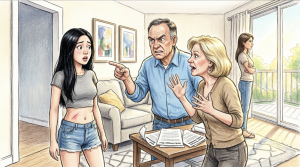
“My name is Catherine Vance,” I said. “And eight years ago, I ran away at sixteen because my sister stabbed me and my parents blamed me.”
A murmur moved through the courtroom—small, surprised. The charity donors had expected to hear about money. Not blood.
I continued. “This year, they found me because they needed me to commit fraud. When I refused, they staged an assault and called the police before they even entered my home. They tried to make my career and my freedom collateral damage.”
My voice stayed level. Not for the judge.
For me.
“I’m not asking for vengeance,” I said. “I’m asking for a record that reflects the truth, because my entire life has been shaped by lies that were believed because they were delivered by parents.”
I paused, then added the sentence that felt like a door locking.
“Today, I’m asking the court to recognize that they didn’t just steal money. They tried to steal my reality again. And I’m asking you to make sure they can’t.”
The judge thanked me.
I stepped back, hands steady, and sat down.
Jared didn’t look at me again.
Susan did. Her mouth trembled, and for a second, I thought she might finally understand the real cost of what she’d done.
Then she turned away.
And I understood something important:
It didn’t matter if she understood.
It mattered that she couldn’t rewrite it anymore.
The judge ordered restitution, asset seizure, and extended supervised release conditions. The charity would recover a portion. Not all. But enough to survive. Enough to keep serving the people it was built for.
Afterward, Elena found me in the hallway.
“You didn’t have to do that,” she said.
“I did,” I replied. “For me.”
She nodded. “You’re one of the clearest witnesses I’ve ever seen.”
I almost laughed. “I had to become clear,” I said. “They trained me to blur.”
That night, I sat on my balcony again, city lights shimmering below, and realized something new.
The legal story was ending.
But my own story was just beginning.
Because now I wasn’t reacting.
I was choosing.
Part 10
A year later, I bought a different kind of lock.
Not a deadbolt.
A front door.
It was a modest place—two bedrooms, lots of light, a small terrace with potted plants I kept alive out of stubbornness. I didn’t buy it because I needed more space. I bought it because I wanted proof I could plant something permanent without fear of it being ripped away by someone else’s narrative.
On moving day, my best friend Maya showed up with boxes and sarcasm.
“You sure you don’t want to invite your parents?” she asked, grinning like she wanted to see my reaction.
I rolled my eyes. “They can’t find me,” I said.
Maya raised an eyebrow. “Because you’re hiding?”
“No,” I replied, sealing a box with tape. “Because they’re not entitled.”
We unpacked into the evening. We argued about where the couch should go. We ordered pizza. We laughed. At some point, Maya stopped and looked around the living room—soft lamp light, framed photos of places I’d traveled for work, books on the shelves that were mine and not a performance of anyone else’s standards.
“This is you,” she said quietly.
I swallowed, throat tight. “Yeah,” I said. “It finally is.”
Work stabilized too.
My leave ended. My employer promoted me—quietly, without using my case as inspiration porn. They didn’t ask me to “share my story.” They simply rewarded my skill and my resilience with the same respect they’d give anyone else who’d earned it.
In the spring, my firm assigned me a case that made my stomach tighten the moment I read the summary.
A nonprofit with missing funds.
An employee blaming an “unstable relative.”
A narrative built on character assassination.
I stared at the file for a long time, feeling my pulse climb.
Then I walked into my manager’s office and said, “I want this case.”
Tessa studied my face. “Because you’re triggered?”
“Because I’m qualified,” I replied. “And because I recognize the pattern.”
Tessa nodded once. “Okay,” she said. “But you tell me if it gets heavy.”
I didn’t say thank you.
I just did the work.
And when I found the hidden transfers, the falsified invoices, the message threads coaching a lie the same way Jared coached bruises, I didn’t feel rage.
I felt satisfaction.
Not in punishment.
In clarity.
Because the numbers balanced.
Because evidence held.
Because someone else wouldn’t have to spend eight years doubting their own memories.
That summer, I got a letter.
Not a call.
Not a jail message routed through attorneys.
A letter mailed from a halfway house in Ohio.
Susan’s handwriting.
My body reacted first—tight throat, hot face, the reflex to drop it like it might burn. But I didn’t. I carried it inside, set it on the table, and stared at it until it became just paper.
I opened it slowly.
Catherine,
I’ve rewritten this letter ten times because I keep wanting to defend myself. I keep wanting to explain. I’m trying to stop doing that. I’m in a program now. They call what I did “enabling.” I called it “keeping peace.” I know now it wasn’t peace. It was cowardice.
I stepped over you. I told myself you were dramatic so I wouldn’t have to feel like a monster. I chose Melinda because she was easier to manage. I chose Jared because he made decisions so I didn’t have to. I let you be the price for my comfort.
I don’t expect forgiveness. I don’t deserve it. I just want you to know I finally stopped lying to myself.
I’m sorry.
Susan
I read it twice.
Then a third time.
I didn’t cry. I didn’t feel relieved. I felt something quieter.
Confirmation.
Because accountability doesn’t always come with a hug and a reunion. Sometimes it arrives as an admission on paper, years too late to fix what it broke.
I didn’t reply.
Not because I wanted to punish her.
Because I didn’t owe her my emotional labor.
Instead, I folded the letter and put it in a drawer with the Ohio court documents.
Not as a treasure.
As a record.
In therapy, my therapist asked, “Do you want any relationship with her?”
I thought for a long time.
“No,” I said finally. “I want peace. And I want it clean.”
My therapist nodded. “That’s allowed,” she said.
That fall, I went back to Ohio one last time.
Not for court.
Not for confrontation.
For closure.
I parked near the old neighborhood and walked past the street where the house still stood, now sold, the bushes trimmed by someone who didn’t know the history soaked into the foundation.
I didn’t go to the door.
I didn’t need to.
I stood on the sidewalk and let the air fill my lungs, and I said quietly, “You don’t get to keep me.”
Then I turned and walked away.
On the flight back to New York, I stared out at the clouds and realized something that felt like a small, fierce victory:
I wasn’t running anymore.
I was leaving.
There’s a difference.
Running is fear.
Leaving is choice.
When I got home, I unlocked my door, stepped inside, and set my keys on the table. The apartment smelled faintly like the candle Maya insisted I buy because “you deserve soft things.”
I smiled to myself.
I cooked dinner.
I ate it alone without feeling lonely.
And later, when the city went quiet, I stood at my terrace and looked out at the lights, feeling my scar under my shirt—still there, still real, but no longer a leash.
The story they tried to write ended on a kitchen floor with blood and blame.
The story I wrote ended here:
With a front door that was mine.
A life that was mine.
A name that was mine.
And the freedom to never, ever cover for them again.
THE END!
Disclaimer: Our stories are inspired by real-life events but are carefully rewritten for entertainment. Any resemblance to actual people or situations is purely coincidental.