Ran Away At 16 After My Sister S.t.a.b.b.e.d Me But Parents Said It’s My Fault, Years Later They Want Me To Cover Up Her Crimes…
Part 1
“She’s unconscious. Let us up or she’ll die.”
My father’s voice cracked through the apartment intercom at exactly 7:00 a.m., pitched high with panic that didn’t belong to him. On the security monitor above my kitchen counter, I watched Jared Vance press his face close to my doorman’s camera like he was auditioning for the role of Terrified Father of the Year.
Beside him, my mother, Susan, sobbed into a handkerchief with the precision of a woman who’d perfected public grief. And my sister Melinda—my sweet, polished, sociopathic sister—stood slightly behind them, staring into the lens with eyes that looked too dry to be genuine.
It was a lie.
I wasn’t dying. I wasn’t unconscious. I was standing barefoot in my own kitchen on the forty-second floor, drinking espresso and watching the people who tried to destroy me eight years ago attempt the same stunt with better lighting.
My doorman, Henry, looked alarmed on his end of the feed. He leaned toward the intercom, voice muffled. “Ma’am, your family says—”
“My family,” I repeated under my breath, and my tongue wanted to spit the word out like it was bitter.
I set the espresso cup down carefully. My hands wanted to shake. I didn’t let them. The scar on my left shoulder—jagged, pale, and permanent—caught the morning light when I shifted. A souvenir from the last time Melinda held a knife and my parents decided it was my fault for bleeding.
Henry’s voice came through again. “Should I call an ambulance?”
“No,” I said. My voice was steady enough that it surprised even me. “Do not let them up.”
A pause.
Then Jared leaned closer to the camera, like he could bully the building itself. “Katie,” he barked, and hearing that name in his mouth made something cold settle behind my ribs. “Open the door. This is an emergency.”
He was right about one thing.
It was an emergency.
Just not the one he wanted Henry to believe.
I walked to the island and opened the drawer where I kept my phone. My thumb hovered over a contact I’d saved under one word: Vance.
Not Jared. Not Susan. Not Melinda.
Mr. Vance. My lawyer. Not related. Not a coincidence either—when you grow up with parents who rewrite reality, you learn to hire people who don’t.
I didn’t call him yet.
Not because I didn’t need him.
Because I wanted a record.
I stepped to the door and rested my palm on the deadbolt. For a second, I remembered another door. Another morning. Another sound of my own blood hitting tile.
But the memory didn’t get to drive.
I turned the lock.
The second the latch clicked, the door flew inward, slamming against the wall with a violence that made the framed skyline photo in my hallway rattle.
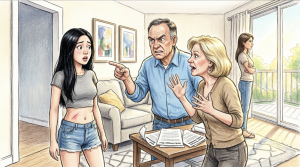
Jared stormed in first, face flushed not with concern but with the specific rage of a man who hates losing control. Susan followed, gripping Melinda’s arm like she was escorting a fragile princess. And Melinda—perfect hair, perfect coat, perfect victim face—walked in and immediately started scanning my apartment.
Her eyes darted to the espresso machine, the marble counters, the floor-to-ceiling windows.
Envy moved across her face like a shadow.
“You changed your number,” Jared spat, kicking the door shut behind him. “Do you have any idea how hard it was to find you?”
I leaned back against the marble island and crossed my arms to hide how badly my hands wanted to tremble.
“You found me,” I said. “Now tell me what you want and get out.”
“We don’t want anything,” Susan hissed, her voice trembling like a violin string pulled too tight. “We need you to do your job. For once in your selfish life, you’re going to be useful.”
She shoved Melinda forward.
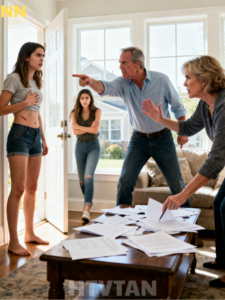
Melinda stumbled just enough to look innocent, then looked up at me with tears that arrived on command, glistening perfectly on her lashes.
“I made a mistake, Katie,” she whispered.
“A mistake is a parking ticket,” I said. “This feels bigger.”
Jared slammed his hand onto my counter. “She took a loan from the charity fund. One hundred eighty thousand.”
I didn’t blink.
“You mean she embezzled one hundred eighty thousand,” I corrected.
“It was a loan,” Jared roared. “She was going to pay it back, but the audit is Monday. We need you to fix the logs.”
There it was.
They didn’t come for money. They knew I didn’t have that kind of cash sitting around.
They came because they knew what I did.
I wasn’t just the girl who ran away at sixteen with a backpack and a bleeding shoulder. I was Catherine Vance, senior data analyst at a forensic auditing firm—someone who spent her days hunting people who tried to hide money in digital mazes.
They wanted me to use my credentials to access the charity system and bury the evidence.
“And if I say no?” I asked.
Melinda’s mouth curved into a tiny, terrifying smile. “Then Dad tells the police you hacked the system,” she said softly. “You have the skills. I have the password. Who do you think they’ll believe? The sweet volunteer or the estranged sister who hunts criminals for a living?”
My stomach tightened.
It wasn’t a desperate plea.
It was a frame job built like a trap: my skill set turned into my weapon.
I looked at them—my father who watched me bleed, my mother who stepped over me, my sister who held the knife.
Fear tried to climb my throat.
I forced it down.
“Fine,” I said, letting my voice crack just enough to convince them. “I’ll help.”
Jared’s shoulders loosened immediately, the narcissist relaxing when he thought he’d won.
“But I can’t do it from here,” I added. “The charity logs have anomaly detection. I need to create noise first. A transaction that confuses the algorithm.”
Jared nodded fast. “Do it now.”
I picked up my phone.
My fingers moved quickly—steady, practiced, clinical. I opened my banking app and selected a contact I’d never deleted: Melinda.
Amount: $10.
Memo: Federal wire fraud facilitation fee – transaction number one.
I hit send.
Melinda’s phone chimed. She glanced down, confused. “Ten dollars? What is this?”
I turned my phone so all three of them could see the screen.
“That,” I said, voice steadying into something colder, “is a digital paper trail.”
Jared frowned. “Katie—”
“I just sent money across state lines,” I continued, “connected to an admitted crime. By accepting it, you didn’t just steal locally. You engaged in wire fraud.”
Susan’s face went pale.
Melinda’s eyes widened.
Jared’s jaw twitched.
“And I didn’t fix the logs,” I added. “I just handed the FBI a receipt with your names attached.”
The room went silent in the way it goes silent when someone realizes they’ve walked into a room with an exit locked.
I pointed at the door. “Now get out of my house before I forward that screenshot to the district attorney.”
For a moment, I thought it worked.
I thought the threat of federal consequences had finally made Jared human.
He turned gray, grabbed Melinda by the arm, and yanked her toward the hallway. Susan stumbled after them, clutching her purse like it contained the last of her dignity.
“You’ll regret this,” Jared hissed over his shoulder, but it sounded hollow.
I followed them to the threshold, my hand hovering over the heavy brass deadbolt, desperate to slide it shut and seal my fortress again.
They stepped into the plush corridor.
I let out a breath I felt like I’d been holding for eight years.
It was over.
Then Melinda stopped.
She planted her feet three feet from my doorway and turned slowly.
The tears were gone.
The fear was gone.
Her face was a blank, terrifying slate.
She smiled.
Not happy. Not sad.
Predatory.
“You shouldn’t have sent that money, Katie,” she whispered.
Then she braced both hands on the metal doorframe and smashed her own face into it.
The sound was wet and sickening, like a branch snapping under a boot.
Blood exploded from her nose, spraying across the white hallway and spattering onto my shirt.
She did it again.
And then she threw her head back and screamed.
“Katie, stop! Please! Don’t kill me!”
It happened so fast my brain couldn’t process physics.
One second she was standing.
The next she was on the floor writhing in a pool of her own blood, clutching her face.
Jared and Susan didn’t freeze.
They didn’t gasp.
They moved with the precision of people following a rehearsed script.
“Help!” Susan shrieked, voice shattering the air. “She’s attacking her! Someone help! She’s killing my baby!”
Jared roared, pointing at me. “She has a weapon!”
My mouth opened.
Nothing came out.
The elevator doors slid open behind them.
Not for a neighbor.
For two uniformed NYPD officers, guns already drawn.
They didn’t ask questions.
They saw a bleeding girl screaming for her life and a woman standing over her.
“Show me your hands!” the lead officer bellowed.
“I didn’t touch her!” I shouted, hands flying up. “She did it to herself—check the—”
“Get on the ground now!”
He didn’t wait.
He rushed past my screaming mother and tackled me.
I hit the hardwood floor of my foyer hard enough to knock the wind out of me.
Cold steel cuffs snapped around my wrists.
Pain shot up my arms, radiating into the old scar on my shoulder.
Jared’s voice boomed above me, thick with fake panic. “I called you ten minutes ago! I told you she was unstable! Thank God you got here!”
Ten minutes ago.
The words hit me like a second tackle.
He’d called them before he entered my apartment.
This wasn’t reaction.
This was premeditation.
They hadn’t come for help.
They’d come to bury me.
Part 2
The holding cell smelled like bleach, stale sweat, and the metallic scent of despair. It was freezing—a deliberate institutional cold designed to make you shiver until you were ready to confess to anything just to get a blanket.
I sat on the metal bench, knees pulled to my chest, staring at the steel toilet in the corner.
The cuffs were gone, but the phantom weight still circled my wrists like a burn.
When the officer shoved me into the squad car, my head hit the doorframe, and the impact sent a jolt through my body that bypassed my brain and went straight into the oldest memory I owned.
I wasn’t twenty-four.
I was sixteen again.
Ohio.
Kitchen floor.
The memory didn’t come as pictures. It came as sensation.
The wet heat of my own blood soaking through my T-shirt. The sting in my shoulder. The vibration of the floorboards as my mother walked toward me.
For a split second, I’d thought she was coming to help.
I remembered reaching up with my good arm, fingers sticky and red.
But she didn’t kneel.
She stepped over me.
Stepped over her bleeding daughter to reach Melinda, who stood by the sink holding the carving knife, sobbing because she chipped her nail during the attack.
“It’s okay, baby,” Mom had cooed, turning her back on me. “We won’t let you get in trouble. Katie just upset you. It’s not your fault.”
That was the moment the invisible chain locked around my neck.
Learned helplessness is what therapists call it.
I called it the lesson: you are the problem. You are collateral. Silence is how you survive.
For an hour in that cell, I let the chain tighten again, fear flooding me so hard I almost vomited. I pictured my career evaporating, my reputation turning to ash, my life collapsing because I’d opened my own door.
Then I looked at my hands.
They were trembling, yes.
But they were manicured.
These weren’t the hands of a victim anymore. These were the hands of a woman who built models that tracked laundering through shell companies and cross-border transfers. Hands that made lies measurable.
My breathing slowed.
I forced air into my lungs until the shaking eased.
They thought they trapped me in their narrative again.
But this wasn’t their kitchen.
This was New York.
And in New York, evidence mattered more than tears—if you knew how to force it onto the record.
I stood.
The fear didn’t vanish.
I shoved it aside and replaced it with something colder.
Clarity.
I walked to the bars and rattled them until the guard looked up.
“I want my phone call,” I said.
He sneered. “You calling mommy?”
“No,” I replied. “I’m calling my lawyer. His name is Mr. Vance. And you’re going to want to let him in because he charges six hundred an hour and he hates waiting.”
The guard stared at me for a moment, finally registering that the crying woman they booked wasn’t the same one standing here now.
He reached for his keys.
The interrogation room was beige in a way that felt intentional—color designed to erase personality. A steel table bolted to the floor. A two-way mirror that hummed with silent judgment.
Detective Miller sat across from me, tired in a soul-deep way, like he’d heard every lie ever invented and was bored by all of them.
He tossed a file onto the table. It slid and stopped an inch from my fingers.
“Your parents gave a compelling statement, Miss Vance,” he said, leaning back. “According to them, you have a history of violent outbursts. They say you demanded one hundred eighty thousand to pay off illegal gambling debts. When your sister refused, you snapped and slammed her face into the doorframe.”
He paused, waiting for me to react.
I didn’t.
I looked at him like he was a spreadsheet with errors.
“Gambling debts,” I repeated. “That’s the narrative.”
“They have witness testimony,” he said. “Your sister has a broken nose. Motive. It’s clean.”
“It’s a script,” I corrected. “And a bad one.”
Miller’s eyebrows rose slightly.
I leaned forward. “Detective, I assume you pulled the 911 dispatch logs.”
“Of course,” he said, irritated.
“What time was the call placed?” I asked.
He checked his notes. “9:14 a.m. Your father reported an active assault.”
“And when did officers breach my floor?” I asked.
“9:17,” he said. “Patrol was nearby.”
I nodded once. “Did you pull my building’s access logs?”
Miller frowned. “Why?”
“Because Henry didn’t swipe anyone into the elevator until 9:15,” I said, and let the silence do the math. “Which means my father called 911 a full minute before anyone could physically reach my apartment.”
Miller’s posture shifted.
“That’s premeditation,” I said softly. “Not an emergency.”
Before he could respond, the door buzzed and opened.
Mr. Vance walked in.
Expensive suit. Older money. No eye contact with Miller at first—just the calm disgust of a man who didn’t like incompetent narratives.
He looked at me. Grim.
“Stop talking, Kate,” he said quietly. “We need a minute.”
Miller stood. “Take your time. We just executed the search warrant at her apartment.”
The door shut.
I stared at my lawyer. “Did you tell them about the server?” I asked.
Vance’s face didn’t soften. “Kate,” he said, voice low, “there is no video.”
My stomach dropped.
“The server was destroyed,” he continued. “Smashed with a fire extinguisher. Your father claims you did it to hide evidence.”
Cold flooded my limbs.
“It gets worse,” Vance said. “Melinda’s claiming your ten-dollar transfer was a test payment. Proof you were extorting her for the full amount.”
Three witnesses against me.
No video.
A perfect frame.
“They’re going to win,” I whispered.
Vance nodded once. “They’re offering a plea. Five years. If we go to trial without the footage, you’re looking at fifteen.”
Silence.
Then something clicked.
“The ten dollars,” I said.
Vance blinked. “What?”
“Open your laptop,” I ordered.
He hesitated just long enough to be human, then opened it and connected through his hotspot.
“Cloud backup,” he murmured, fingers moving fast. “Encrypted real-time sync… you set that up?”
“I don’t trust hardware,” I said. “I trust redundancy.”
The door buzzed again.
Detective Miller stepped back in, smug, plea agreement in hand.
“You ready to sign?” he asked.
Vance turned the laptop toward him.
“Sit down, Detective,” he said.
He hit play.
Part 3
The video was flawless.
Clear hallway view. Clear audio.
Jared and Susan dragging Melinda toward the elevator. Melinda stopping, turning, shedding the tears like a costume.
“You shouldn’t have sent that money, Katie,” she hissed.
Then the self-smash into the doorframe.
Once. Twice.
Jared’s voice, calm and instructive: “Harder. We need bruises.”
Susan’s voice, counting down like a stage manager: “Okay—scream now.”
Melinda’s high shriek.
“Katie, stop! Don’t kill me!”
Detective Miller’s face went pale in slow motion.
He whispered, almost to himself, “That’s a false report.”
“Conspiracy,” Vance said calmly.
I leaned forward, voice steady. “Pause at 9:12.”
The screen froze on me in my apartment, holding up my phone with the ten-dollar transfer visible.
“That’s your motive,” I said. “They didn’t call 911 because of an assault. They called because I created federal exposure.”
Miller’s jaw tightened. He understood.
“The one hundred eighty thousand is state theft,” I continued. “But the ten dollars crossed state lines.”
Miller swallowed hard.
“Wire fraud,” he whispered.
“And coordinated false reporting,” I said. “And intimidation. And obstruction.”
Miller stood abruptly and bolted for the door.
“Get the FBI,” he snapped to someone outside. “Now.”
Within thirty minutes, the station’s atmosphere changed. You can feel federal involvement like pressure in the air. Different posture. Different speed. Different seriousness.
Jared didn’t get to keep performing.
They brought him into an interview room and showed him the footage.
His face did something strange—rage first, then calculation, then the hollow look of a man realizing the script was no longer his.
Susan started crying immediately, real this time.
Melinda stared at the screen like it was rude for exposing her.
They cuffed all three.
Not because it was satisfying.
Because it was necessary.
When I walked out of the precinct three hours later, the afternoon sun hit my face like I was emerging from underwater.
Vance handed me my phone.
“You’re going home,” he said simply.
I nodded, throat too tight for words.
On the news that night, their mugshots filled the screen.
Federal indictment.
Wire fraud.
Racketeering.
No bail.
I stood on my balcony with a glass of wine I didn’t want and stared at the skyline.
Eight years ago, I ran away at sixteen because my sister stabbed me and my parents blamed me. I slept on couches and in cars and in cheap motels. I built myself from scratch while they told everyone I was unstable.
Now, for the first time, the record reflected the truth.
Not because anyone suddenly cared about my pain.
Because my pain finally came with evidence.