The numbers appeared on the screen late Tuesday night, and my fingers went numb around the ticket.
For a few seconds, I couldn’t tell if the pounding in my ears was excitement or panic. My eyes moved from the drawing to the small rectangle of paper in my hand, then back again, as if reading it a third time would turn it into something else.
It didn’t.
$18.6 million.
I stared until my eyes ached, then walked into the bathroom and locked the door like money could hear me through walls.
“Don’t tell anyone yet, Claire,” I whispered to my reflection.

The woman in the mirror looked like the same person who’d spent the last decade being everyone’s safety net. Thirty-four years old. Tired eyes. Hair tied into a quick knot. A face that had learned to keep a smile ready even when no one asked how she was doing.
In my family, money didn’t just change people.
It exposed them.
And I’d spent my whole life watching exposure happen in real time—birthday checks becoming demands, “loans” becoming entitlement, generosity being treated like an obligation instead of a choice.
So I folded the ticket twice, slid it into the back compartment of my wallet, and put the wallet in the small fireproof box I kept under the sink.
Then I sat on the bathroom floor and waited for my heartbeat to stop acting like a siren.
It didn’t.
I’d always been the dependable one.
The fixer.
The person who got the call when something went wrong, even if what went wrong wasn’t my responsibility.
My mother, Linda, had a way of speaking like she was always one bill away from collapse, even when she wasn’t. She called me when her prescriptions were “suddenly” too expensive. When the car needed repairs. When the electric bill was “higher than usual.”
My brother Derek liked to call me “too soft,” right after I covered something he promised he’d pay back. He’d say it like advice while taking advantage of it.
My sister Megan didn’t call often, but when she did, it was never to ask how I was. It was to ask if I could “spot her” until Friday. Until the next paycheck. Until the next crisis.
And my husband, Ryan, had his own version of dependence.
He called me practical.
It sounded like a compliment until you realized it meant: You’ll handle it. I don’t have to.
He’d say, “You’re just better with bills,” and then conveniently forget to ask if the bills were crushing me.
I loved him once in a way that made me believe teamwork was automatic.
In hindsight, I realize he loved the version of me that didn’t require him to show up.
So after the lottery win, the first thought I had wasn’t “What will I buy?”
It was:
Who am I safe with?
And the second thought, sharp and immediate, was:
I need to know before anyone else does.
The next morning, I sent a group text.
Not cruel. Not dramatic.
Just one line designed to reveal what loyalty really looked like when it wasn’t convenient.
Emergency. I’m short on a payment. I need help—today.
I sat at my kitchen table and stared at my phone.
Within minutes, Mom called.
I answered and forced my voice into something fragile.
“Mom,” I said, “I’m really scared. I can’t cover it.”
She didn’t ask what happened.
She didn’t ask if I was okay.
Instead, she sighed loudly—the way she did when she wanted me to feel like a burden.
“Claire,” she said, “what did you do this time?”
My stomach tightened.
“I just… I’m behind,” I said, keeping it vague. “I need help.”
Another sigh. Louder.
“I can’t keep rescuing you,” she snapped. “Figure it out. Maybe Ryan can work more hours. Don’t pull us into your problems.”
My throat burned.
I could have argued. Could have reminded her how many times I’d covered her “problems.”
Instead, I did what daughters like me were trained to do.
I thanked her anyway.
“Okay,” I whispered. “Thanks, Mom.”
She hung up quickly.
I stared at my phone like it had betrayed me.
But the betrayal wasn’t the phone.
It was the familiarity of her reaction—how unsurprising it was.
Ryan came home for lunch.
He walked in with a paper bag and the distracted look he always wore when he felt entitled to rest.
I sat at the kitchen table with a blank envelope and a fake overdue notice I’d printed online. I’d made it look official, just enough to spark urgency if urgency existed.
“I’m behind,” I said softly, sliding the paper toward him. “Could you help me this month?”
He glanced at it like it annoyed him.
“Seriously?” he said. “You handle the bills. That’s your thing. Don’t put this stress on me.”
I waited for the second half of his sentence to soften it.
It didn’t.
Then he added, “Ask your mom. Or your brother. Someone.”
Someone.
Like I was a call center.
Like the concept of “our problem” didn’t exist.
He grabbed his lunch and ate standing up, scrolling his phone.
That was Ryan’s version of support: proximity without involvement.
When he left, he didn’t kiss my forehead.
Didn’t say, “We’ll figure it out.”
He just said, “Try not to spiral, okay?”
Spiral.
As if fear was a flaw in my personality.
Derek replied next.
Sell your car. Stop overreacting.
Megan responded with one emoji.

Then silence.
By late afternoon, my chest felt heavy—not because I needed money, but because the truth had finally settled in.
To them, I wasn’t family.
I was a backup plan.
A convenient cushion.
A predictable resource.
I grabbed my keys and drove to the grocery store, pretending I was doing something normal. I parked at the far end of the lot and sat in my car as the sun lowered behind the building.
I stared through the windshield and tried to breathe normally.
I told myself the test was enough.
That I didn’t need more evidence.
But my phone buzzed again.
A new message.
Ethan—my younger cousin, the one everyone forgot to include at Thanksgiving.
Where are you? he wrote. No explanations. Just tell me. I’m coming.
My throat tightened immediately.
Not because of the words.
Because of the simplicity.
He didn’t ask what I’d done wrong.
Didn’t lecture.
Didn’t tell me to sell something.
He just… showed up in language.
I texted my location.
Two minutes later, he called.
“Claire,” he said, slightly out of breath, “stay in your car. I’m five minutes away.”
For the first time that entire day, I trusted someone.
Then I lifted my head—and saw Ryan’s truck turning into the same parking lot.
My stomach dropped.
He eased down the row like he was searching.
He parked two spaces away and stayed inside for a moment, hands gripping the steering wheel, eyes fixed on my car as if I were a problem he wanted to solve without touching.
How did he know where I was?
When he finally got out, his jaw was clenched. He marched toward my car like he was angry I’d made him move.
“Why are you out here?” he demanded.
“I needed air,” I replied, keeping my voice calm. “You told me to ask someone else—so I did.”
His eyes narrowed immediately.
“Who did you ask?”
It wasn’t concern.
It was control.
I noticed the phone in his hand, screen still glowing.
A sick certainty formed in my chest.
“Did you follow me?” I asked.
His eyes darted away for a split second.
“Don’t be paranoid,” he snapped.
My face burned.
“Answer me.”
He shrugged like it was nothing.
“I checked your location,” he said. “We’re married. We share things. It’s not illegal.”
Then his tone sharpened.
“So who’s coming? Derek? Your mom? Don’t embarrass me, Claire.”
Embarrass him.
I almost laughed.
Not because it was funny.
Because it was clarifying.
I crossed my arms, buying time.
“Why does it matter?” I asked. “You said this was my problem.”
Ryan’s mouth twisted.
“Because if you’re broke, it affects me too,” he said. “We have an image. People talk.”
There it was.
Not my fear.
Not my stress.
The image.
He inhaled, then softened his voice like he was being generous.
“Look, I can lend you a couple hundred,” he said. “But you need to stop being reckless—and you need to tell me what’s really going on.”
Help wrapped in criticism.
A leash disguised as kindness.
My phone buzzed.
I’m here, Ethan texted.
A small sedan pulled into the row behind my car. Ethan stepped out—no performance, no polish—just jeans, a hoodie, and urgency written all over his posture.
He glanced at Ryan, then positioned himself subtly near my driver’s door, protective without being dramatic.
“You okay?” Ethan asked, looking only at me.
Ryan blinked.
“Who the hell are you?”
Ethan extended a hand calmly.
“Ethan Brooks,” he said. “Claire’s cousin.”
Ryan ignored it.
“This is between me and my wife,” he snapped.
Ethan’s voice stayed level, but colder.
“She asked the family for help,” he said. “I showed up.”
Ryan snorted.
“So she ran to you for money? Cute.”
He turned to me, face flushing.
“You’re really dragging him into this? After I said I could handle it?”
I met Ryan’s eyes.
“You didn’t offer to handle anything,” I said. “You blamed me.”
Ryan stepped closer, anger rising.
“You always make me the villain—”
“Back up,” Ethan said, firm now.
Ryan’s eyes flashed.
“Or what?”
My heart pounded.
And in the middle of that parking lot, something inside me settled.
Because I understood the test had reached its final question.
Not “Who loves me?”
But:
Who respects me?
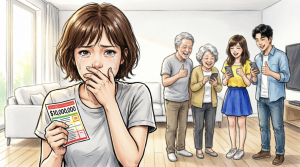
I took a breath and pulled the lottery ticket from my wallet—still folded, still secret—and held it between us.
“I didn’t text you for money, Ryan,” I said. “I texted you for honesty.”
Then I opened the ticket enough for the numbers to show.
“And I just got it.”
Ryan froze.
Ethan’s eyebrows shot up.
Ryan’s voice cracked.
“That’s… Claire… is that real?”
I met his stare.
And said quietly, “Now tell me who you really are—before I decide what you deserve.”
Ryan’s eyes clung to the ticket like money had its own gravity. His expression melted into something syrupy—too sweet to be true.
“Baby,” he said gently, hands raised, “why would you hide something like that from me? I’m your husband.”
Ethan didn’t move.
“She asked you for help,” he said. “You told her to figure it out.”
Ryan ignored him, locked on me.
“I was stressed,” he said quickly. “I didn’t mean it like that.”
He swallowed, tried again.
“We’ve been through a lot. This could fix everything.”
I thought of my mom’s sigh.
Derek’s joke.
Megan’s emoji.
Ryan tracking my location.
And Ethan’s message:
Tell me where you are. I’m coming.
I folded the ticket carefully and slid it back into my wallet.
“You didn’t even ask if I was okay,” I said. “Not once.”
Ryan’s eyes flickered, panic creeping in.
“I came looking for you,” he insisted. “That proves I care.”
“No,” I replied evenly. “It proves you needed control.”
His jaw tightened.
“So what—now your cousin runs your life?”
Ethan spoke calmly.
“No one’s running her life. She’s choosing.”
Ryan’s face reddened.
“This is insane. We’re married. That money is ours.”
Something in me ignited.
“No,” I said. “My body, my time, my kindness—none of it was ever ‘ours’ when you let me drown.”
I pulled up my notes on my phone—the dates I’d paid his credit cards, every “loan” to Derek that vanished, every bill Mom guilted me into covering.
“I kept records,” I said. “Not because I’m bitter. Because I’m done being gaslit.”
Ryan’s confidence shattered.
“Don’t do this here,” he hissed.
“Here?” I glanced around the parking lot. “You made my pain private for years.”
I turned to Ethan.
“Can you take me home?” I said. “Not our home. Mine.”
Ryan raised his voice.
“You’re leaving over one bad day?”
I looked at him.
“It wasn’t one bad day,” I said quietly. “It was the day the mask came off.”
Ethan opened his car door like it was the most natural thing in the world.
As I stepped away, I sent one final message to the family group chat:
Test complete. I’m fine. I just learned who I can trust.
Then I blocked them—one by one.
Because the real prize wasn’t money.
It was the moment I stopped being everyone’s backup plan.
Ethan drove like someone who understood that urgency doesn’t need sirens.
He didn’t ask me a hundred questions. He didn’t lecture. He didn’t say I told you so—the phrase my family loved almost as much as they loved borrowing money.
He just kept both hands on the wheel and said, “Do you want to go somewhere safe?”
“Yes,” I whispered.
Not our home.
Not the house Ryan thought he could track like it was an app feature.
“Okay,” Ethan said. “My place is close. You can breathe there. Then we make a plan.”
We pulled into a small apartment complex on the east side of town. Nothing fancy. Clean. Quiet. A place that didn’t look like anyone was trying to impress anybody.
Inside, Ethan tossed his keys into a bowl, filled a glass with water, and handed it to me like it was the most normal thing in the world.
“I’m going to say one thing,” he said, voice steady. “You don’t have to decide your whole life tonight. You just have to protect yourself for the next twelve hours.”
I nodded. My hands wouldn’t stop shaking.
He looked at my face carefully.
“Are you in danger?”
I thought of Ryan’s jaw clenched in the parking lot. The way he demanded to know who was coming. The way he said We share things like it meant You belong to me.
“I don’t know,” I admitted.
“Okay,” Ethan said. “Then we act like the answer is yes.”
He didn’t say it dramatically. He said it like a firefighter planning for worst-case scenarios……..