Get out of the car, the officer screamed, his g.?u//n drawn. I was being arrested for a felony hit and run. Across town, my sister and parents were celebrating, certain I’d go to prison for the crash she caused. I let the handcuffs click around my wrists. Get out of the car, the officer screamed, his g.?u//n. They forgot one tiny detail.
“Get out of the car with your hands up,” the officer screamed through a megaphone, his g.?u//n already drawn and steady, as if he had been waiting his entire career for this exact moment to pull the trigger on someone like me.
Across town, in my parents’ sprawling living room with imported marble floors and a wine cabinet worth more than my first apartment, my mother was likely pouring Cabernet into crystal glasses while my younger sister Harper cried tears of relief into her fiancé’s designer blazer, absolutely certain that I was about to disappear into a prison cell for a crash she caused.
I did not argue when the red and blue lights swallowed my sedan whole, and I did not resist when the handcuffs bit into my wrists with a cold mechanical finality, because they had forgotten one tiny, microscopic detail that would eventually detonate their entire plan from the inside out.
“Turn the engine off and drop the keys outside the window, do it now,” the amplified voice commanded again, vibrating so violently against my rearview mirror that it felt less like sound and more like a physical shove against my chest.
The interior of my car pulsed with alternating crimson and sapphire strobes, washing out the dashboard and turning the familiar leather steering wheel into something foreign and surreal, as if I were already inside a nightmare constructed by someone else’s lies.
I raised my hands slowly, deliberately, pressing my palms flat against the cold windshield while rain streaked downward in trembling lines that fractured the police lights into distorted ribbons of color.
My pulse did not spike the way it should have during a high-risk felony stop involving firearms aimed directly at my heart, and instead of adrenaline I felt an almost clinical clarity settling into place, like the final piece of a complex equation sliding neatly into alignment.
“With your left hand, open the door from the outside and step out slowly,” the officer barked, his voice no longer amplified but close enough to carry the raw edge of hostility that comes from believing you are facing someone monstrous.
The night air sliced across my face as I rolled down the window, carrying the metallic scent of rain hitting hot asphalt and the low synchronized rumble of three idling cruisers forming a half-circle behind me.
Gravel crunched beneath my boots when I stepped onto the shoulder, and instantly three high-intensity LED spotlights pinned me to the darkness like a specimen on display, their beams so bright I could barely make out the silhouettes of officers crouched behind their open doors, weapons leveled at my chest with unwavering precision.
A red laser dot jittered across my coat, dancing over my sternum as if impatient to confirm a kill shot.
“Turn around, interlace your fingers behind your head, and walk backwards toward the sound of my voice,” the lead officer instructed, his tone clipped and rehearsed, already convinced he was dealing with a coward who had crushed a family minivan and fled the scene.
I followed each direction with measured calm, turning my back to the loaded g.?u//ns and stepping backward into the glare without hesitation, because fear would have given them exactly what they expected from a guilty driver facing a decade behind bars.
The officer closed the distance before I reached the cruiser, grabbing my interlaced fingers with a sharp, punishing grip and slamming my chest against the freezing trunk of my own car so hard that the impact reverberated through my ribs.
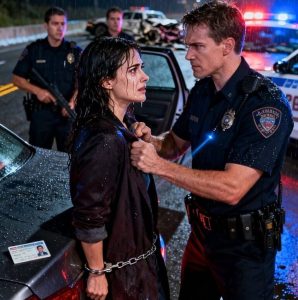
The heavy metallic ratcheting of Smith and Wesson steel cuffs snapping shut around my wrists echoed through the rain and police radio chatter like the closing line of a verdict already decided.
“You’re under arrest for felony hit and run resulting in severe bodily <injury>,” he growled into my ear while aggressively patting down my coat pockets, his breath hot and furious against my neck as he searched for a weapon that was never there.
As he recited my Miranda rights in that eerily calm, memorized cadence, each word landed like a brick sealing the entrance to a tunnel they believed I would never crawl out of.
I did not shut my eyes.
I watched the rain cascade over the taillights of my sedan and thought about Harper, my younger sister, the golden child whose disasters had always been transformed into my consequences.
For twenty-six years Harper had been a beautifully dressed tornado tearing through everything in her path, and for twenty-six years my parents Richard and Diane had sprinted behind her with industrial-grade cleaning supplies and open checkbooks.
When Harper failed out of her second college after partying through finals week, my mother blamed toxic professors and outdated curricula, insisting that creative spirits were often misunderstood.
When Harper crashed her first car at nineteen while driving intoxicated, my father hired the most ruthless defense attorney in the state and quietly drained the college fund my grandparents had left specifically for me, explaining that family loyalty sometimes required sacrifice.
I learned early that sacrifice meant me.
I became the independent one, the distant one, the quiet achiever who moved three states away and built an ironclad career as a senior data analyst for a private logistics firm specializing in digital infrastructure, insulating myself from their chaos with spreadsheets, encryption protocols, and the comforting logic of data that never lied.
Until three days ago, when my mother orchestrated what she called a reconciliation dinner at a high-end steakhouse downtown, claiming Harper had matured and wanted to repair our fractured bond before her extravagant wedding to the heir of a local real estate empire.
I should have recognized the performance when Harper hugged me too tightly, her tears dampening the collar of my trench coat while her hands lingered just a fraction too long near the inside pocket where I kept my spare driver’s license.
She was not apologizing for years of manipulation and destruction.
She was lifting my identity with the delicate precision of someone who had rehearsed the motion in a mirror.
Tonight at exactly 9:14 p.m., Harper slid behind the wheel of her fiancé’s oversized luxury SUV while intoxicated and blasted through a four-way intersection, t-boning a civilian minivan carrying a family who never saw the impact coming.
Instead of checking whether the people inside were breathing, she ran into the dark, her heels slipping on rain-slick pavement as sirens began to wail in the distance.
Before she disappeared, she tossed my stolen driver’s license onto the driver’s side floorboard, positioning it like a final signature on a masterpiece of betrayal.
Ten minutes later my mother placed an anonymous call from a prepaid burner phone, calmly reporting that she had seen a woman matching my exact description driving erratically near the crash site.
They were not merely covering up Harper’s recklessness this time.
They were constructing a narrative that would erase me.
As the officer finished securing the cuffs and spun me around to face him, I saw genuine disgust in his eyes, the kind reserved for someone who would allegedly leave a family bleeding on wet asphalt.
“Do you understand the rights I just read to you,” he demanded, clearly expecting panic, tears, or frantic accusations about a stolen ID.
He was waiting for chaos.
He was waiting for the messy unraveling of a guilty conscience collapsing under the weight of consequence.
Instead, standing in the freezing rain with ten years of mandatory prison time hovering over me like a concrete ceiling, I allowed a slow, measured smile to touch my face.
It was not hysteria.
It was not denial.
It was the quiet recognition of a chess player who had just watched his opponent confidently march their king into a trap they did not even know existed.
Because my family had invested days into crafting a physical frame job, meticulously planting tangible evidence and orchestrating phone calls, assuming the blunt force of the criminal justice system would crush me before I had time to respond.
They believed this was a battle of objects.
They did not understand that every modern crime scene bleeds data.
The molded plastic seat in the back of the cruiser dug into my spine during the twenty-minute drive to the precinct, every pothole sending jolts through my restrained wrists, yet I remained still, staring through the wire mesh at neon signs dissolving into rain.
The initial shock of betrayal had already calcified into something colder and more precise.
They assumed I would be locked in a holding cell all weekend, pressured by an overworked public defender into accepting a plea deal before I could gather my thoughts.
They assumed I would react emotionally.
They assumed wrong.
The cruiser descended into the subterranean garage of the central precinct, tires screeching slightly against slick concrete before halting beneath fluorescent lights that hummed with bureaucratic indifference.
I was marched through the bullpen past ringing phones and clattering keyboards, officers glancing at me not as a person but as a file number attached to a violent collision and a fleeing suspect.
They led me into interrogation room B, a claustrophobic concrete box painted in a nauseating institutional off-white, illuminated by a single buzzing fluorescent tube that cast sharp shadows across a bolted steel table.
My right wrist was uncuffed from behind my back only to be immediately secured to an iron ring welded into the table’s center, the metal cold and unyielding against my skin.
“Sit tight,” the officer muttered before exiting, the heavy door slamming shut and locking with a definitive metallic clack.
Then the waiting began.
They believed isolation would fracture me.
They believed silence would amplify fear.
They believed the ticking clock would erode whatever composure I had left.
But as I sat alone beneath the buzzing light, staring at my faint reflection in the two-way mirror, I did not feel trapped.
I felt focused.
And somewhere across town, Harper and my parents were still celebrating, entirely unaware that the first move in their flawless plan had already triggered a countermeasure they never saw coming.
Type “KITTY” if you want to read the next part and I’ll send it right away.
PART 2
The detective finally entered the room with a thick manila folder tucked beneath his arm, his expression set in the confident neutrality of someone who believes the case in his hands is already airtight.
He placed photographs across the steel table one by one, images of twisted metal, shattered glass, and a minivan crushed at the driver’s side door, describing in grave detail the <injury> sustained by the civilian whose collarbone had been broken on impact.
He slid a clear evidence bag forward containing my driver’s license, recovered from the SUV Harper had abandoned, and leaned back in his chair as if waiting for my composure to finally crack.
“This was found at the scene,” he said evenly, watching my face for the flicker of guilt he was certain would surface.
I studied the license for a long moment before meeting his gaze, allowing silence to stretch deliberately between us, because timing is everything when unveiling structural failure in someone else’s certainty.
“You’re assuming I was there,” I replied calmly, my voice steady despite the cuff biting into my wrist, “and you’re assuming that physical placement equals physical presence.”
His eyes narrowed slightly, irritation flashing across his features as he interpreted my tone as arrogance rather than precision.
“What exactly are you suggesting,” he asked, leaning forward now, his earlier confidence beginning to thin at the edges.
I inhaled slowly, picturing the digital trail already archived across encrypted servers and cloud backups, each timestamp a quiet witness that could not be bribed, intimidated, or emotionally manipulated.
“I’m suggesting,” I began carefully, “that before you charge me with a felony that carries a ten-year sentence, you might want to pull the traffic cam footage from the warehouse district at 9:14 p.m., cross-reference it with my vehicle’s telematics, and then compare that with the GPS handshake data from my phone, smartwatch, and company-issued laptop.”
The room fell silent except for the faint buzz of fluorescent light.
Because while my family had built a frame using objects they could touch, they had completely overlooked the architecture of the invisible system I design for a living.
And as the detective’s expression shifted from irritation to something far more cautious, I realized the celebration happening across town was about to collide with a detail they never accounted for.
C0ntinue below
Turn the engine off and dropped the keys outside the window. Do it now. The voice didn’t just boom through the megaphone. It physically vibrated against the rear view mirror of my sedan. I didn’t need to look behind me to know how many of them there were. The interior of my car was completely flooded with a blinding strobing mixture of crimson and sapphire light.
It washed out the dashboard, casting long, jagged shadows across the leather steering wheel. Show me your hands. Keep them where I can see them. I slowly lifted my hands, pressing my palms flat against the cold glass of the windshield. My pulse was steady. I didn’t feel the frantic suffocating spike of adrenaline that usually accompanies a high-risisk felony traffic stop.
Instead, a profound, almost clinical sense of clarity washed over my mind. With your left hand, open the door from the outside. Step out slowly. I rolled down the window. The freezing night air hit my face, carrying the sharp metallic scent of rain on hot asphalt and the heavy hum of three idling police cruisers. I pulled the exterior handle and pushed the heavy door open.
The gravel crunched loudly under my boots as I stepped out onto the slick highway shoulder. Instantly, three highintensity LED spotlights pinned me to the darkness. I squinted through the glare, making out the silhouettes of three officers taking cover behind their open car doors, their service weapons drawn and leveled directly at my chest.
The red dot of a laser sight danced erratically over the center of my coat. Turn around. Interlace your fingers behind your head. walk backwards toward the sound of my voice. I followed the instructions with the frictionless precision of a ghost. I turned my back to the loaded g.?u//ns, laced my fingers together, and took slow, measured steps backward.
The lead officer didn’t wait for me to reach the cruiser. He closed the distance, grabbed my interlaced fingers with a violent, authoritative grip, and slammed my chest hard against the wet freezing trunk of my own car. The heavy ratcheting click of Smith and Wesson steel handcuffs biting into my wrists sounded incredibly loud over the crackle of the police radios.
You’re under arrest for a felony hit and run resulting in severe bodily injury. The officer growled into my ear, his breath hot against my neck as he aggressively patted down my coat pockets for a weapon. You have the right to remain silent. Anything you say can and will be used against you in a court of law. As he recited the Miranda warning, reciting the exact legal poetry of my destruction, I didn’t close my eyes.
I stared at the rain streaking across the tail lightss of my car, and I thought about my younger sister, Harper. Harper was the golden child. For 26 years, she had been a reckless, destructive force of nature. And for 26 years, my parents, Richard and Diane, had been her dedicated cleanup crew. When Harper failed out of college, they blamed the professors.
When Harper totaled her first car driving drunk at 19, my father hired the most ruthless defense attorney in the state to get the DUI expuned, paying the fees by quietly draining the college fund my grandparents had left for me. I was the independent one, the quiet one, the one who moved three states away, built an ironclad career as a senior data analyst for a private logistics firm, and permanently insulated myself from their toxic enabling chaos. until 3 days ago.
My mother had orchestrated a family reconciliation dinner at a high-end restaurant downtown. She claimed they missed me, that Harper had finally matured and was getting her life together before her upcoming wedding to the heir of a local real estate empire. I should have known better. During the dinner, Harper had hugged me tightly, crying theatrical tears onto my shoulder. She wasn’t apologizing.
She was pickpocketing my spare driver’s license from the interior pocket of my trench coat. Tonight, at exactly 9:014 p.m., Harper had gotten behind the wheel of her fiance’s heavy SUV, completely intoxicated, when t-boned a civilian minivan at a four-way intersection. She didn’t stick around to check if the family inside the crushed metal was breathing, she fled on foot.
But before she ran into the dark, she executed a masterpiece of familial betrayal. She tossed my stolen driver’s license onto the driver’s side floorboard. 10 minutes later, my mother called the precinct from an anonymous burner phone, reporting that she had seen a woman matching my exact description, driving erratically near the crash site.
They weren’t just covering up Harper’s mistake this time. They were actively framing me. They were sacrificing my freedom, my spotless criminal record, and my career so that Harper’s million-doll wedding wouldn’t be ruined by a 10-year prison sentence. Right now across town, the three of them were likely sitting in my parents’ sprawling living room drinking Cabernet, shaking with relief, entirely certain that the police had just locked the cage around their perfect scapegoat.
The officer finished his pat down, grabbed me by the biceps, and spun me around to face him. He was young, his face tight with disgust, looking at me like I was a monster who had just left an innocent family bleeding out on the asphalt. “Do you understand the rights I have just read to you?” he demanded. He was waiting for me to panic.
He was waiting for me to cry, to hyperventilate, to scream that it was my sister, to beg him to believe a wild story about a stolen ID and a setup. He was waiting for the chaotic, messy reaction of a guilty hitand-run driver. Realizing their life was over, I didn’t do any of those things, the rain hit my face. The red and blue lights painted the wet pavement in violent flashing colors.
And standing there in the freezing cold, securely handcuffed at g.?u//npoint, facing a 10-year mandatory minimum sentence, I smiled. It wasn’t a crazy smile. It was the terrifying quiet smile of a chess player who just watched their opponent confidently walk their king right onto a landmine. Because my family had spent days meticulously crafting a flawless physical frame job.
But they were deeply, incredibly ignorant about the exact nature of what a senior data analyst actually does for a living. The molded hard plastic back seat of the police cruiser was specifically engineered for maximum physical discomfort. With my hands tightly cuffed behind my back, every pothole and sharp turn on the 20-minute ride to the precinct sent a rigid, bruising shock wave up my spine. I didn’t shift.
I didn’t complain about the cuffs cutting off the circulation to my wrists. I stared out the wire mesh window, watching the blurred neon signs of the city bleed through the raindrops streaking across the glass. In a bizarre, almost terrifying way. My mind felt like a perfectly calibrated machine.
The initial shock of the betrayal had entirely evaporated, replaced by a cold, surgical hyperfocus. My parents and Harper had orchestrated a physical frame job, relying on the blunt force mechanics of the criminal justice system to crush me before I could speak. They assumed the police would arrest me, lock me in a holding cell for the weekend, and by Monday morning, a public defender would be pressuring me to take a plea deal.
They fundamentally misunderstood the battlefield. They thought this was a game of physical evidence. They didn’t realize that in the modern world, physical evidence is nothing but a shadow cast by digital architecture, and I was the architect. The cruiser violently lurched to a halt inside the subterranean parking garage of the central precinct.
The heavy door was yanked open and the arresting officer hauled me out by the bicep. The transition from the freezing night air to the suffocating, heavily airond conditioned atmosphere of the precinct was jarring. The air smelled of stale coffee, industrial floor bleach, and the sharp metallic tang of adrenaline and sweat.
I was marched through the chaotic bullpen. Phones were ringing off the hook, keyboards were clattering, and uniformed officers were shouting over the den. None of them looked at me with curiosity. to them where I wasn’t a complex human being with a story. I was a file number. I was the monster who had t-boned a family minivan, shattered a civilian’s collarbone, and cowardly fled the scene into the dark.
I could feel the hostility radiating from the desks as I was paraded past them. They didn’t put me in a general holding cell. Because the hit and run involved severe bodily injury, it was a high priority felony. They walked me straight into the violent crimes division and shoved me into interrogation room B.
The room was a textbook example of psychological deprivation. It was a claustrophobic windowless concrete box painted in a nauseating institutional shade of off-white. A single violently bright fluorescent tube buzzed angrily overhead. In the center of the room was a bolted down steel table with two heavily scuffed aluminum chairs.
One entire wall was dominated by a massive, perfectly clean two-way mirror. The officer pushed me into the chair furthest from the door. He unhooked my handcuffs only to immediately recuff my right wrist to a heavy iron ring welded directly to the center of the steel table. “Sit tight,” he muttered, not making eye contact.
The heavy metal door slammed shut behind him. The deadbolt engaged with a loud final clack. “Then the waiting game began.” “This is standard police procedure. It’s designed to let the isolation and the ticking clock erode the suspect’s sanity. They leave you alone in the freezing room so your imagination can torture you with visions of a prison sentence, breaking your psychological defenses before the detective even walks through the door.
But I didn’t panic. I didn’t cry and I didn’t stare anxiously at the two-way mirror. I sat perfectly still, regulating my breathing, dropping my resting heart rate back to a baseline of 60 beats per minute. I mentally mapped out the exact network architecture of the local cellular towers, the GPS refresh rates of modern luxury SUVs, and the biometric syncing protocols of my personal devices.
I was building the gallows for my family line by line of code in my head. 45 minutes later, the dead bolt snapped open. A man in a cheap rumpled gray suit walked in, carrying a thick manila folder and a styrofoam cup of black coffee. He had dark circles under his eyes and the exhausted, cynical posture of a man who had spent 20 years listening to guilty people lie to his face.
He didn’t introduce himself. He pulled out the chair opposite me, the metal legs screeching harshly against the lenolium floor and sat down. He tossed the manila folder onto the center of the table. “I’m Detective Vance,” he said, his voice a low grally monotone. He took a slow sip of his coffee, his eyes fixed on me like a predator assessing a wounded animal.
You want to tell me why you’re sitting in my precinct tonight, Maya? I imagine you’re going to tell me, detective, I replied, my voice completely level, stripped of any emotion or tremor. Vance’s jaw tightened. He didn’t like the absolute lack of fear in my eyes. It broke the script he was used to. He flipped the manila folder open.
At 9:014 p.m. tonight, a black luxury SUV blew through a red light at the intersection of Fourth and Elm, Vance stated, “Leaning forward, invading my physical space. It t-boned a Honda Odyssey carrying a family of four. The mother is currently in surgery with a punctured lung.” The driver of the SUV didn’t even tap the brakes.
They hit the gas, drove two blocks until the radiator blew, and then abandoned the vehicle, fleeing on foot into the residential alleys. He reached into the folder and pulled out a heavy plastic evidence bag. He slapped it down onto the steel table right in front of me. Inside the bag was my stateisssued driver’s license. The responding officers found this resting on the driver’s side floorboard, Bance said, his voice dropping into a harsh accusatory whisper.
10 minutes later, we received an anonymous 911 call from a concerned citizen who saw a woman matching your exact description sprinting away from the crash site. We ran the plates on the SUV. It’s registered to a local real estate firm. The exact same firm your sister’s fiance owns. Your family connection to the vehicle is undeniable.
Vance leaned back in his chair, crossing his arms. He had laid out the trap. Now he was waiting for me to step into it. We have your ID. We have an eyewitness. We have the vehicle. Vance continued, shifting into the sympathetic cop routine. I know how it happens, Maya. You had a few too many drinks. You made a mistake. You panicked.
If you confess right now, if you show remorse, the district attorney might drop the maximum sentence. If you lie to me and make me hunt down the street camera footage to prove it, I will personally make sure you serve the full 10 years for almost killing that family. He stopped talking. The room went dead silent in except for the angry buzzing of the fluorescent light above us. He expected me to demand a lawyer.
He expected me to scream that my sister stole the ID. He expected a messy, chaotic defense that he could easily tear apart. I looked at the evidence bag containing my driver’s license. Then I slowly raised my eyes and locked onto Vance’s gaze with a level of cold clinical detachment that made him physically flinch.
“That is a beautifully constructed narrative, Detective Vance,” I said softly. The silence of the room amplifying every single syllable. It’s compelling. It’s neat. But structurally, it is a catastrophic failure. You don’t have a hit-and-run case sitting in front of you. You have a massive coordinated conspiracy to commit perjury, frame an innocent civilian, and obstruct a federal investigation, Vance scoffed, shaking his head.
Save the conspiracy theories for your public defender. I don’t need a public defender. I cut him off, my voice dropping an octave, carrying the absolute uncompromising weight of a senior data analyst about to dissect a flawed system. I need you to open the cardboard box containing the personal effects your officers confiscated from my coat pockets when I was arrested because inside that box is my encrypted smartphone.
And the second you hand it to me, I am going to give you the exact GPS coordinates, the biometric heart rate data, and the real-time cellular triangulation of the three felons who actually orchestrated that crash. Detective Vance didn’t laugh. He didn’t slam his hands on the table. He just stared at me, the styrofoam coffee cup frozen halfway to his mouth.
The heavy cynical superiority that he had walked into the room with was suddenly suspended, entirely paralyzed by the absolute lack of fear in my posture. In his 20 years on the force, he had interrogated murderers, gang enforcers, and white collar embezzlers. They all had a tell, a twitch of the jaw, a slight tremor in the voice, a desperate need to overexlain.
I wasn’t giving him a defense. I was giving him a hostile takeover. You think I’m going to hand a felony suspect? their uncarched unwarranted personal device in the middle of a homicide adjacent interrogation. Vance asked his voice dropping into a dangerous grally register. He set the coffee down. I think you are a pragmatist detective.
I replied, the fluorescent light buzzing angrily above us, casting sharp clinical shadows across the steel table. and you have a severely injured mother in the ICU, a destroyed civilian vehicle, and a district attorney who is going to want a watertight conviction by sunrise. You can either spend the next 6 months subpoenaing Apple, fighting my lawyers for cloud decryption keys, and praying your circumstantial eyewitness holds up in cross-examination, or you can unlock my right hand, hand me the plastic bin sitting in your evidence locker, and let
me solve your case in the next 4 minutes.” Vance looked at the two-way mirror. I knew exactly what he was doing. He was silently consulting the unseen commanding officer, standing in the dark observation room on the other side of the glass. The silence stretched. 10 seconds, 20 seconds. The tension in the claustrophobic concrete box was thick enough to suffocate on.
Finally, Vance pushed his chair back. The metal leg shrieked violently against the lenolium. He didn’t say a word. He walked to the heavy iron door, knocked twice, and waited for the deadbolt to disengage. He stepped out. 2 minutes later, he returned. He was carrying a clear, hard plastic evidence bin.
Inside it was my trench coat, my keys, my wallet, and my matte black enterprisegrade smartphone. He set the bin on the table, pulled a small silver key from his belt, and unlocked the heavy Smith and Wesson cuff binding my right wrist to the table ring. I am watching your screen. Vance warned, pulling his chair so close that our knees almost touched.
You don’t open a messaging app. You don’t make a call. You do anything other than what you just promised and you lose the phone and I book you for the maximum. I didn’t acknowledge the threat. I didn’t massage my bruised wrist. I reached into the bin, picked up the cold, heavy device, and pressed my thumb against the biometric scanner.
The screen flared to life, casting a sharp bluish glow across the sterile white walls of the interrogation room. “Your crash occurred at exactly 9:014 p.m.” I stated, my voice slipping into the clinical frictionless cadence I used when presenting quarterly risk assessments to corporate boards. I tapped an encrypted health monitoring application on my home screen.
The human body reacts to a high-speed automotive collision with a massive, unavoidable surge of cortisol and adrenaline. Heart rates spike to over 140 beats per minute. Blood pressure skyrockets. I turned the phone around, sliding it across the steel table, so it sat directly under Vance’s nose. Some on the screen was a highly detailed minute-by-minute line graph generated by my synced smartwatch.
The exact same smartwatch that was currently strapped to my left wrist. At 9:014 p.m. tonight, detective, my heart rate was a steady, resting 58 beats per minute, I said smoothly. My respiratory rate was 12 breaths per minute and my devices internal GPS was statically pinging my apartment’s private Wi-Fi router exactly 12 mi away from the intersection of Fourth and Elm.
I was asleep on my couch. Vance stared at the graph. He didn’t blink. He was a veteran cop. He knew that smartwatch telemetry was increasingly being used by the FBI to establish irrefutable alibis and homicide cases. It wasn’t just data. It was biological perjury prevention. Unless you are suggesting, detective, that I managed to t-bone a minivan at 60 mph while remaining in a medicallyinduced coma.
“You are currently holding the wrong suspect,” I added, my tone merciless. “Vance swallowed hard.” He looked up from the screen, his eyes narrowing. “That proves you weren’t physically driving. It doesn’t explain how your physical driver’s license ended up on the floorboard of the suspect vehicle.” “No,” I agreed.
pulling the phone back toward me. It doesn’t, but the vehicle itself is going to explain that. My fingers flew across the digital keyboard with surgical precision. I bypassed my standard apps and opened a secured two-factor authenticated enterprise gateway. “You ran the plates on the suspect SUV,” I continued, speaking as I typed.
You know it’s registered to a local commercial real estate firm when what you don’t know is that my private logistics company holds the exclusive multi-million dollar contract to manage the telematics and geo fencing for their entire corporate fleet. Vance’s posture visibly stiffened. The realization of what I was saying and what I had access to began to wash over him like ice water.
I bypassed the security firewall, accessed the raw backend server logs for the real estate firm’s fleet, and filtered the database by the specific VIN number of the wrecked SUV. A massive wall of raw, unforatted code flooded my screen. Modern luxury SUVs are not just cars, detective. They are rolling three-tonon data servers, I explained, translating the raw code into a clean, readable dashboard interface.
I turned the phone back to him. At exactly 913 and 42 seconds, the vehicle’s onboard computer registered a catastrophic hardto-breaking event. 2 seconds later, the frontal airbag deployment sensor triggered. But I don’t care about the collision telemetry. I care about the primary cabin sensors. I tapped a specific line of code highlighted in yellow.
To prevent airbags from deploying and killing children, the passenger and driver seats are equipped with highly calibrated weight sensors,” I said, leaning over the table, my voice dropping into an icy absolute whisper. At the moment of impact, the driver’s seat weight sensor registered exactly 115 lbs of kinetic mass.
“I am 5’9”, detective, and I weigh 142 lb. But my younger sister Harper, who is currently engaged to the heir of the real estate firm that owns that exact truck, or is 5’2 and weighs exactly 115 lbs, Vance completely stopped moving. The styrofoam cup of coffee in his hand crinkled slightly under his tightening grip.
His career-making felony case was disintegrating right in front of his eyes, replaced by something much darker and far more complex. She stole my ID 3 days ago at a family dinner, I said, delivering the final blow with ruthless precision. She drove drunk. She crushed that family. And she planted my license to save her upcoming wedding.
But planting the ID wasn’t enough to guarantee I’d take the fall. They needed to force your hand. They needed to make sure you arrested me before I could establish an alibi. I took the phone back one last time. You mentioned you received an anonymous 911 call from a concerned citizen 10 minutes after the crash.
I said, my fingers flying across the screen, accessing a completely different set of data architectures. Let’s find out exactly where that concerned citizen was sitting when they decided to ruin my life, shall we? Detective Vance didn’t say a word. He didn’t interrupt, and he didn’t reach for his styrofoam cup of coffee. He simply stared at the illuminated screen of my smartphone, watching his entire neatly packaged hitand-run investigation shatter into a thousand irreconcilable pieces of data.
In the span of 4 minutes, I had systematically dismantled the physical evidence. But dismantling the trap wasn’t enough. I needed to incinerate the people who said it. Now, you said you received an anonymous tip 10 minutes after the collision. I stated, my voice completely devoid of the panic or desperation that usually echoed off the concrete walls of this room.
I minimized the logistics server and opened a commercial telecom application. An eyewitness who claimed they saw a woman matching my exact physical description fleeing the wreckage on foot. I didn’t wait for him to confirm. My thumbs moved across the digital keyboard, bypassing the standard consumer login screen and entering a two-factor administrative portal for a major national cellular provider.
For the last 5 years, my parents, Richard and Diane, have refused to pay their own cellular bills, I explained, delivering the biographical context with the same clinical detachment as the server logs. To avoid the constant arguments, I migrated their numbers onto my corporate enterprise plan. I am the primary account holder, the billing administrator, and the legal owner of the devices they carry.
The interface loaded, displaying a highly detailed real-time dashboard of four active cellular numbers. I selected the line registered to my mother, Diane, under the Patriot Act and standard telecommunications compliance. All enterprise accounts log exact timestamp data, duration, and the receiving numbers of outgoing calls directly to the master server, I said.
I filtered the daily call log, isolating the data from 9:00 p.m. to 9:030 p.m. I turned the phone back toward Vance, pushing it precisely to the center of the steel table. “Look at the third line down, detective,” I instructed softly. Vance leaned over the table, his eyes narrowing as he read the glowing text and his jaw visibly tightened, the muscles in his neck strained against his rump
led collar. At exactly 9:024 p.m., precisely 10 minutes after the frontal airbags deployed in the SUV, my mother’s phone had initiated an outgoing call. The receiving number was listed simply as 911 emergency services. The call duration was 47 seconds. It wasn’t an anonymous concerned citizen, I said, my tone dropping into an absolute icy whisper. It was my mother.
But that’s not the piece of data that’s going to put her in a federal penitentiary. I tap the screen one more time, opening a secondary tab labeled network geol location. A highresolution satellite map of the city materialized, peppered with overlapping blue circles representing cellular tower triangulation. When you dial 911, the network automatically flags the closest cell tower to route the emergency response, I explained, tracing a perfectly manicured fingernail across the glass screen.
The collision occurred at the intersection of Fourth and Elm, right in the heart of the downtown grid. But my mother’s device didn’t ping a downtown tower at 9:024 p.m. It pinged a localized low-frequency note in the middle of Oakbrook Estates, an exclusive gated suburb 12 m away from the crash site.
My mother didn’t see me running from the wreckage, Detective Vance. because my mother was sitting in her own living room drinking Cabernet while she committed felony obstruction of justice and filed a false police report to frame her oldest daughter. The silence in the interrogation room was no longer just tense. It was heavy, suffocating, and absolute, and the buzzing of the fluorescent tube above us sounded like a chainsaw.
Vance finally exhaled. It was a long, slow breath. He ran a heavy hand over his exhausted face. The cynical superiority entirely scrubbed from his posture. He wasn’t looking at a suspect anymore. He was looking at the architect of the most airtight conspiracy case his department would see this decade. He reached for the heavy iron ring on the table, picked up the Smith and Wesson handcuffs, and hook them onto his own belt.
I’m going to dispatch three units to Oakbrook Estates right now,” Vance said, his voice a low, dangerous rumble. The cop in him was boiling over, a mother bleeding out in the ICU. a family destroyed and the perpetrators were sitting in a gated community trying to pin it on their own blood. I’m going to rip those doors off the hinges, Maya, when I’m going to book your sister for felony hit and run and I’m going to book your parents for conspiracy.
He stood up, the aluminum chair scraping violently against the floor and reached for the radio on his shoulder. Wait, I commanded. I didn’t raise my voice, but the absolute surgical authority in my tone froze his hand halfway to the microphone. He looked down at me, his brow furrowed in confusion. “You don’t just want an arrest, Detective Vance,” I said, leaning back in my chair, folding my hands neatly in my lap.
“If you kick their door down right now, Richard will immediately invoke his right to counel. He will hire a $500 an hour defense attorney. They will claim the phone was hacked. They will claim the SUV was stolen. They will drag this out in court for 3 years. And there is a statistical probability they will confuse a jury enough to walk away with probation.
Vance’s eyes darkened. So what do you suggest, Maya? I have the telematics. I have the phone logs. That’s enough for a warrant. You have the metadata. I corrected him smoothly. But what you really want, what the district attorney wants is a full uncoerced confession caught on tape. I picked up my smartphone one last time.
When Richard and Diane bought that sprawling estate, they didn’t know how to set up the encrypted smart home security network. I said, “A terrifying razor thin smile finally touching the corners of my mouth. So, I installed the interior highdefinition cameras for them, and they were far too arrogant and far too technologically illiterate to ever ask me to transfer the master administrative privileges.
I bypassed the telecom portal and opened a sleek black application. The logo of a premium home security firm flashed on the screen. They think I’m sitting in a holding cell right now, I whispered, the light from the screen illuminating the cold satisfaction in my eyes. They think they won. They think the trap snapped shut, which means they are currently sitting in their living room completely unguarded, discussing exactly how they pulled it off.
I tapped the camera feed labeled main living room audio enabled. The screen of my smartphone buffered for a fraction of a second before the encrypted 4K video feed flared to life. The contrast between the sterile, nauseatingly bright interrogation room and the warm or amberlit luxury of my parents sprawling Connecticut living room was jarring.
The hidden camera nested discreetly inside a digital thermostat on the far wall captured the entire room with flawless wide-angle precision. The audio was pristine, picking up the crackle of the gas fireplace and the heavy, terrified silence of three guilty people. Detective Vance leaned in so close I could hear his shallow breathing.
His eyes were locked onto the glowing glass. On the screen, my father, Richard, was pacing the length of a massive Persian rug. He was holding a crystal tumbler of scotch. My mother, Diane, was sitting on the edge of a custom leather sofa, her face buried in her hands. And sitting directly across from her was Harper, my golden child sister, still wearing the expensive silk dress she had worn to the family dinner 3 days ago, and her makeup was smeared across her cheeks.
“Stop crying, Harper. Just stop.” Richard snapped, his voice echoing cleanly through the phone speaker. “It’s done. The police have the ID. They have Diane’s phone call. It’s a closed loop. What if Maya tells them? Harper sobbed, her voice a pathetic, trembling whine. She pulled her knees to her chest. What if she demands a lawyer? What if she proves she wasn’t in the SUV? She was sleeping in her apartment, Harper.
Diane practically shouted, dropping her hands from her face. She lives alone. She has no witnesses. It’s her physical ID at the scene of a catastrophic wreck against her word. The police don’t care about a data analyst claiming she was in bed. They care about physical evidence. By Monday morning, Hana, a public defender will force her to take a plea deal.
Vance’s jaw visibly clenched, the muscles in his neck strained against his collar. He was watching three wealthy, arrogant civilians casually narrate the exact mechanics of a federal conspiracy, completely unaware that the lead detective on the case was watching them live. I had to use her license. Dad,” Harper whispered, staring blankly at the fireplace.
“If I get arrested for a felony DUI, the wedding is off. The Brooks family will cancel the engagement immediately. I’d lose everything. You’re not losing anything,” Richard said, taking a long, arrogant swallow of his scotch. He walked over and placed a hand on Harper’s shoulder. “Maya is strong. She’s cold.
She can survive a few years in a minimum security facility. Her career is already built. You need this marriage, Harper. We did what we had to do to protect the family. The police are probably booking her into a holding cell right now. I didn’t smile. I didn’t look at Vance for validation. I just watched the screen with the absolute freezing detachment of an executioner watching the trap door release.
Vance didn’t say a single word. He didn’t need to. He slowly reached for the heavy black radio clip to his shoulder harness. He unhooked it, pressed the transmission button, and brought it to his mouth. His eyes never left my phone screen. Dispatch, this is Detective Vance. Priority one, he growled. His voice a low, lethal rumble that filled the concrete box.
I need four patrol units and a tactical breach team deployed to Oakbrook Estates immediately. I have a live uncoerced audiovisisual confession for a felony hit and run, conspiracy, and obstruction of justice. The suspects are contained in the primary living room. Approach with silent sirens. Do not let them hear you coming.
Copy that, detective. The radio crackled back. Units rolling. Vance lowered the radio. He looked at me, the cynical exhaustion completely gone from his face, replaced by a profound, almost terrifying level of respect. “Keep the feed running,” Vance ordered softly. We sat in absolute silence for exactly 14 minutes. We watched Richard pour another drink.
We watched Diane convince herself that sacrificing her eldest daughter was a necessary collateral damage for their social standing. We watched Harper stop crying and start scrolling through her wedding Pinterest board. The guilt completely evaporating from her sociopathic mind. Then the ambient lighting on the video feeds suddenly shifted through the massive floor to ceiling windows of their living room.
Violent strobing flashes of red and blue light began to paint the walls. The police cruisers had cut their sirens, but the light bars were blinding. Richard froze. His scotch glass stopped halfway to his mouth. Diane stood up so fast she knocked over a side table. Harper dropped her phone onto the rug. Richard, Diane whispered, her voice picked up flawlessly by the hidden microphone.
“Richard, what is that?” “Nobody move?” Richard commanded, his boardroom authority instantly shattering into pure unadulterated panic. They didn’t have time to move. They didn’t have time to craft a lie, call a lawyer, or delete a single text message. The heavy custom mahogany front door of the estate didn’t just open when it exploded inward with a deafening splintering crash. Police search warrant.
Show me your hands. Six heavily armed officers flooded into the living room feed, their tactical flashlights cutting through the amber glow. Harper let out a blood curdling, hysterical scream as an officer grabbed her by the arm and slammed her face first into the custom leather sofa, ratcheting heavy steel cuffs around her wrists.
“Get on the ground. Do it now.” An officer roared at Richard. “My father,” the man who had spent 30 years controlling every narrative and buying his way out of every consequence, didn’t argue. He dropped to his knees, his hands trembling violently above his head, his face completely drained of blood. Diane was sobbing uncontrollably as an officer read her her Miranda writes, “The exact same rights I’d listened to on the freezing highway less than two hours ago.
” Vance exhaled a long, heavy breath. He reached across the steel table, took the small silver key from his pocket, and unlocked the iron cuff binding my right wrist. The heavy metal fell away with a clatter. “You’re free to go, Maya,” Vance said softly, standing up from the table. I’ll have an officer drive you back to your vehicle, and I will personally ensure your arrest record is expuned before sunrise.
I picked up my smartphone, watching the live feed of my sister being dragged out of the house by her hair. I slipped the phone into my coat pocket. “Thank you, detective,” I said. I walked out of the interrogation room, leaving the door wide open behind me. 6 months later, the mother in the Honda Odyssey made a full recovery.
Because the police had secured a flawless recorded confession, my family’s expensive defense attorneys were entirely useless. Harper was sentenced to a mandatory 8 years in a state penitentiary for felony hit and run, resulting in severe bodily injury. The Brooks family canled the wedding the morning after the arrest, publicly distancing themselves from the scandal.
My parents didn’t escape the blast radius. Richard and Diane were both convicted of federal obstruction of justice and conspiracy to commit perjury. To pay for their catastrophic legal fees, they were forced to liquidate the Oakbrook estate, their luxury vehicles, and Richard’s retirement portfolios.
They avoided prison time, but they were permanently bankrupted, forced to move into a tiny run-down rental property in a neighboring state, where they tried to call me from a prepaid burner phone a few weeks after the trial, likely to beg for financial assistance or a shred of forgiveness. I didn’t answer. I simply opened my corporate telecom portal, located the burner phone’s exact geo location, and permanently blacklisted the IMEAI number from every cellular network on the eastern seabboard.
Meanwhile, my logistics firm promoted me to director of data architecture, complete with a corner office and a salary that guaranteed I would never have to look back. If your own parents and sister conspired to frame you for a felony to protect their social standing, would you have warned them that you had the data to prove your innocence? Or would you have sat in that interrogation room and watched the SWAT team kick their door down live on camera like I did? Well, let me know exactly how you would handle this betrayal in the