The ICU monitor made a sound I will never forget.
Not loud.
Not dramatic.
Just steady enough to prove I was still there.
The room smelled like antiseptic, plastic tubing, and the metallic trace of blood that clung to everything after a delivery went wrong.
I remember the ceiling tiles more clearly than I remember the first time I saw my daughter.
That is the kind of sentence a mother feels guilty for writing, but guilt does not change the truth.
Three days earlier, my heart stopped twice on the delivery table.
The first time, I was told, the room went silent for half a second.
The second time, the nurse said later, nobody waited for silence.
They moved.
Hands pressed down on my chest.
Someone called out numbers.
Someone else lifted my newborn daughter away while I disappeared behind a blue surgical drape and a blur of white lights.
When I woke, my throat felt scraped raw.
My chest ached like it had been split open.
My abdomen burned under the bandage, and every breath pulled against stitches that seemed too new to belong to my own body.
A nurse named Denise, whose name tag was crooked and whose eyes were too kind for the hour, told me I was in the ICU.
She said my baby girl was healthy.
She said I was lucky.
People use the word lucky when the alternative is too ugly to hold in their mouth.
My husband, Mark, came to see me late that first night.
He did not bring flowers.
He did not bring a clean robe or a phone charger or the soft blanket I had packed in the hospital bag and forgotten in the car.
He stood near the foot of my bed and asked if I knew where the catering invoice was.
I thought I had misunderstood him.
The medication was still making my thoughts slow.
“The invoice,” he said again, impatient. “For Friday dinner. I told you I needed the updated head count.”
Our daughter was asleep in the bassinet beside me, swaddled so tightly only her tiny face showed.
Her mouth made little sucking motions in her sleep.
Mark looked at her the way some people look at a lamp that has been left on.
An object.
A cost.
An interruption.
I had been married to Mark Whitman for two years.
He was charming in the way men can be charming when charm has worked for them too long.
He remembered names at parties.
He opened doors when other people were watching.
He could make a room believe he was generous before anyone noticed that generosity always returned to him with interest.
When we met, I was twenty-six and working at a medical billing office, eating lunch at my desk because there was nobody waiting for me anywhere else.
My parents had died when I was young.
I grew up passed between relatives who meant well until meaning well became expensive.
By the time Mark found me, I had learned how to be quiet in other people’s homes.
He called me independent.
Then he called me simple.
Then he called me low maintenance.
The words sounded like compliments until I realized they were instructions.
Do not ask.
Do not need.
Do not make yourself hard to keep.
His mother, Eleanor, understood the arrangement before I did.
She never raised her voice in public.
She did not need to.
She could make one look across a dinner table feel like being corrected in front of a whole room.
In the beginning, I tried to win her over.
I learned how she liked her coffee.
I remembered that she hated cilantro.
I wrote thank-you notes after dinners where she had corrected my posture, my dress, my recipes, and once the way I folded napkins.
When I told her I was pregnant, she looked me up and down and said, “Well, let’s hope motherhood teaches you stamina.”
I laughed because I did not know what else to do.
That is another thing lonely people learn early.
They laugh at things that hurt because arguing risks losing the room entirely.
On the third afternoon after the birth, the doctor came in with my chart.
He looked tired.
Doctors looked tired in that ICU, but this was different.
This was the face of a man preparing to argue with someone who believed money outranked medicine.
My blood pressure had been written on the white board in red marker.
168/104.
Recheck ordered.
My discharge status was not cleared.
My body was not ready.
My daughter had just finished nursing and lay warm against my chest, her little fist pressed under her chin.
The room was quiet except for the monitor and the soft hiss of the air vent.
Then Mark walked in.
He wore a white shirt with the cuffs rolled once.
His watch flashed when he checked the time.
Behind him came Eleanor, dressed in cream, carrying a leather purse and the expression of a woman entering a hotel room she found disappointing.
Mark did not ask how I felt.
He did not ask whether our daughter had eaten.
He looked at the doctor and said, “Can we expedite this discharge?”
The doctor blinked.
Mark continued, “We have a major dinner with investors tonight. I can’t babysit in a hospital ward.”
A nurse near the medication cart paused with a vial in her hand.
I felt heat rise in my face, which made the room spin.
“Mark,” I said softly, “I can’t go home yet.”
He did not look at me.
He looked at the doctor.
That hurt more than if he had shouted.
Shouting at least admits the other person exists.
“Her blood pressure is dangerously unstable,” the doctor said. “She was in the ICU. Discharge today is against medical advice.”
Eleanor gave a small laugh.
“In my day, women had babies and went right back to work. She’s been resting long enough.”
Resting.
The word entered the room and took up more space than all the machines.
Resting was what you did on a couch after Thanksgiving dinner.
Resting was a nap.
Resting was not waking up with bruised ribs from chest compressions.
Resting was not bleeding through hospital pads while learning how to hold a newborn without tearing open your incision.
“Mrs. Whitman,” the doctor said to Eleanor, with the tight politeness of a man barely holding on, “your daughter-in-law nearly died.”
“She’s dramatic,” Eleanor said.
Mark exhaled through his nose.
“I’ll sign the waiver.”
Paperwork makes cruelty look clean.
That is why cruel people love it.
The Against Medical Advice form came from the hospital intake desk at 4:12 p.m.
The nurse placed it on the rolling table beside my bed.
The doctor’s notes were clipped behind it.
Blood pressure instability.
Postpartum hemorrhage risk.
ICU observation recommended.
Mark signed where they told him to sign.
His signature was smooth and confident.
Mine looked like it belonged to someone writing from inside a moving car.
Eleanor folded the discharge packet and put it in her purse.
I watched her do it and thought, absurdly, of grocery receipts.
That was how easily she reduced the record of my survival.
A folded thing.
Something to be tucked away.
Denise helped me sit up.
I tried not to gasp.
The pain was not one pain but several.
A burning at the incision.
A deep ache in my chest.
A pulling between my hips.
A dizziness that made the edges of the room brighten and dim.
My daughter made a little squeak from her bassinet.
I reached for her because instinct moved faster than fear.
Mark checked his phone.
Eleanor said, “Don’t start crying. You’ll upset the baby.”
For one ugly second, I imagined throwing the plastic water pitcher at the wall.
Not at Mark.
Not at Eleanor.
At the wall, just to make a sound big enough to prove I was still human.

But my daughter was there.
So I folded the rage smaller than my pain and tucked it somewhere nobody could see.
They put me in a wheelchair.
That was not dignity.
That was transport.
The hallway outside the ICU smelled like coffee from the nurses’ station and over-warmed vending machine food.
A little boy in a Spider-Man hoodie leaned against his father near the elevator.
An older woman in scrubs walked past with a paper coffee cup and looked at me for half a second too long.
I wondered what she saw.
A new mother.
A sick woman.
A wife being taken somewhere she did not want to go.
At 4:48 p.m., Mark’s Mercedes pulled away from the hospital curb.
The baby was strapped behind Eleanor.
I sat in the back seat beside the car seat, one hand on the handle as if I could protect my daughter from motion itself.
Mark drove too fast.
Every lane change tore through me.
Every red light was a blessing.
Eleanor scrolled through her phone from the front passenger seat.
“The caterer says the trays are already delivered,” she said. “The kitchen had better be presentable.”
I closed my eyes.
The word kitchen reached into me and found a new place to hurt.
I had cleaned that kitchen the night before my water broke.
I had wiped down counters while contractions tightened low in my back because Mark had said the housekeeper missed corners.
I had packed my hospital bag between loads of laundry.
I had left a note on the fridge reminding him where the newborn diapers were.
He had texted back a thumbs-up emoji.
That was Mark’s version of tenderness.
Acknowledgment without inconvenience.
On the highway, I saw the first black SUV in the side mirror.
It was several cars behind us.
Then there was another.
Then another.
A line of dark vehicles merged into our lane and stayed there, smooth and quiet, like they had practiced.
At first, I thought it was the medication.
Pain can make patterns where there are none.
Grief can turn strangers into signs.
I looked away.
When I looked back, they were still there.
Mark did not notice.
He was talking about seating arrangements and investor wives and whether I could wear something that did not look so “hospital.”
Eleanor asked whether I had remembered to thaw the rolls.
I almost laughed.
A dry, cracked sound climbed my throat and died there.
By the time we reached our neighborhood, the sun was sinking into a bright gold wash over the lawns.
The house looked perfect from the street.
White trim.
Wide driveway.
Small American flag moving gently on the porch.
Two hanging baskets Eleanor had bought because she said mine looked cheap.
A mailbox by the curb with our last name in black letters.
Whitman.
I had worn that name for two years, and it had never felt less like mine.
Mark pulled into the driveway.
He got out first and lifted the baby carrier like it was a heavy briefcase.
I opened my own door because he did not come around to help me.
The first step nearly dropped me to the pavement.
The air outside smelled like cut grass, exhaust, and the faint sweetness of someone’s dryer vent.
Normal smells.
A normal street.
A normal house pretending not to contain what it contained.
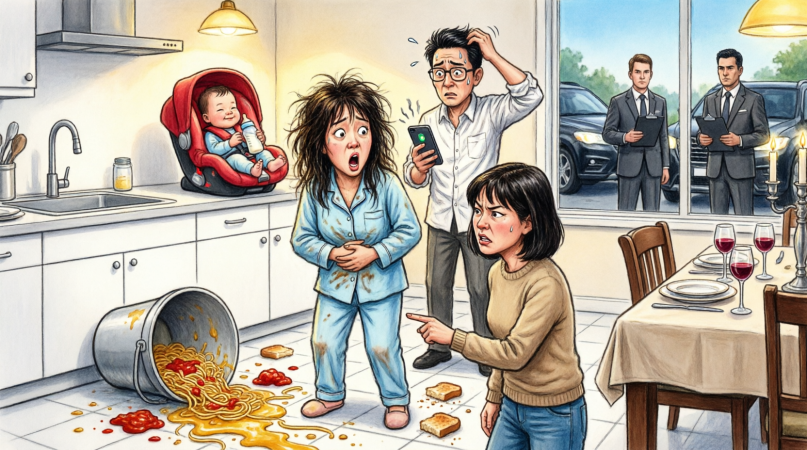
Inside, the kitchen was already set up for Mark’s performance.
Wine glasses lined the island.
White plates were stacked near the stove.
Catering trays sat under foil on the counter, and grocery bags slumped by the side door.
The baby slept in her carrier beside a vase of white flowers Eleanor must have ordered for herself.
Mark loosened his tie.
“Go change,” he said. “And then help Mom.”
I looked at him.
“I need to lie down.”
His jaw tightened.
“Do not embarrass me tonight.”
There it was.
Not concern.
Not even irritation.
Image.
That was the god Mark served.
Eleanor disappeared into the laundry room and came back with a gray plastic bucket.
The smell reached me before the bucket did.
Sour mop water.
Old lemon cleaner.
Something spoiled from under the sink.
She set it down with a slap, then pushed it hard with her foot.
No.
Not pushed.
Kicked.
The bucket slid across the tile.
Dirty water rolled over the rim and spread toward my feet.
I was wearing the loose hospital pants Denise had helped me into and socks with grips on the bottom.
The first cold splash touched my toes.
Then I felt warmth between my legs.
Bleeding.
Again.
My hand went to my abdomen.
“You’ve been resting in that hospital bed long enough,” Eleanor said. “Scrub the kitchen. Your husband is bringing guests over.”
I looked at Mark because some foolish part of me still believed there might be a bottom.
A line.
A place even he would not cross.
He stood beside the counter, thumb on his phone, our newborn inches from his elbow.
He rolled his eyes.
“Don’t start,” he said. “Just do what Mom says.”
The kitchen froze around those words.
The dishwasher hummed.
A foil tray crackled softly as steam pressed under the lid.
A wine glass caught the porch light and flashed once.
Dirty water crept across the grout toward my other foot.
In that moment, I understood what my daughter would inherit if I accepted this as normal.
Not money.
Not a last name.
A lesson.
That women bleed quietly while men host dinner.
That mothers apologize for surviving.
That love is measured by how much humiliation you can carry without making a scene.
I could not give her that.
I braced one hand against the counter.
I was about to speak when the headlights crossed the kitchen window.
At first, Mark ignored them.
Then another pair followed.
And another.
The bright beams moved across the cabinets, the sink, Eleanor’s face, the wet floor, the baby carrier.
Mark looked up.
His irritation faltered.
Eleanor turned toward the window.
Outside, black SUVs rolled into the driveway one after another, blocking the Mercedes in.
The last one stopped near the mailbox.
Doors opened.
Men in dark suits stepped out, not rushing, not hesitating.
One of them carried a sealed cream folder.
My maiden name was printed on it.
Not Whitman.

My name.
The name I had thought belonged only to old school records, a few photographs, and the parents I lost before I knew how to ask enough questions.
Mark’s phone slipped lower in his hand.
“Who are they?” Eleanor whispered.
For the first time since I had known her, she did not sound annoyed.
She sounded small.
The man with the folder came to the front door.
Mark moved before I did.
He crossed the living room with a smile already forming, the kind he used for bankers and donors and people whose approval could be converted into profit.
He opened the door halfway.
“Gentlemen,” he said, “I’m afraid this is a private residence.”
The man did not look impressed.
He looked past Mark, into the kitchen, at me standing in dirty water with a hospital wristband still on my wrist.
Then he looked at the newborn carrier on the counter.
Then at the bucket.
It was a quiet inventory.
I watched his eyes do what nobody in that house had done all day.
Take the facts seriously.
“Mrs. Whitman?” he asked.
My throat tightened.
“Yes.”
He corrected himself gently.
He used my maiden name.
The room changed.
Mark’s shoulders went stiff.
Eleanor drew in a breath.
The man lifted the folder.
“We were instructed to come if hospital records indicated coercion, neglect, or medical discharge against advice within seventy-two hours of delivery.”
The words were so precise they did not feel real at first.
Coercion.
Neglect.
Against advice.
Seventy-two hours.
The doctor had written notes.
Denise had watched.
The hospital intake desk had recorded the timestamp.
The AMA discharge form Mark signed had not disappeared into his convenience.
It had become evidence.
Mark laughed once.
It was too sharp.
“There must be some misunderstanding. My wife is emotional. She just had a baby.”
The man did not blink.
“That is why we are here.”
Eleanor stepped forward.
“Who sent you?”
The man opened the folder.
Inside were copies of documents clipped in careful order.
A hospital discharge notice.
A physician’s recommendation.
A notarized letter with my father’s signature at the bottom.
I knew that signature.
I had traced it as a child on old birthday cards until the ink nearly disappeared under my finger.
My knees weakened.
The suited man saw it and moved as if to help, but I lifted a hand.
I needed to stand for this.
Not because I was strong.
Because I was finally being told the truth standing up.
“Your father anticipated that certain protections might be necessary after your marriage,” the man said.
Mark went pale.
Not confused.
Recognizing.
That was worse.
“What protections?” I asked.
The man looked at me with something that might have been pity if he had been less disciplined.
“Financial. Medical. Legal. Personal. They were placed in trust before his death. You were not to be notified unless a triggering event occurred.”
A triggering event.
My body in an ICU bed.
My husband’s signature on a discharge waiver.
My mother-in-law’s bucket at my feet.
There are people who mistake a woman’s silence for the absence of witnesses.
They forget that paperwork has a memory.
Mark took one step toward the folder.
“This is absurd. Whatever her father left, it has nothing to do with me.”
The man turned a page.
“It does now.”
Eleanor grabbed the counter behind her.
Her rings scraped the granite.
It was a small sound, but everyone heard it.
The baby stirred.
I moved first.
Even half-bent, even bleeding, I reached her before Mark did.
I lifted the carrier off the counter and set it on the dry side of the kitchen table, away from the water, away from the bucket, away from his elbow.
That was the first thing I took back.
Not the money.
Not the house.
My daughter.
Mark watched me like I had broken some rule written in language only he understood.
“You’re being ridiculous,” he said.
I looked at him.
My voice came out thin but clear.
“No. I was ridiculous when I believed you would become kind if I stayed quiet long enough.”
Nobody moved.
Even Eleanor looked away.
The man in the suit placed the folder on the island, carefully avoiding the wet part of the counter.
“Mrs. Whitman, before anything else, you need medical attention. An ambulance has been called.”
Mark’s face hardened.
“I didn’t authorize that.”
The suited man looked at him then.
Fully.
“No one asked you to.”
That was when the first real crack appeared in Mark’s performance.
He was used to rooms bending toward him.
He was used to men shaking his hand.
He was used to women translating his cruelty into stress, ambition, pressure, responsibility.
He was not used to being spoken to like a problem.
Sirens sounded faintly in the distance.
Eleanor started crying before anyone accused her of anything.
That was her talent.
She could turn tears on like a faucet when consequence entered the room.
“I was only trying to help,” she said.
I looked at the dirty water around my socks.
I looked at the bucket.
I looked at my baby sleeping under a pink hospital blanket.
“No,” I said. “You were trying to teach me my place.”
Her mouth opened.
No answer came.
The paramedics arrived minutes later.
They came through the front door with a stretcher and a black medical bag, bringing cold outside air into the house.
One of them looked at the floor and then at me.
His expression changed.
Professional calm remained, but beneath it was anger.
Not loud anger.
The useful kind.
They checked my blood pressure at the kitchen table.
The numbers made the younger paramedic press his lips together.
I was bleeding heavily enough that Denise’s warning came back to me like a voice over my shoulder.
You need observation.
You need rest.
You need someone watching you.
Mark had watched his watch.

The ambulance ride back to the hospital was brighter than I expected.
Late sun came through the rear windows.
My daughter rode safely beside me with a paramedic watching her carrier.
For the first time since delivery, someone asked me what I needed and waited for the answer.
At the hospital, Denise saw me come through the doors.
Her face changed before she could stop it.
She touched my shoulder with two fingers, gentle enough not to hurt.
“I’m glad you’re back,” she said.
I started crying then.
Not because I was weak.
Because someone had finally said the right thing.
Mark was not allowed past the first waiting area.
Eleanor tried to follow and was stopped by a nurse with a clipboard and a voice that did not bend.
The suited man remained near the wall, speaking quietly on the phone.
By 7:36 p.m., a hospital social worker had taken a statement.
By 8:10 p.m., the discharge incident had been documented in my chart.
By 8:42 p.m., copies of the AMA form, physician notes, and intake timestamps had been attached to a formal hospital record.
There are moments when rescue does not look like a dramatic embrace.
Sometimes it looks like a printer warming up.
Sometimes it looks like a nurse labeling a file correctly.
Sometimes it looks like a woman in a blue cardigan asking, “Do you feel safe going home?” and not flinching when the answer is no.
I did not go home that night.
Neither did my daughter.
We stayed under bright hospital lights, with a bassinet beside my bed and a call button within reach.
I slept in fragments.
Every time I woke, I checked her breathing.
Every time she moved, pain shot through me as I reached for her too quickly.
But she was there.
Warm.
Fed.
Safe.
The next morning, the man with the folder returned.
His name was Mr. Keller.
He did not offer a dramatic speech.
He offered documents.
That made me trust him more.
He explained that my father had left a trust in my name, one protected from marital control.
He explained that after my parents died, certain assets had been managed quietly until I reached an age and circumstance that triggered review.
He explained that Mark had been aware of more than he admitted.
That part I had already seen in his face.
There had been correspondence.
Requests.
Attempts to access information through channels that sounded polite on paper and predatory once read in order.
Mr. Keller slid copies across the hospital tray.
Emails.
Inquiry letters.
A rejected authorization attempt.
Dates.
Signatures.
The kind of trail Mark had always assumed only other people left.
I read until my eyes blurred.
Then I stopped.
“Did my father know this would happen?” I asked.
Mr. Keller was quiet for a moment.
“I think your father knew that people sometimes target those who appear alone. He wanted that appearance to be misleading.”
I looked at my daughter.
Her tiny fingers flexed in sleep.
For years, I had believed being alone was the fact around which everything else had to arrange itself.
I had made myself smaller around that belief.
I had tolerated Eleanor’s corrections.
I had forgiven Mark’s absences.
I had treated scraps of politeness like proof of love.
But my father had left one final message inside a legal structure Mark could not charm, bully, or host dinner around.
You are not as alone as they think.
That sentence did more for me than any speech about courage could have done.
Over the next weeks, I learned how much of my marriage had been built on controlled information.
Mark had kept bills from me.
He had discouraged me from returning to work.
He had told me certain accounts were too complicated, certain meetings too boring, certain documents not worth my time.
He had said, “I handle that stuff.”
He had made ignorance sound like care.
Mr. Keller helped me document everything.
The hospital records.
The discharge form.
Photos of the kitchen floor taken by one of his associates before the water was cleaned up.
A written statement from Denise.
Text messages from Mark about the dinner.
A timeline that began with ICU admission and ended with Eleanor’s bucket.
The trust provided housing.
Medical coverage.
Counsel.
Safety.
Not revenge.
Safety.
That distinction mattered to me.
I did not want to become cruel because they had been cruel.
I wanted to become unavailable to their cruelty.
There is a difference.
Mark tried calling first.
Then texting.
Then sending flowers to the hospital with a card that said, Let’s talk when you’re calm.
I kept the card because the wording was useful.
When Eleanor called, she left a voicemail saying motherhood had made me unstable.
I kept that too.
People who think they are insulting you sometimes hand you evidence because arrogance makes them generous in the wrong ways.
Three weeks later, I moved into a small house arranged through the trust.
It had a front porch, a working mailbox, and a bedroom where morning light fell across the crib.
No one ordered me to clean while I bled.
No one checked a watch while I cried.
No one treated my daughter like an interruption.
On the first night there, I sat on the floor beside her crib because my body still hurt too much to sit comfortably in a chair.
The room smelled like baby lotion, clean cotton, and the cardboard boxes I had not yet unpacked.
She slept with one fist beside her face.
I thought about the kitchen.
The bucket.
The wine glasses.
The dirty water touching my hospital socks.
I thought about Mark saying, Just do what Mom says.
I thought about the headlights crossing the window.
An entire house had tried to teach me that survival made me obligated.
That nearly dying meant I owed them usefulness.
That being orphaned meant I should accept whatever family I was given, even if it came with orders and locked doors.
They were wrong.
My daughter will never learn that mothers apologize for surviving.
She will know that love shows up.
It signs the right forms.
It waits in hospital hallways.
It notices the blood pressure on the board.
It steps through the door when the bucket hits the floor.
Months later, when the legal process was already moving and Mark’s polished life had begun to crack in ways he could not hide with dinner parties, I drove past the old house once.
The porch flag was still there.
The driveway was empty.
The windows looked bright and ordinary.
That was the strangest part.
Places can look innocent after holding terrible things.
I did not stop.
In the back seat, my daughter made a soft sound in her sleep.
I checked the mirror and saw her tiny face.
Then I kept driving.
Not because I was running.
Because for the first time in my life, I knew exactly where I was going.