Once everyone had a plate, Rick grabbed my arm in the hallway. Hard. Too hard. “You’re crossing a line,” he whispered. I felt his fingers dig in. Before, that pain would have silenced me. Not tonight. “Let go of me.” “We’ll talk later, just you and me.” “No. We talk now.”
I tried to pull away. He squeezed harder. At that instant, Brenda appeared at the end of the hallway and saw Rick’s hand on my arm. “Let her go,” she said. Rick didn’t look at her. “Stay out of this.” “I’m already in it.”
Tony stepped up behind her. Then Eleanor. Then Rose, her phone in hand. Suddenly, the hallway was full of eyes. Rick dropped my arm like I was on fire. “Oh, please. It’s not like I did anything to her.”
I lifted my arm. The red marks were already blooming. Eleanor put a hand to her chest. “Rick…” He rolled his eyes. “Mom, don’t you start too.” “Is that how you talk to her?” she asked. “That’s how he always talks,” I said.
And then I pulled out the final piece. It wasn’t in the blue folder. It was on my phone.
Three weeks ago, after his humiliation, I started hitting record every time he began his rants. It wasn’t legally perfect, it wasn’t heroic, it wasn’t out of a movie. It was fear turned into a red record button.
I played an audio clip. Rick’s voice filled the hallway: “You’re never going to leave me, Mary. Where are you going to go? Back to your dead-end job at the supply store? You’re a nobody without me.”
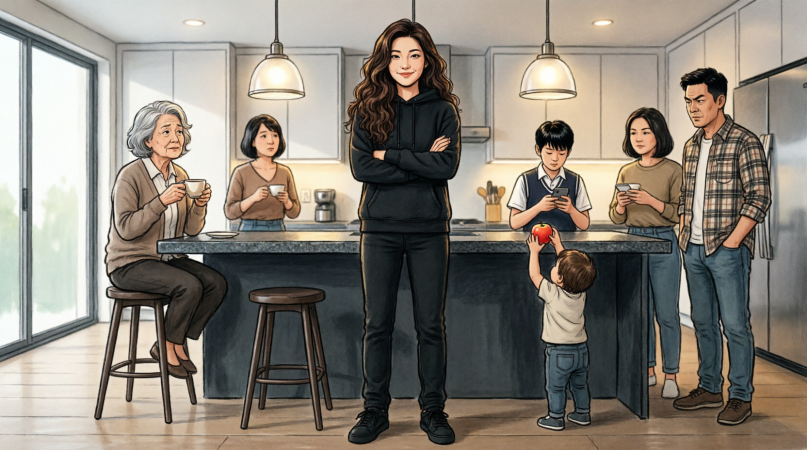
Then another. “If my mom wants to eat, you cook for her. That’s what you’re here for.” Eleanor closed her eyes.
One more. “My family is coming on Saturday. You’re making brisket, pulled pork, and a cake. And I don’t want any of your attitude. If you want to eat, pay for your own food.”
No one breathed. The BBQ I didn’t cook became heavier than any pot. I remembered my grandmother grinding spices in the kitchen, saying that food shouldn’t be prepared with anger because it turns bitter. I remembered the city markets, the aisles full of herbs, seeds, chocolate, cinnamon, the voices and hands of women who knew how to nourish without disappearing. I had confused love with exhaustion. Not anymore.
Rick tried to snatch my phone. Rose pushed him back. “Don’t even think about it.” “This is a trap,” he said, looking at his family. “You want to ruin me on my birthday.” “No,” Tony replied. “You ruined yourself.”
The final blow didn’t come from me. It came from his mother.
Eleanor walked up to Rick. She was a short woman, with auburn-dyed hair, hands swollen from years of washing dishes, knees tired from climbing bus steps. She always defended her son. She always said, “That’s how men are,” and “You just have to endure a little.”
Tonight, she didn’t say that. She slapped him. Not hard. But clean. Enough to crack something in the room.
“I raised a son,” she said. “Not a master.” Rick stood frozen. Eleanor was crying, but she didn’t back down. “Your father spoke to me the exact same way. I thought that if I gave you everything, you would be different. But I just gave you permission to be exactly like him.”
The uncles looked away. The party was no longer a party. The cake remained intact, its candles unlit. The cobbler was melting in the corner. Outside, the kids ate BBQ without knowing that sometimes a family has to break so that someone can stop breaking on the inside.
Rick started to laugh. An ugly, dry laugh. “So what now? Everyone against me? Mary feeds you and suddenly she’s a saint?” “I don’t want to be a saint,” I said. “I want my life back.” “This house is in my name.” “No.”
That word stopped him. I pulled another paper from the folder. “The lease is in both our names. But I paid the deposit. And yesterday I spoke with Grace, the landlord. I’m staying until the end of the month. You are leaving today, or the cops will be here tomorrow for domestic abuse.”
Rick’s face changed. For the first time, he believed I was capable of it. “You have no proof.” Rose held up her phone. “I have a video of you grabbing her.” Brenda said: “And I’m a witness.” Tony added: “Me too.” Eleanor wiped her tears. “Me too.”
Rick looked around for allies. He didn’t find enough. Matt tried to say something, but his wife elbowed him and he shut up. The kids asked for more coleslaw. Chuck, out on the patio, pretended not to listen but peeked over every five seconds.
Rick marched toward the bedroom. “I’m getting out of this dump.” “Your things are in trash bags,” I said. He stopped. “What?” “The basics. Shirts, shoes, documents. I didn’t touch anything that wasn’t yours.” “Who gave you permission?” “The same person who told me everyone pays for their own things.”
He slammed the bedroom door. No one spoke. We heard drawers opening, things falling, a suitcase dragging. I felt my legs go weak. It wasn’t bravery holding me up. It was a mix of fear, exhaustion, and something new I couldn’t quite name yet. Maybe dignity.
When Rick came out with two black trash bags and a backpack, he looked at me as if he wanted to kill me with his eyes. “You’re going to regret this.” I took a deep breath. “I’ve already spent seven years regretting it. That’s enough.”
He left without saying goodbye. The door clicked shut. And the silence left behind wasn’t empty. It was space.
Eleanor sat in the nearest chair. She looked older and freer at the same time. She looked at me with shame. “Forgive me, Mary.” I didn’t know what to answer. Because her apology didn’t erase her comments, her demands, her “take care of my son,” her “don’t make him angry.” But I also couldn’t deny that the crack in her face was real. “Not today,” I told her. “But thank you for saying it.” She nodded, as if understanding that forgiveness also has a price and can’t always be paid up front.
People started eating in silence. Then, little by little, conversation returned. The kids asked for cake. Brenda put the candles on, even though no one knew whether to sing. Tony walked over to me with a plate of BBQ. “Eat something.” “I’m not hungry.” “Then save your strength.”
I felt embarrassed to cry in front of everyone, so I went to the kitchen. The stove was still off. Clean. Quiet. I ran my hand over the cold burners. That morning, Rick thought an unlit stove was a threat to his party. He didn’t understand that for me, it was an open door. Every burner I didn’t light was a word I didn’t swallow.
Rose walked in behind me. “I brought the copies you asked for,” she said, pulling an envelope from her purse. “Receipts, audio files on a flash drive, screenshots of the text where he orders you to cook. Everything.” I hugged her. And then I did cry. Not like when you break. I cried like someone who finally stops carrying the weight alone.
That night there was no feast of brisket, baked beans, or pulled pork made by my tired hands. There was BBQ paid for by whoever wanted to eat, kids with sauce on their shirts, and women talking quietly on the patio about bills, jobs, rent, and boundaries.
Before leaving, Eleanor left me her peach cobbler. “It’s not that good,” she said. “But I made it.” I accepted it. It was the closest thing to an apology with sugar.
The next morning, I woke up before seven. Out of habit, I thought about making coffee for two. Then I remembered I didn’t have to. The house was quiet. I opened the window. From the street drifted the smell of fresh bagels and bacon. A city bus rolled by, heading downtown. In the distance, someone was sweeping the sidewalk and a vendor was shouting as if the world were still the same. But my world wasn’t.
On the table was the piece of paper with Rick’s rule. I picked it up, folded it, and put it in the blue folder. Not as a sad memory. As proof that sometimes a cruel phrase can become a key.
At nine o’clock, Grace, the landlord, arrived with a new lease. “Rose told me,” she said. “I had one of those, too. Sign here, honey. This house stays in your name.” I signed with a trembling hand. Not out of fear. Out of hope for the future.
That afternoon, I turned on the stove. Just one burner. I made chicken noodle soup for myself, with tomatoes, garlic, and a whole jalapeño, just the way I liked it. I didn’t make extra. I didn’t save a bowl “just in case Rick comes back.” I didn’t set the table for anyone who wasn’t there.
I ate slowly. Every spoonful tasted like something I didn’t know I was missing. Peace.
On the third day, Rick sent a text message: “Are you done with your tantrum?” I didn’t answer. Then another: “I’m coming over for food.” I didn’t answer that either. Then the last one came: “Mary, I’m hungry.”
I stared at the message for a long time. I didn’t smile with cruelty. I smiled with exhaustion. Then I typed: “Then pay for your own food.”
And I turned off my phone. The soup was still hot. The stove was still on. But this time, the fire was mine.